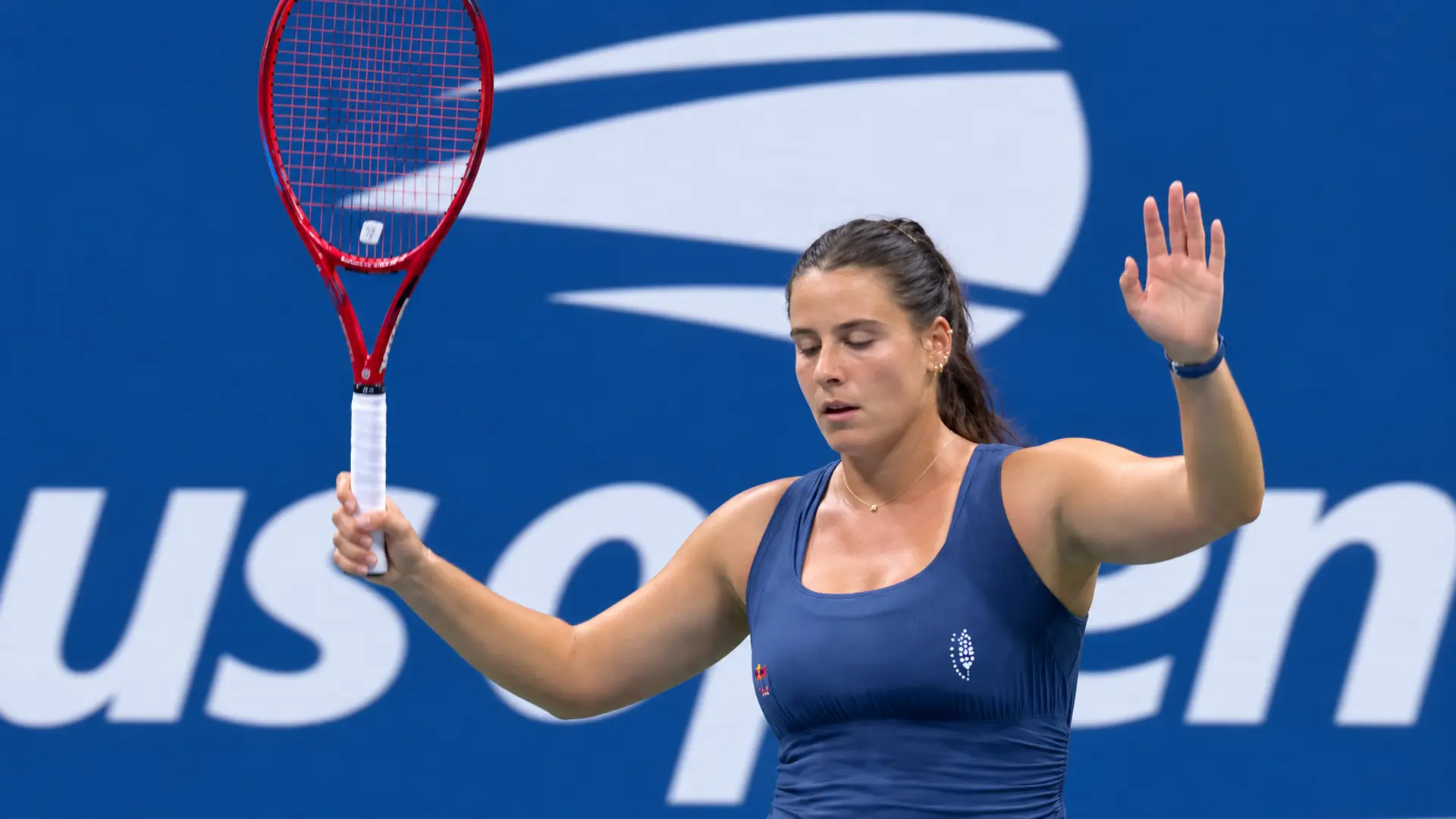
“So yeah, I gained some weight this year. But I also gained my life back.”
Emma Navarro wrote that on September 30, in the statement that ended her 2026 season. Four months earlier, she had beaten the world No. 9 for a title in Strasbourg. Two months before that, she could barely string two wins together.
Read the season without that statement and it looks like a slump. Navarro started 2026 at No. 15 and finished it at No. 27 in the live WTA rankings, a second straight year of decline. Read it with the statement, and the slide becomes the smaller story.
When she is well, Navarro wins by refusing to give opponents a cheap point. She moves superbly, keeps the ball deep and hits to placement rather than power. Her plan is to make the other player hit one more ball than they would like. That plan needs legs, patience and a clear head, and for much of the past three years she was short of all three.
She is No. 27 in the 2026 WTA Season Assessments countdown.
At 25, the New Yorker who grew up in Charleston has a ranking that should still bring a seeding in Melbourne. Her health matters rather more. Her 2026 grade is a B (GPA 3.0), the same letter as in 2025.
January to March: Leads That Kept Slipping
Navarro arrived in Australia with the No. 8 ranking of 2024 still shaping expectations. Auckland and Adelaide brought a loss to Francesca Jones and a quarterfinal, where Diana Shnaider beat her 6-3, 6-3. Neither told us much.
Melbourne did.
A year after reaching the quarterfinals at the Australian Open, she won the first set against Magda Linette and lost 3-6, 6-3, 6-3. Linette grew more comfortable with every game, and Navarro’s serve offered little cover. Those were heavy points to drop, and the pattern behind them was worse.
The Gulf swing repeated it.
Hailey Baptiste, a wildcard, beat her in three sets in Abu Dhabi, even though Navarro won the second 6-0.
Anna Kalinskaya needed a decider in Doha.
In Dubai, Elise Mertens won 6-2, 6-2. In that match, Navarro’s dominance ratio of 0.47 says she rarely controlled a rally.
Merida made the contrast cruel. In 2025 she won the title there without losing a set, bageling Emiliana Arango twice in the final. This time a qualifier, Shuai Zhang, put her out in the second round.
At Indian Wells, Sonay Kartal edged her in a final-set tiebreak, 6-1, 3-6, 7-6(2), after 150 minutes.
From outside, it looked like a familiar tale. A young player rises too fast, then loses her nerve near the top. Nobody outside her team knew how unwell she was.
Why Navarro Stepped Away in Spring 2026
After Indian Wells, she stopped. She withdrew from Charleston, her home event, and missed Miami and the early clay events until May.
The comeback was modest. Elisabetta Cocciaretto beat her 6-3, 6-3 in Rome. She then dropped down to a WTA 125 in Paris, beating Lola Radivojevic before Katie Volynets won 6-3, 6-2.
A former world No. 8 at a 125 event looks like a step backward. For a player trying to find out whether her body could handle a week of matches, it was the sensible step. She reached Strasbourg ranked No. 39, with four tour-level wins all season.
Strasbourg 2026: Navarro’s First Clay Title
The first match of the week, a 6-1, 6-4 win over Sara Bejlek, was tidy. The second, a three-set win over Iva Jovic, then ranked No. 17, was a real test.
In the quarterfinal, the story nearly ended. Zhang took the first set 6-2 and had Navarro two points from defeat in the second-set tiebreak. Navarro won it 7-5 and the decider 6-2. That was the first close match of the year she had turned in her favor.
Ann Li came next and made 41 unforced errors to Navarro’s 19 in a 6-1, 6-3 semifinal. Li hit 22 winners, but she kept going for them too early. Navarro absorbed the first strike, kept her depth and waited. She also won 58.3% of her second-serve points, so Li rarely got a free swing.
The final against Victoria Mboko was the season in miniature. Mboko, the No. 9, had far more pace. Navarro did not try to match it. She worked the Canadian side to side and took the first set 6-0. Mboko made 20 unforced errors in it, Navarro three.
The point of the match came in a long fourth game. Navarro read a volley, then chased down a drop shot and finished with a forehand winner across the court. She does not have a frightening first strike. She can still turn a scramble into a winner.
Then the old script returned. Mboko began using the drop shot to drag Navarro forward, saved a championship point at 5-4 and took the set 7-5. In January, this was where Navarro faded.
This time she adjusted. She started reading the drop shot early. Her serve took over too, and she won 12 of her first 13 service points in the decider. Mboko’s errors came back, and Navarro won 6-0, 5-7, 6-2.
That made three career titles, two of them at WTA 500 level, and a first on clay. Her previous trophy had come 15 months earlier. Nothing about it was flashy, and that was the encouraging part. The qualities that took her into the Top 10 were coming back.
Roland Garros, Nottingham and Bad Homburg: Proof and Limits
Roland Garros arrived within days and offered a corrective. Navarro beat Janice Tjen 6-4, 6-3, then met Jovic again. A week after losing to Navarro in three sets, Jovic won 6-0, 6-3. One good week, it turned out, had not fixed everything.
Grass went better than anyone could have expected in February. Caty McNally beat her in three sets in ‘s-Hertogenbosch, but Nottingham brought a run to the final. Navarro recovered from losing the first set to Anna Bondar, outlasted Yuliia Starodubtseva over three hours, then beat Jessica Bouzas Maneiro and Viktorija Golubic.
The final against Marie Bouzkova showed the other side of her game. Navarro had two set points in the first set and led 3-1 in the tiebreak, but Bouzkova took it 7-5. Navarro won the second 6-4, at one stage taking 12 of 13 points on serve.
In the decider, Bouzkova lengthened the rallies and asked Navarro to win them. Navarro tried to force the issue and made 21 unforced errors in that set alone. Bouzkova won 7-6(5), 4-6, 6-2. Against a player who never gives her a cheap point, Navarro has to find a plan beyond patience, and on that day she did not.
Bad Homburg brought the best win of her year. After beating Eva Lys, she faced Iga Swiatek, the world No. 3, whom she had also beaten in Beijing in 2025. Navarro led 3-0, let it slip to 4-4 and still took the set 7-5. Swiatek won the last five games of the second.
The decider was Navarro at her best. She broke early and chose her moments to attack. In that set she hit 17 winners against four unforced errors, and won 7-5, 2-6, 6-3. Swiatek served seven double faults in the first set alone, which helped. Navarro still had to stay calm enough to cash in. Then qualifier Elena Gabriela Ruse beat her 6-4, 6-2 in the quarterfinals. A big win followed by an early exit was becoming a habit.
Wimbledon exposed the second serve.
Three-set wins over Paula Badosa and Oksana Selekhmeteva led to Marta Kostyuk, the No. 13. Kostyuk won 6-2, 4-6, 6-1. Navarro won 77.3% of her first-serve points but just 27.8% behind her second. Kostyuk attacked every second ball, and Navarro went out a round sooner than in 2025.
US Open 2026: Muchova Beaten, Pegula a Step Too Far
The North American summer started badly. Navarro beat Sofia Kenin in Washington, then lost to Cocciaretto in three sets.
In Toronto, Alina Korneeva, a qualifier ranked No. 89, needed 76 minutes to win 6-2, 6-2. Navarro landed 45.3% of her first serves that day, and without a serve she cannot build her rallies.
Cincinnati was better. After a comeback against Anhelina Kalinina, she lost 7-5, 6-2 to Jessica Pegula, whose flat hitting kept taking time away from her. That defeat set up the rematch that ended her season.
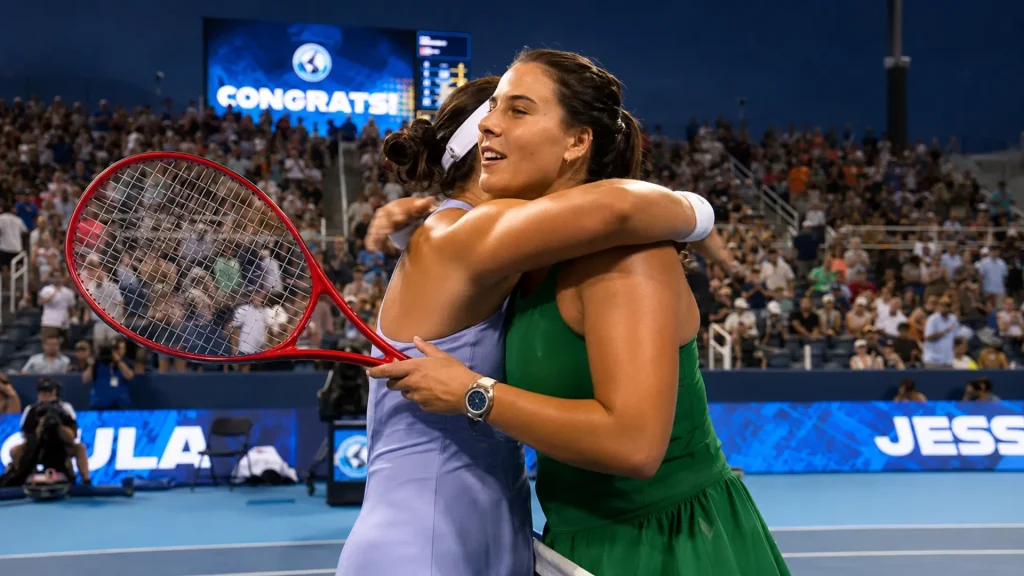
New York began with two scrappy wins, over Lois Boisson and then over McNally from a set down. Each took close to three hours. For a player who had spent the spring unsure of her body, getting through both mattered more than how they looked.
The third-round win over Karolina Muchova was her most complete match of the year. Muchova, the No. 7, thrives on chaos, changing pace and spin at will. In the wind, Navarro kept it simple, and Muchova made 32 unforced errors to her 18 in a 6-3, 7-5 defeat. That made nine Top 10 wins in her career, three of them in 2026.
She beat Kalinskaya 6-4, 6-2 to reach the quarterfinals, then took the first set off Pegula 6-3. Pegula then raised her level, keeping the ball low and flat. At 4-5 and 30-30 in the second set, Navarro double-faulted, and Pegula took the next point to level. She broke for 4-2 in the third and won 3-6, 6-4, 6-3.
It was the January pattern again, a lead lost when the match tightened. This time, though, it came in a Grand Slam quarterfinal, her first since the 2024 US Open semifinal, and against the world No. 3.
RED-S and Hashimoto’s: What Navarro Revealed in September
Navarro then ended her season. She skipped Asia to work on her health and set January 2027 in Australia as her return. In a long statement, she explained why.
Late in 2025, doctors found RED-S, short for Relative Energy Deficiency in Sport. Put simply, her body was not getting enough fuel for training and daily life. A second diagnosis, Hashimoto’s hypothyroidism, made the puzzle harder, because a thyroid condition affects energy too.
She traced the problem back almost three years, to a 2023 season of 88 matches. Fatigue, headaches, dizziness, broken sleep and trouble concentrating all came while she was climbing into the Top 10. She had been under-fueling the whole time.
Her treatment changed what she ate, the medicine she took and how she trained. She admitted the work was not finished. By the US Open, though, she said she could play as herself again.
That changes how the whole year reads. The spring losses were not a confidence problem or a “sophomore slump”, the charge she says she heard in 2025. A player short of energy was trying to win matches that demand constant movement.
What Navarro Does Best, and Where It Breaks Down
None of that erases the results. Navarro fell 12 places and lost early at three of the four majors. For three months she lost matches she would normally win. The context explains the slide. It does not make it a good season on its own.
The wins show what still works.
Mboko got no slugging match, and when her drop shot started to bite, Navarro changed her position. With Swiatek across the net, she held on to an early break in the decider by serving better and waiting. Muchova, the most inventive of the three, lost to simple tennis.
That is who she is.
A right-hander from the baseline, she covers the court, takes pace and sends it back, and uses placement to earn the ball she can attack. Her forehand can hurt opponents, but her best weapon is the extra ball. When she moves freely, she frustrates players who hit much harder.
The limits are just as clear. Her second serve is too easy to attack, as Kostyuk showed at Wimbledon. Flat, low hitting, Pegula’s game, takes away the rhythm she needs. When she has to force the issue, as in the Nottingham decider, her errors climb fast.
Set against 2025, the numbers are blunt.
That year brought a Merida title, a Melbourne quarterfinal and a drop from No. 8 to No. 15. This one brought a bigger title, a grass final and a run to the last eight in New York. She still lost 12 more places, because Melbourne shrank from a quarterfinal to one match and Wimbledon from round four to round three.
Last year’s assessment read her decline as the strain of defending a Top 10 ranking. Her statement shows it missed the bigger factor. She was not only fighting for confidence among the elite. She was trying to compete while her body ran on empty.
Emma Navarro’s 2026 Grade: Why It Is Still a B
There is no hiding the ranking. Navarro ended 2026 lower than she started it. A title in Strasbourg and a quarterfinal in New York do not cancel a lost spring.
Still, calling it a simple fall from the Top 10 would miss most of the year. She stepped away, came back to win on clay and reached a grass final. She beat three Top 10 players, then shut her season down to finish the job off court.
Last year’s grade was a B with a 2.9 GPA, under the old scale. 2026 gets the same letter, for a very different season. The 2026 rubric values a B at 3.0. The extra tenth is a change of scale, not progress. It sits level with Maria Sakkari and Ann Li in this countdown.
Letter Grade: B
GPA: 3.0
For 2027, the first goal is to arrive in Australia healthy.
Strasbourg, Bad Homburg and New York show that the tennis to trouble the best players is still there. Whether she can hold it for a full season is next year’s question.
She finished 2026 at No. 27, 12 places lower than she started. She also finished it knowing what her body needs to compete and to live. The WTA awards no ranking points for that. It may still be the most useful thing she won all year.
Leave a Reply