
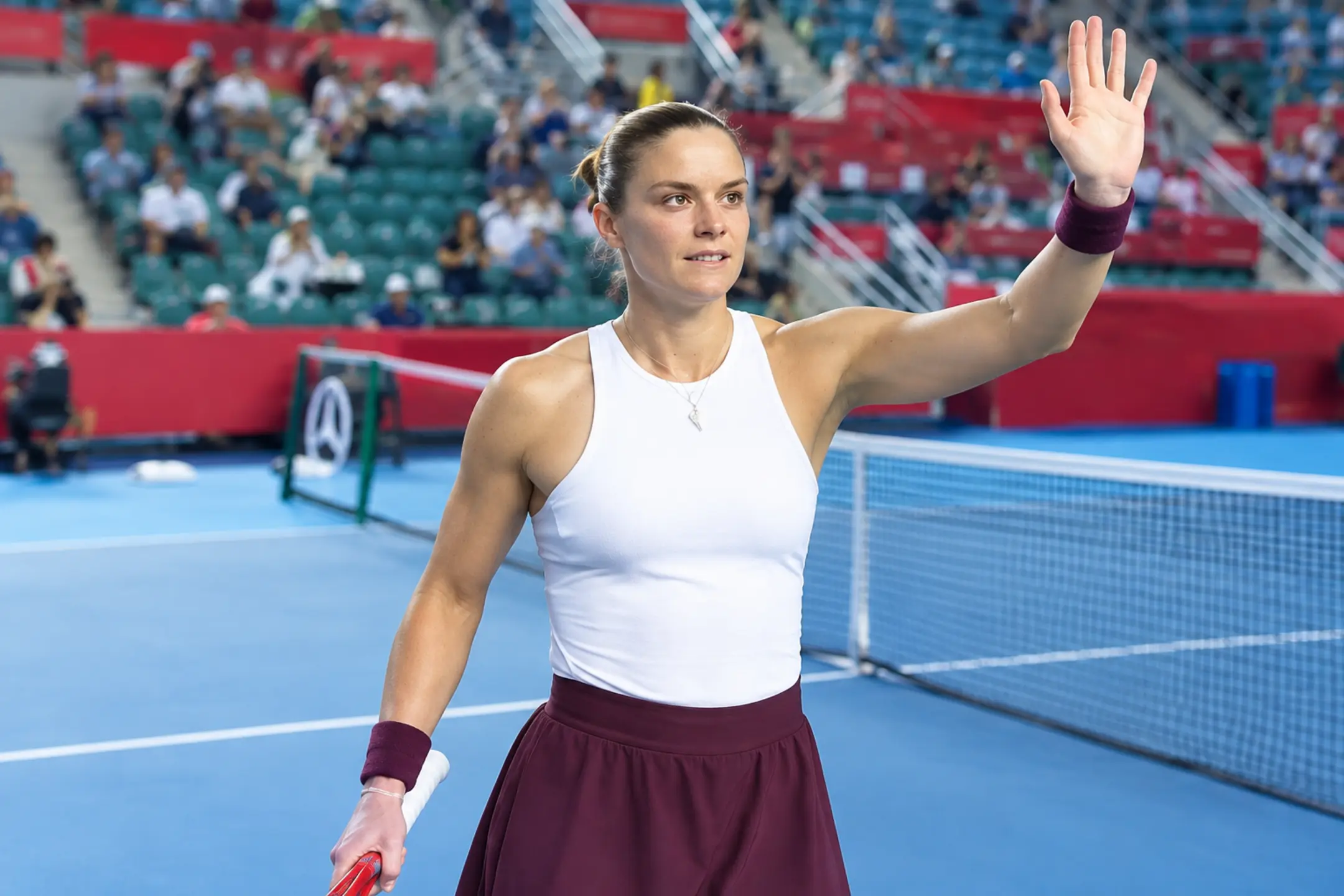
In February 2026, Maria Sakkari lost the first set to top seed Iga Swiatek in Doha and won anyway, 2-6, 6-4, 7-5. It ended Swiatek’s run of 109 straight wins at WTA 1000 level after taking the opening set. Four weeks later at Indian Wells, Swiatek beat her 6-3, 6-2.
That pairing is Sakkari’s 2026 in miniature. On her good weeks she can still beat almost anyone. On her bad ones, she loses to players she should handle comfortably.
She began the year outside the top 50 and finished it at No. 29.
She went 29-23, reached one final and two other semifinals, and recorded three wins over top-10 players.
The climb was genuine.
It was also uneven, and the second half of the year showed both sides of it.
Where Maria Sakkari Started
The baseline was low. RallyHer did not grade her 2025, because she finished it outside the top 40. Our February 2025 look at her slide traced a former world No. 3 through early exits, a shoulder injury and a revolving coaching box. By January 2026 she was ranked around No. 51 and playing Adelaide as a wildcard.
Her tennis had not changed shape. Sakkari is a first-strike player built around her serve. She looks to take control of the point early rather than outlast anyone. When that works, she overwhelms opponents. When it does not, the errors come in volume.
That tension runs through every phase of her season. She hit 35 winners in one Tokyo defeat and 37 in a Wuhan quarterfinal.
She lost both.
January and Doha: The Ceiling
The year started with a useful United Cup. She beat Naomi Osaka and Emma Raducanu before Coco Gauff ended her run.
Adelaide and Melbourne were less kind. Daria Kasatkina beat her in straight sets, and Mirra Andreeva won their Australian Open second-round match 6-0, 6-4.
Doha changed the mood. Ranked No. 52, Sakkari beat Zeynep Sonmez and then dismissed Jasmine Paolini, ranked No. 8, 6-4, 6-2. She saw off Varvara Gracheva, then came from a set down against Swiatek.
The semifinal against Karolina Muchova supplied the warning. Sakkari won the first set 6-3 and led by a set and a break. Muchova began taking the ball earlier and angling her returns, and the rallies lengthened. Sakkari won only 13 of 41 points in a 6-1 final set.
It was the first of five matches this year that she lost after winning the opening set. Doha showed the ceiling and the leak in the same week.
Spring: The Ranking Stalled
The next three months undid much of February’s work. Swiatek gained her revenge in the Indian Wells third round.
Alycia Parks, ranked No. 105, beat her in straight sets in Miami.
Clay offered little relief. Paula Badosa, a wildcard ranked No. 113, beat her in Charleston.
Karolina Pliskova, at No. 197, did the same in Madrid.
Elena Rybakina and Peyton Stearns ended her runs in Rome and Strasbourg.
Roland Garros brought the one real lift.
She beat No. 12 seed Linda Noskova 7-5, 7-6(3), then Claire Liu from a set down. Maja Chwalinska then came from a set down to beat her in the third round. By late May her ranking had slipped back to No. 49.
Five of her six defeats from Miami to Roland Garros came against players ranked below her. Four of those players sat outside the top 100. This was the stretch that kept her from a far better year.
Grass, Then a Home Final
The grass season started poorly.
Tatjana Maria, a qualifier, beat her at Queen’s Club.
Qinwen Zheng, then ranked No. 160, came from a set down to win in Nottingham.
Wimbledon was better.
She beat No. 24 seed Clara Tauson 6-3, 6-3, then survived Kamilla Rakhimova 7-6(7) in a third set after losing the second 6-0. Paolini ended it in the third round, winning more than 84% of her first-serve points in a 6-1, 6-2 rout.
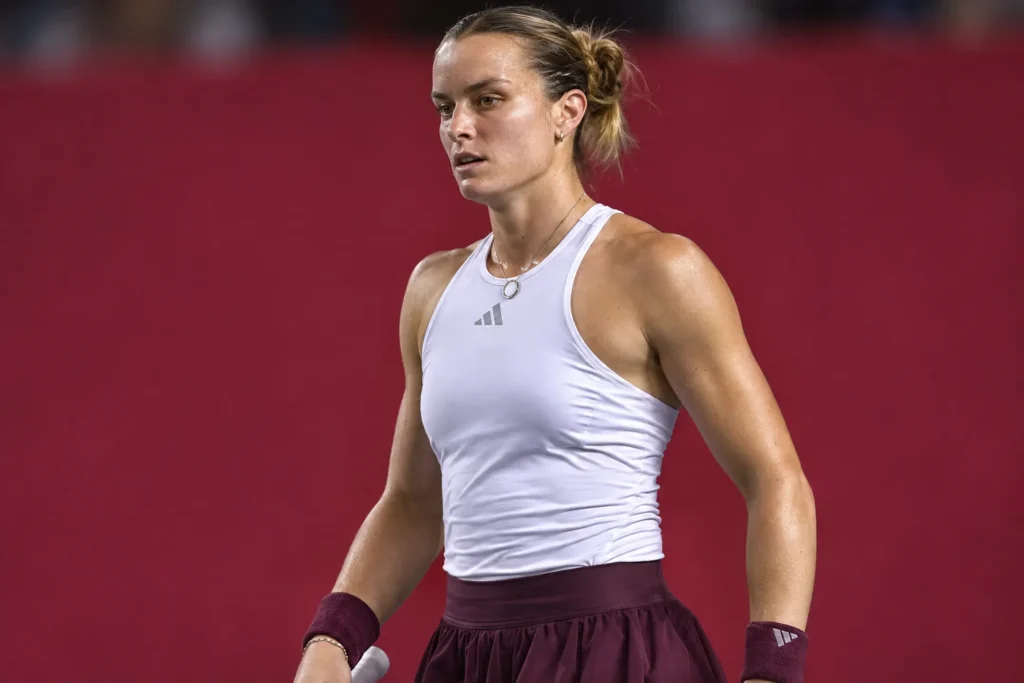
Then came Athens, and the most important week of her year. At the first edition of the Athens event, in front of a home crowd, Sakkari reached the final without dropping a set. She beat Polina Kudermetova, Harriet Dart, Alycia Parks and Alina Korneeva. It was her first WTA final in more than two years.
The final against Barbora Krejcikova was the season’s central lesson. Sakkari led 4-1 in the first set. Krejcikova broke back, and a netted volley decided the tiebreak 7-5. Sakkari broke early in the second set, but Krejcikova broke twice and won 7-6(5), 6-3.
Sakkari hit 24 winners to Krejcikova’s nine. She also made more unforced errors, 29 to 26, and lost 64 points to 60. Krejcikova simply won the points that mattered. Sakkari had the bigger game that afternoon. Krejcikova had the better plan for a close finish.
The Summer Hard Courts: Competitive, Not Dangerous
The North American swing showed how far she had come and how far she still had to go.
She beat Zeynep Sonmez in Toronto before Gauff won 6-1, 6-4. In Cincinnati she beat Rakhimova again, then took the first set from Swiatek.
That set was excellent. She hit five aces and won 20 of 26 service points. Then Swiatek won 12 of the last 13 games. Sakkari made 39 unforced errors in the match and hit just one winner across the final two sets.
The US Open repeated the pattern.
She recovered from a set down to beat Robin Montgomery, then won the first set 6-1 against Yuliia Starodubtseva. The Ukrainian won a second-set tiebreak and the third set 6-2.
She did not reach the second week at any of the four majors in 2026.
Asia: Her Best Stretch, With the Usual Catch
The autumn was her most consistent phase, and it moved her into the top 30.
In Singapore she won two rounds before Talia Gibson, ranked No. 63, beat her in three sets.
In Beijing she beat Storm Hunter and lost a close match to Elina Svitolina, 6-4, 7-5.
Wuhan brought her best performance of the year.
She beat Donna Vekic and then No. 8 seed Marta Kostyuk 4-6, 6-2, 6-2. Kostyuk made 46 unforced errors. Sakkari made four, and she did not lose serve after breaking early in the second set.
That control is the version of Sakkari that wins big tournaments. She beat wildcard Mia Pohankova next, then met Chwalinska again in the quarterfinals. This time Chwalinska won the first set 6-0 without dropping a service game. Sakkari reset, won the second and held to 5-5 in the third. Chwalinska then held and broke her for the match. Sakkari hit 37 winners and 33 unforced errors, and she saved 11 of 15 break points.
Tokyo was the same story in a smaller room. She hit 35 winners against Yulia Putintseva but made 39 unforced errors. She trailed 0-4 in the third set and lost 6-1.
Hong Kong closed the season respectably.
She beat Carol Young Suh Lee, Maya Joint from a set down and Aliaksandra Sasnovich dropping serve only once. In the semifinal, Alexandra Eala beat her 7-5, 3-6, 6-4 after two hours and 43 minutes. Sakkari saved 17 of 22 break points and still came up short.
Player Assessment
The season record is 29-23, and the split by surface says most of what needs saying. She went 24-15 on hard courts, 3-5 on clay and 2-3 on grass. Her best tennis lives on medium-paced hard courts, where her serve and first strike have time to land.
Against the best, she was competitive without being consistent. She went 3-7 against the top 10, beating Swiatek, Paolini and Kostyuk. Against the top 20 she went 5-10.
The more damaging number sits at the other end. She lost five matches to players outside the top 100, all of them before July. That spring stretch cost her a good deal of ranking ground.
Her serve explains her results better than any other statistic. In matches with full data, she landed about 62% of first serves in both wins and losses. She won 71.6% of those points in wins. That fell to 56.5% in losses.
The difference is not how often the first serve lands. It is whether opponents can neutralise it. When they can, the pressure arrives quickly. She faced roughly five break points per match in wins and about 11 per match in losses.
The majors tell a quieter story of progress.
When we looked at her slide in February 2025, she had lost in the first round at six of her previous eight Grand Slams. In 2026 she won at least one match at all four. That is a low bar, but she cleared it every time.
Close matches were a coin toss at best.
She went 9-9 in deciding sets and 4-6 in tiebreaks. She also came from a set down to win six times, which shows real resilience. The five defeats from a set up show the other side.
The deeper issue is what happens when her first plan fails. In Wuhan and Tokyo she out-hit her opponent and still lost. In Cincinnati the winners dried up and the errors did not. She rarely found a middle setting between full attack and damage control.
Compared with the next tier, she is not far away on talent. She is further away on consistency, and five losses to players outside the top 100 in four months make that point plainly.
Final Verdict
Sakkari’s 2026 was a solid recovery that stopped short of a breakthrough.
She climbed more than 20 places, reached a home final and beat the world No. 2. She also failed to win a title, never passed the third round at a major and spent the spring losing to the wrong opponents.
Within this series, the grade sits below the title winners. Peyton Stearns and Donna Vekic each earned a B+ with a trophy to show for their year. Ann Li received a B for a season that included a win over Aryna Sabalenka but no final. Sakkari belongs closer to Li, with the Athens final as her strongest argument for the upper end of the grade.
Grade: B
GPA: 3.0
The implication for 2027 is clear enough. If she holds a ranking inside the top 32, she will arrive at the majors as a seed, which keeps her away from other seeds in the first two rounds. What she does with that protection depends on whether she can add a plan B.
She has proved in 2026 that she can play with the best for a set, sometimes for a week. Now she has to learn how to win the matches that turn against her.
Leave a Reply