
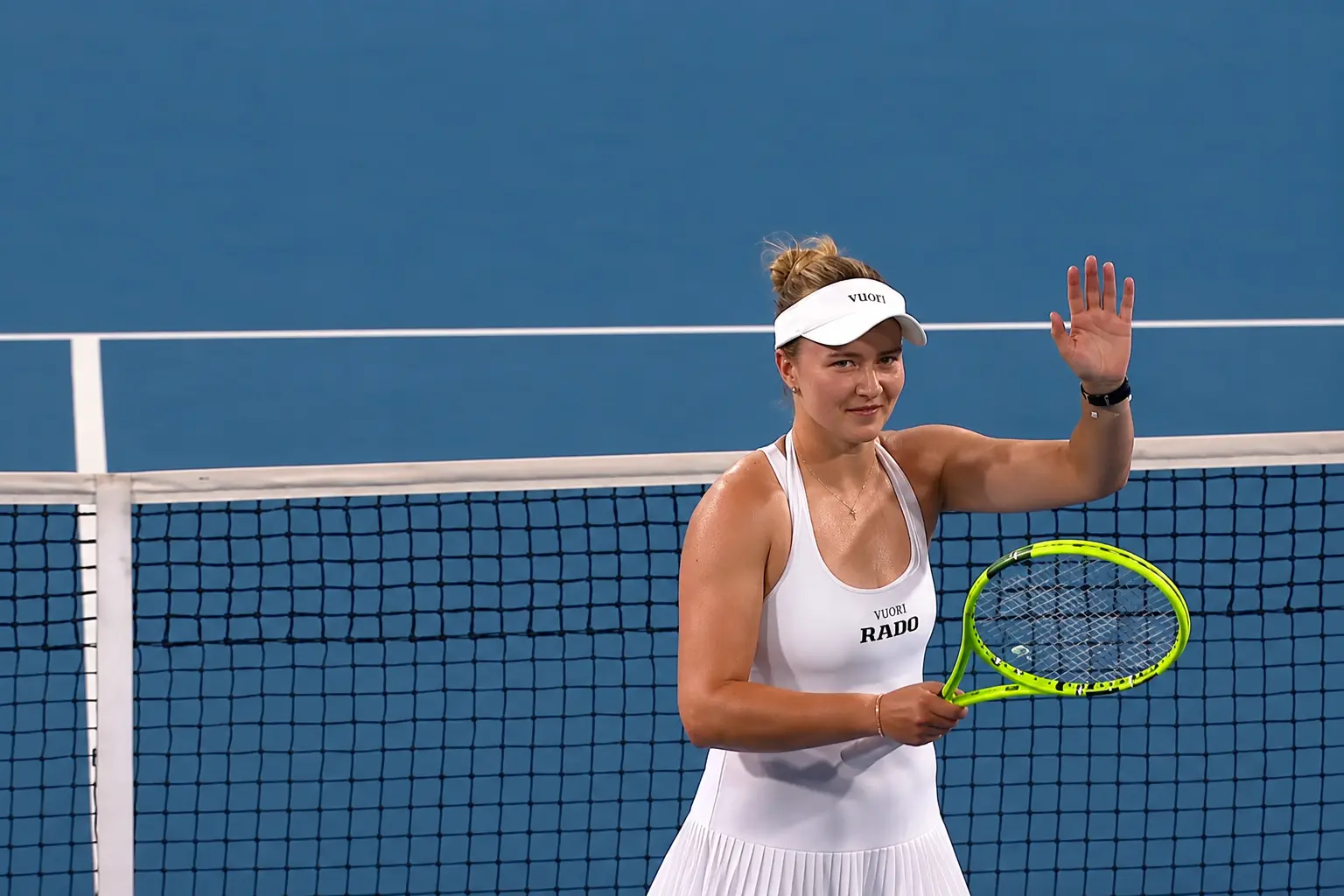
Maria Sakkari had the crowd, the early lead and the more explosive tennis.
Barbora Krejcikova had the colder hand.
The Czech beat Sakkari 7-6(5), 6-3 to win the Athens Open 2026 title, denying the Greek a home triumph in the inaugural edition of the tournament. It was a final between two former Top 5 players rebuilding after injury setbacks, and it came down to the narrow spaces where finals are usually decided.
Sakkari hit 24 winners to Krejcikova’s nine. She hit more aces. She led 4-1 in the opening set. She broke first in the second.
Still, the trophy went to Krejcikova.
That was the beauty and cruelty of this final. Sakkari often produced the louder tennis. Krejcikova produced the better answers when the score began to burn.
Sakkari Has the Home Final in Her Hands
For a while, Athens had exactly the final it wanted.
Sakkari opened with a love hold, looked sharp behind her serve and soon pushed ahead. At 1-2, Krejcikova came under pressure, and Sakkari broke for 3-1 after taking control of the longer rallies.
Then she held to love for 4-1.
The Greek player had waited a long time for a week like this: a home final, a chance to lift a trophy in front of her own supporters, and a run that felt like another step away from an injury-hit period.
But finals ask a second question.
Can you lead?
Then can you finish?
Krejcikova Quietly Changes the Set
Krejcikova’s comeback did not arrive with fireworks.
She held for 2-4, then broke for 3-4. A hold for 4-4 changed the mood of the set completely. Sakkari was no longer running ahead. She was protecting something.
To her credit, the Greek did not collapse. She held for 5-4, then again for 6-5, forcing Krejcikova to serve twice to stay in the set.
The Czech did both jobs.
That was the first warning. Krejcikova was not producing spectacular tennis, but she was refusing to leave the set. She stayed close enough for the decisive points to arrive.
When they did, she took them.
The Tiebreak Says Everything
The opening-set tiebreak was small, tense and revealing.
Sakkari fought back from a mini-break down to 5-5, giving herself a real chance to rescue a set she had once controlled. The crowd could feel the opening.
Then Krejcikova immediately earned another mini-break and sealed the set 7-5 when Sakkari netted a volley.
It was a brutal ending for the home favorite. Not because one volley decided everything, but because it captured the final’s central problem for her.
Sakkari had done so much right.
Krejcikova still left with the set.
The Second Set Offers Sakkari Another Chance
The second set gave Sakkari a fresh opening.
Krejcikova held for 1-0, but Sakkari broke for 2-1. After losing a painful first set, the Greek had a chance to restart the match and pull the crowd fully back into it.
Krejcikova gave her almost no time to enjoy the lead.
She broke straight back for 2-2, then held for 3-2. Sakkari leveled for 3-3, but the pressure soon returned. At 4-3, Krejcikova broke again.
That was the championship break.
Sakkari had spent much of the match striking the more eye-catching ball. Krejcikova spent it asking whether she could keep doing it at 5-5 in a tiebreak, after losing a lead, and deep in the second set.
Too often, the answer was no.
Krejcikova served out the match at 5-3 and took the title.
The Stats Show a Final Decided by Tiny Margins
The numbers underline how close this final was.
Krejcikova won 64 of 124 total points. Sakkari won 60. The dominance ratio was almost even: 1.02 for Krejcikova, 0.98 for Sakkari.
Sakkari’s winners column was much stronger, 24 to nine, but she also made 29 unforced errors to Krejcikova’s 26. Krejcikova did not need to out-hit her. She needed to keep the error count low enough and win the late-set points.
Both players were perfect on break points. Krejcikova converted all three of hers. Sakkari converted both of hers. That made every loose service game expensive.
The serve numbers were close too. Krejcikova won 66 percent of her service points. Sakkari won 65 percent. Krejcikova’s serve rating was slightly better, 270 to 248, despite Sakkari hitting more aces.
This was not a final of domination.
It was a final of timing.
Sakkari’s Home Dream Ends, but the Week Still Speaks Loudly
For Sakkari, the defeat will hurt.
A home final is never just another final. Every missed chance carries more emotional weight when the crowd is not only supporting you, but seeing itself in you.
She had the opening set in her hands at 4-1. She had an early break in the second. She hit more winners and produced long stretches of tennis worthy of the title.
She still left without it.
Reaching the Athens final is a significant step for Sakkari after a difficult stretch marked by injuries and inconsistency. It was her first WTA final in more than two years, and it came in Greece, with all the expectation and pressure that brings.
She did not get the fairytale ending.
She did give the tournament its first great final storyline.
Krejcikova Adds Another Trophy to a Career That Keeps Rebuilding
For Krejcikova, this title carries practical and emotional value.
The two-time Grand Slam champion did not come to Athens needing proof that she belongs on big stages. She has already done that. But after injury interruptions and ranking turbulence, a title like this confirms that her match instincts are still intact.
This was her ninth WTA singles title.
It is also projected to lift her back to world No. 26, a useful move for a player whose best tennis still has top-tier quality.
Krejcikova did not win Athens by producing a perfect final.
She won it by solving the final.
Sakkari had emotion, the crowd and the bigger winner count. Krejcikova had the calmer hand when the trophy came close enough to make both players feel it.
That is why Athens belongs to her.