
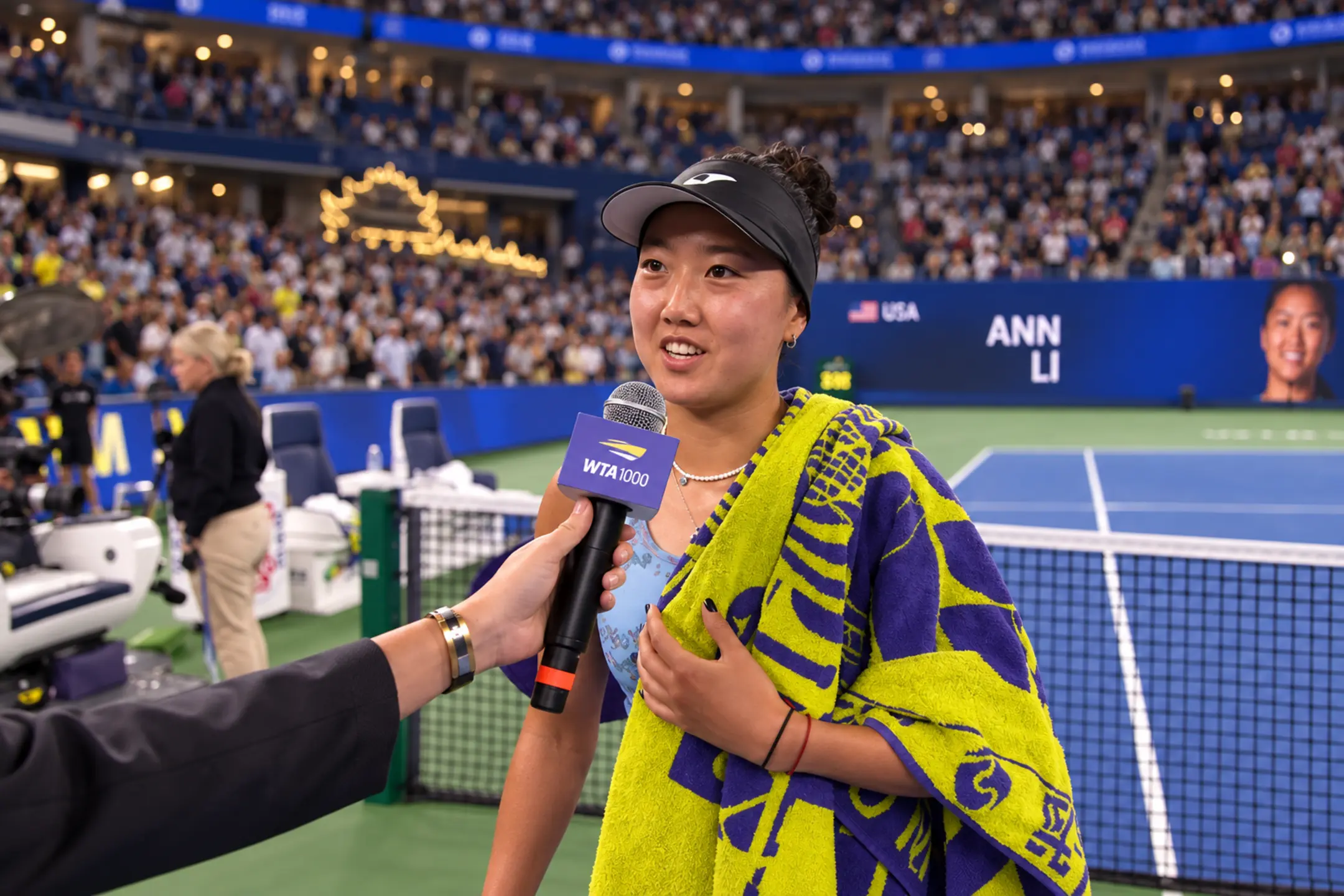
Ten match points. That is how many Ann Li needed to complete the biggest victory of her career against Aryna Sabalenka in Wuhan. Yet the American finished 2026 without reaching a single WTA singles final.
The contrast is striking. Li had reached three finals in 2025, winning the Guangzhou title and finishing world No. 38. She climbed further in 2026, briefly reaching a career-high No. 25, but never returned to a championship match.
At 26, the Pennsylvania-born player is the tenth woman of RallyHer’s Season 2026 WTA Assessments, entering our countdown at world No. 31.
Li’s season was not a failure.
Her first WTA 1000 quarterfinal, three semifinals and victories over established Top 20 players proved that she belonged at this level. But the consistency that defined her comeback in 2025 became harder to find when tournaments approached their decisive stages.
An Uneven Australian Summer
Li began 2026 with something she had lacked a year earlier: a secure place inside the Top 40. The ranking brought better entries and greater expectations.
Her first weeks suggested that turning those advantages into results would require patience.
Qualifier Olivia Gadecki, ranked No. 204, beat her 6-4, 6-4 in Brisbane. Hobart brought a comeback victory over Katie Volynets, followed by a frustrating loss to Elisabetta Cocciaretto.
Li had won the opening set 6-1. She lost the next two 7-5, 7-5.
At the Australian Open, she survived another three-set match against Camila Osorio. She won 6-4, 6-7(5), 7-5, but Magda Linette ended her run 6-3, 6-3.
Against Linette, Li won only 30% of second-serve points. Her first delivery was reasonably reliable, landing 60% of the time, but too many service games became difficult once the first serve missed.
This had been one of her priorities during the offseason.
Working with Spanish coach Carlos Boluda, Li had focused on greater physical intensity, smarter aggression and reducing errors. She had also identified the second serve as an area requiring improvement.
The opening tournaments offered little evidence that the problem had been solved.
Doha Offers Encouragement Before Another Stalled Spring
Doha produced Li’s first genuinely convincing sequence of the season.
She beat Leylah Fernandez 6-4, 6-3, winning 79.3% behind her first serve. She followed that with a straight-sets victory over Magdalena Frech.
Cocciaretto stopped her again, this time 7-6(5), 5-7, 6-4 after nearly three hours.
Li had competed well across two demanding matches, but once again left without reaching the quarterfinals.
Dubai ended in a three-set defeat to Linda Noskova.
At Merida, she took the opening set against Zeynep Sonmez before losing 3-6, 7-6(7), 6-4.
Indian Wells brought a first-round defeat to qualifier Talia Gibson, ranked No. 112.
Then came an encounter that would acquire greater significance later in the season.
At Miami, Li beat Kimberly Birrell before meeting world No. 1 Sabalenka. She pushed the Belarusian into a first-set tiebreak and remained competitive throughout the second.
Sabalenka won 7-6(5), 6-4, but Li had produced an encouraging performance against the tour’s leading player.
She won 54.3% of second-serve points and saved 12 of 15 break points. Against someone who attacks second serves as aggressively as Sabalenka, those were meaningful improvements.
Li could compete with the world’s best. The challenge was learning how to defeat them.
Clay Brings a Different Kind of Progress
Li entered the European clay season after another disappointing opening-round defeat, this time against Dayana Yastremska in Linz.
Rouen offered a response.
She came from a set down against Daria Kasatkina, winning 6-7(6), 6-2, 6-4. Another comeback followed against Kamilla Rakhimova.
Top seed Marta Kostyuk stopped her in the quarterfinals, 6-0, 6-7(4), 6-3.
The first set had exposed how badly things could go when Li struggled to establish her preferred baseline rhythm. Yet she showed considerable determination to force a decider.
Madrid produced a more substantial achievement.
After defeating Alycia Parks in three sets, Li faced world No. 4 Iga Swiatek. She took the opening set in a tiebreak, lost the second and led 3-0 in the third when Swiatek retired.
It was an important result, although the retirement meant Li had not completed a victory over the Pole.
Fernandez then defeated her 6-3, 6-2 in the fourth round.
Li had reached the third round of Madrid in 2025. This time she advanced one round further, showing that her hard-court background did not prevent her from competing effectively on clay.
Rome was less productive. She recovered from a disastrous opening set against Shuai Zhang, then lost to Liudmila Samsonova.
The biggest clay-court opportunity was still ahead.
Strasbourg Shows How Dangerous She Can Be
Strasbourg brought Li’s first semifinal of 2026, and arguably her strongest sustained tennis of the first half of the season.
She began by beating Maya Joint 6-1, 6-2.
Against Ekaterina Alexandrova, ranked No. 14, Li lost the opening set but fought back to win 4-6, 6-4, 6-3.
The performance depended on a familiar balance. Li needed to absorb the Russian’s flat power without becoming passive herself. She also needed enough first serves to establish her own attacks.
She won 75.5% of first-serve points, an encouraging figure against such an aggressive opponent.
Marie Bouzkova presented a different challenge in the quarterfinals. The Czech’s consistency demanded patience and an ability to construct points rather than finish every exchange quickly.
Li won 6-3, 7-5.
Then Emma Navarro dismantled her 6-1, 6-3 in the semifinals.
The match offered a particularly revealing study of Li’s attacking instincts.
She struck 22 winners to Navarro’s 12. But the American on the opposite side of the net was considerably more disciplined. Li committed 41 unforced errors, while Navarro made only 19.
Navarro repeatedly absorbed the opening attack and forced Li to produce another quality shot. Too often, the next ball went wrong.
Li had chances, including four break points in Navarro’s opening service game. She converted just one of eight break points across the match.
It was a cruel contrast. Against Alexandrova, Li’s aggression had helped overturn a deficit. Against Navarro, the same willingness to attack became increasingly difficult to control.
Her Roland Garros campaign lasted two rounds. She beat Zhang before losing 6-3, 6-4 to Diane Parry.
The second-round finish matched her result in Paris in 2025. Strasbourg had shown genuine improvement on clay, but the Grand Slam had not.
Grass Becomes Another Missed Opportunity
Grass had long been Li’s preferred surface, yet the 2026 season produced little reward.
Nottingham began with consecutive three-set comebacks against Birrell and Taylah Preston. The quarterfinal against Viktorija Golubic ended in defeat, 6-3, 2-6, 6-3.
At Bad Homburg, Alexandrova beat her 6-1, 6-7(5), 6-1.
The Russian dictated much of the match. Li’s determination carried her through the second-set tiebreak, but she could not sustain the resistance.
Wimbledon delivered another disappointment.
Sonmez, who had already beaten her in Merida, won 7-5, 1-6, 6-4.
Li struck eight aces and won 74.1% of first-serve points. Yet her second serve remained vulnerable, producing only 40.5% of points won.
In 2025, Li had reached Wimbledon’s second round. This time she departed immediately.
The grass season felt like a squandered opportunity.
The Summer Hard Courts End Short of Another Final
July brought mixed results.
Li defeated Maria Timofeeva in Athens before losing heavily to Alina Korneeva, ranked No. 90.
Washington ended in a first-round defeat to Frech. In Toronto, Li beat Canadian wildcard Kayla Cross, then lost 6-2, 7-5 to Elena Rybakina, the world No. 2.
Cincinnati followed a similar pattern. She defeated Zhang, but Coco Gauff stopped her 6-1, 7-6(3).
Monterrey offered the opportunity to change the direction of her summer.
Li beat Osorio 6-1, 6-2, then advanced by walkover against Timofeeva. She defeated Parks 6-2, 6-3 in the quarterfinals, winning 86.7% of first-serve points.
Parry stood between her and the final.
The Frenchwoman edged a tense opening tiebreak 9-7, then completed a 7-6(7), 6-4 victory.
Li had reached another semifinal. But she had again fallen one match short of a title opportunity.
The comparison with 2025 was becoming increasingly difficult to escape. Twelve months earlier, she had reached the Cleveland final and used that momentum to launch her best Grand Slam campaign.
In 2026, Monterrey brought valuable ranking points but no comparable breakthrough.
The US Open Highlights What Has Been Lost
New York had been one of the defining tournaments of Li’s 2025 comeback.
She defeated Belinda Bencic on her way to the fourth round, her best Grand Slam performance. A year later, she returned as a seeded player, with the chance to build on that achievement.
The opening match was straightforward. Li beat Antonia Ruzic 7-5, 6-1.
The second round demanded considerably more. Against Donna Vekic, Li lost the first set and faced another difficult afternoon.
She recovered to win 5-7, 7-6(4), 6-4 after two hours and 44 minutes.
It was exactly the kind of hard-fought victory that had characterised her rise in 2025.
Noskova ended the run in the third round, winning 6-2, 6-7(6), 6-2.
Li had taken a set from the world No. 6, but the deciding set slipped away quickly. She landed only 43.4% of first serves and won 41.7% behind her second delivery.
A year earlier, she had reached the second week. In 2026, her US Open campaign ended one round sooner.
Across the four Grand Slams, Li won four matches. Her strongest major performance was the third round in New York.
For a player who had already established herself inside the Top 30 during the season, that was an underwhelming return.
Beijing Brings Back Her Competitive Edge
The Asian swing was considerably more encouraging.
Li defeated Ashlyn Krueger 6-4, 6-2 in Beijing, then produced one of her best victories of the year against Bencic, ranked No. 12.
She won 6-4, 6-3 in just 78 minutes.
Her first serve was especially effective. Li struck enough clean first balls to win 79.1% of those points, while also producing an ace rate of 17.4%.
That allowed her to play with greater conviction and keep Bencic from establishing sustained pressure.
Elina Svitolina ended the run 6-2, 6-3 in the fourth round. Li won only 52.5% of first-serve points and could not impose the same attacking rhythm.
Still, Beijing had restored some confidence.
The next tournament would give Li the defining moment of her season.
Ten Match Points Against Sabalenka in Wuhan
Li arrived in Wuhan ranked No. 31. After an abbreviated opening-round victory over Osorio, who retired while trailing 6-1, 3-0, she faced Sabalenka.
The Belarusian was the tournament’s top seed and world No. 2.
Li had lost their previous three meetings, including the competitive encounter in Miami earlier that year.
The opening set suggested another defeat. Sabalenka took it 6-3, then established a 4-2 lead in the second.
What followed was extraordinary.
Li began extending exchanges without surrendering her attacking instincts. She matched Sabalenka’s pace more effectively, kept the ball in play when required and waited for opportunities to strike.
She won nine of the next 11 games, taking the second set 6-4 and building a 5-2 advantage in the decider.
Her approach was not simply defensive. Li struck eight aces and finished with 31 winners. More importantly, she committed 28 unforced errors compared with Sabalenka’s 44.
She remained competitive even when the Belarusian produced spectacular winners.
Then came the finish.
Sabalenka saved five match points to hold for 5-3. She erased another two at 5-4, then survived two more in the deciding tiebreak.
Li had nine opportunities to finish the match. All disappeared.
Afterwards, she admitted she had been “about to crash out” as the chances slipped away.
But she kept attacking.
On her tenth match point, Li struck a forehand winner to secure a remarkable 3-6, 6-4, 7-6(5) victory.
It was the biggest win of her career by opponent ranking.
For WTA fans who had followed Li through her years outside the Top 100, the moment was particularly satisfying. Here was a player who had rebuilt her career through persistence, now holding her nerve against one of the sport’s most intimidating opponents.
She followed the victory with a 6-1, 7-6(1) win over Janice Tjen, reaching her first WTA 1000 quarterfinal.
Swiatek ended the run 6-4, 6-1.
Li remained competitive throughout much of the opening set but could not convert three break-point opportunities. Her attacking game then deteriorated as Swiatek maintained relentless pressure.
Li committed 49 unforced errors, while winning just 34.8% behind her second serve.
The contrast was revealing. Against Sabalenka, her aggression had remained controlled enough to survive the biggest moments. Against Swiatek, the balance between attacking and making the next ball broke down.
Wuhan was nevertheless a breakthrough. Li had finally beaten Sabalenka and reached a WTA 1000 quarterfinal.
Osaka Offers One Last Chance
Li arrived in Osaka as the top seed, carrying the confidence of her Wuhan run.
She recovered from a set down against Emerson Jones, then defeated Sonmez 6-3, 6-1.
That victory was especially satisfying after her earlier losses to the Turkish player in Merida and Wimbledon.
The quarterfinal against Lilli Tagger became a demanding test. Li won 6-4, 3-6, 7-6(0), delivering a flawless deciding tiebreak.
It was her third semifinal of the season.
Krueger stood between her and the final.
The match showed both Li’s growing tactical variety and the limits of her control.
After losing the opening set, she combined forceful groundstrokes with drop shots to disrupt Krueger’s rhythm. The adjustment helped her win the second-set tiebreak.
But Krueger struck early in the decider. Her aggressive first-ball tennis, supported by a strong serve, prevented Li from taking command.
Krueger won 6-4, 6-7(4), 6-3.
Only weeks earlier, Li had beaten the same opponent comfortably in Beijing. Osaka showed how quickly the balance could change when Krueger’s serve and opening groundstroke worked together.
Li’s final tournament was Tokyo. Alexandrova defeated her 6-4, 6-4 in the first round.
She ended the season ranked No. 31, after briefly reaching a career-high No. 25.
It was an improvement on her 2025 ranking, but the absence of a final left an unmistakable sense of unfinished business.
Ann Li Assessment
Li’s 2026 was a season of further establishment rather than another major breakthrough.
Her playing identity became clearer. She is a right-handed baseliner who can combine direct groundstroke power with changes of pace. Under Carlos Boluda, she has worked towards a more physical, aggressive game without sacrificing control.
When she finds that balance, she can challenge elite opponents.
Against Sabalenka in Wuhan, Li absorbed enormous power while committing fewer errors. Her first serve helped her attack, and she kept forcing Sabalenka to play additional balls.
Against Bencic in Beijing, the first delivery was again a major advantage. Li won 79.1% of first-serve points and completed a convincing straight-sets victory.
Osaka showed another part of her game. Against Krueger, she used drop shots alongside her groundstroke power to change the rhythm and recover the second set.
But the recurring weakness was just as clear.
Her second serve remained vulnerable. She won only 30% of those points against Linette at the Australian Open, 40.5% against Sonmez at Wimbledon and 34.8% against Swiatek in Wuhan.
Those figures came against different opponents and on different surfaces. They show how often Li was forced to defend when her first delivery failed.
Her shot selection also became less reliable against opponents who could absorb the initial attack.
In Strasbourg, Navarro allowed Li to strike 22 winners but drew 41 unforced errors. Against Swiatek in Wuhan, Li again produced far too many mistakes to sustain pressure.
These matches captured the central tension of her tennis. She has enough pace to threaten the best players, but aggression becomes counterproductive when she cannot maintain accuracy.
The comparison with 2025 is instructive.
Last year, Li’s biggest achievement was consistency. She began at No. 91, finished at No. 38, reached three finals and won Guangzhou. Her US Open fourth-round appearance confirmed that she could sustain quality across a Grand Slam week.
In 2026, she improved her ranking and produced a better WTA 1000 result. Yet she failed to reach a final and could not repeat her New York second-week appearance.
Her three semifinals at Strasbourg, Monterrey and Osaka demonstrated that she could still accumulate victories. Her losses in those matches showed that she had not found the next level of reliability.
At 26, Li has time to improve. But her ambitions must now extend beyond proving she belongs in the Top 40.
The next challenge is turning competitive weeks into title opportunities.
Final Verdict
RallyHer awarded Li a B+ and a 3.3 GPA for 2025. It was an excellent recovery from several difficult seasons, built on three finals, a title and a rise from No. 91 to No. 38.
This year, we gave Li a slightly lower grade. Her 2026 season brought meaningful progress, but she could not match the achievements of 2025.
She finished No. 31, briefly reached a career-high No. 25 and recorded the biggest victory of her career against Sabalenka. Her first WTA 1000 quarterfinal in Wuhan was another important milestone.
But she did not reach a singles final. She won only four Grand Slam matches and failed to reproduce the week-to-week consistency that had defined her comeback.
That makes 2026 a solid season, broadly meeting the expectations created by her return to the Top 40, without exceeding them.
Letter Grade: B
GPA: 3.0
The grade falls from B+ in 2025 because the ranking improvement was not accompanied by similar progress in titles, finals or Grand Slam performances.
For 2027, Li must protect her second serve more effectively and keep her aggression under control against opponents who refuse to give her easy points.
She has already proved she can beat a player as formidable as Sabalenka. Now she must show that the same tennis can carry her through the final weekend of a tournament.
The next step in Ann Li’s career is not another spectacular upset. It is giving herself a chance to lift another trophy.