
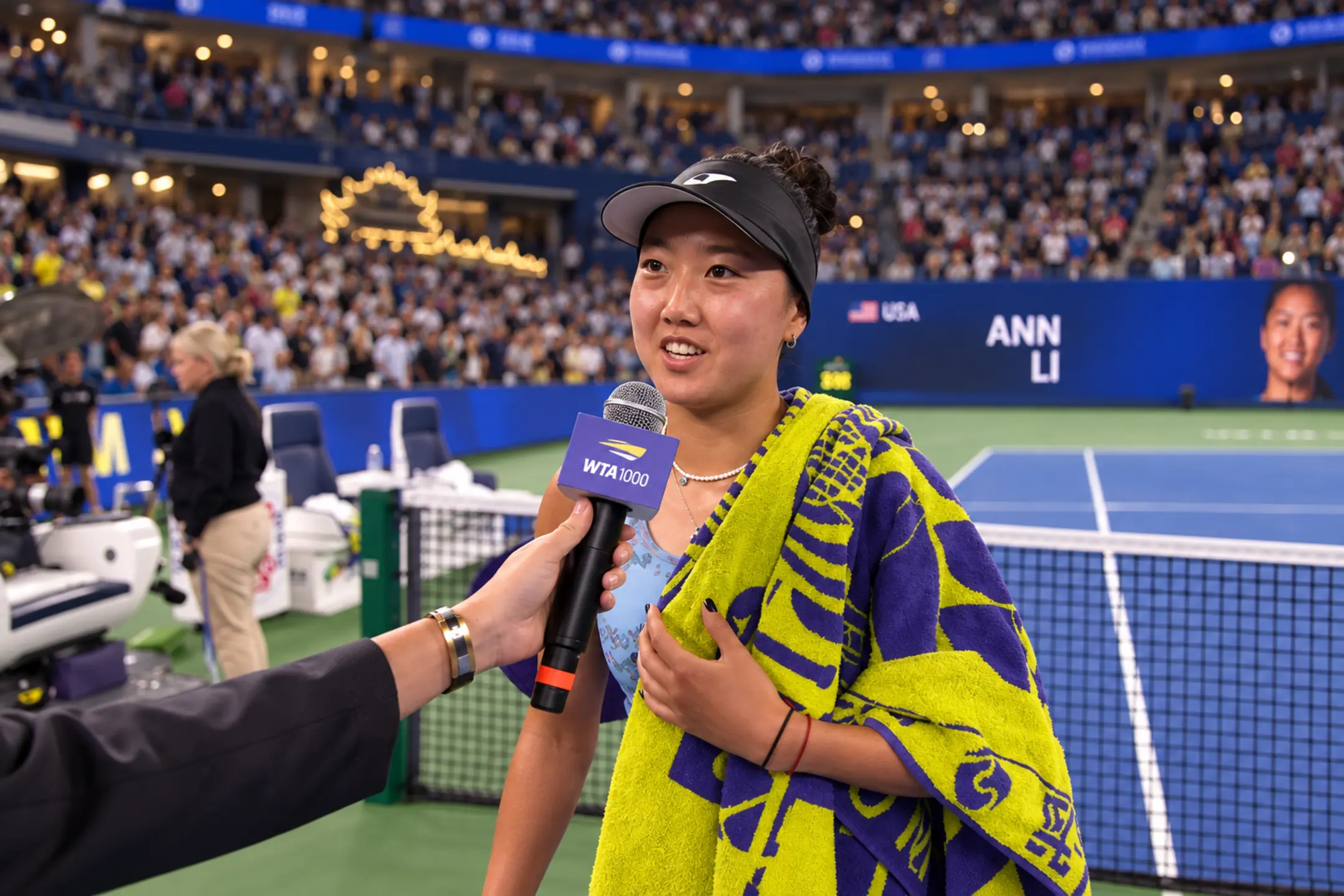
Aryna Sabalenka vs. Ann Li — Wuhan Open 2026 Second-Round Match Report
For nine match points, Aryna Sabalenka kept alive the possibility that this difficult stretch was still only that: a stretch.
On the 10th, Ann Li ended the argument.
The world No. 31 beat Sabalenka 3-6, 6-4, 7-6(5) in the top seed’s opening match in Wuhan, surviving an extraordinary sequence in which the Belarusian repeatedly refused to lose.
The result changes the interpretation of Sabalenka’s recent form.
She did win her opening match in Beijing against Renata Zarazua, so this is not another one of the consecutive opening-match losing streaks she has suffered a long time ago in her career. But Beijing ended in the third round against Nikola Bartunkova, and Wuhan is now over after one match.
Had Sabalenka escaped against Ann Li and gone on to contend for the title, Beijing could easily have been filed away as a blip.
She did not.
For a player who has spent 99 weeks at world No. 1, the downturn can now reasonably be called a personal crisis of form.
Inside Ann Li’s 10-Match-Point Win Over Aryna Sabalenka
Sabalenka Looks in Control Before Li Changes the Direction
The opening set gave little indication of what was coming.
Sabalenka broke for 3-1 and, although Li recovered one of the breaks at 4-3, the favorite struck back immediately. Another break made it 5-3 before Sabalenka served out the set 6-3.
The second set initially followed the same direction.
Sabalenka broke for 3-2 and held for 4-2.
Then Li changed the match.
Or was it Sabalenka?
Li held for 4-3, but Sabalenka quickly moved 30-0 ahead on serve. Then, all of a sudden, her confidence on serve disappeared.
There had been no sign that it was coming, but it did.
Sabalenka lost four of the next six points on serve before Ann Li broke back coming from deuce for 4-4.
The American then moved ahead 5-4. With Sabalenka serving to stay in the set, Li broke again. On her third set point, she took the set.
6-4.
A match that had looked firmly under Sabalenka’s control was suddenly going the distance.
Credit where credit is due.
Ann Li did raise her level toward the end of the set, especially on serve and return.
Ann Li Gets Away, Sabalenka Refuses to Leave
Li carried that momentum into the third set.
She broke for 3-1, moved to 4-1 and then held for 5-2.
What followed was the extraordinary part.
With Sabalenka serving at 2-5, Li reached match point five separate times.
Sabalenka saved all five.
She eventually held for 3-5 and then broke Li to get back to 4-5.
Two more match points came on Sabalenka’s next service game.
Both disappeared.
By the time she held for 5-5, seven chances had gone and Li had every reason to wonder whether the match was slipping away.
It did not.
Both women held once more and headed into a deciding tiebreak.
Match Point No. 10 Finally Ends It
Li again put herself in position to finish the job.
She reached 6-3 in the breaker, creating three more match points.
Sabalenka saved the first.
Then the second.
Nine had now vanished across the set.
At 6-5, Li had No. 10.
This one stayed won.
The breaker finished 7-5, and with it came a result that felt more significant than a single upset.
Relive All 10 Match Points
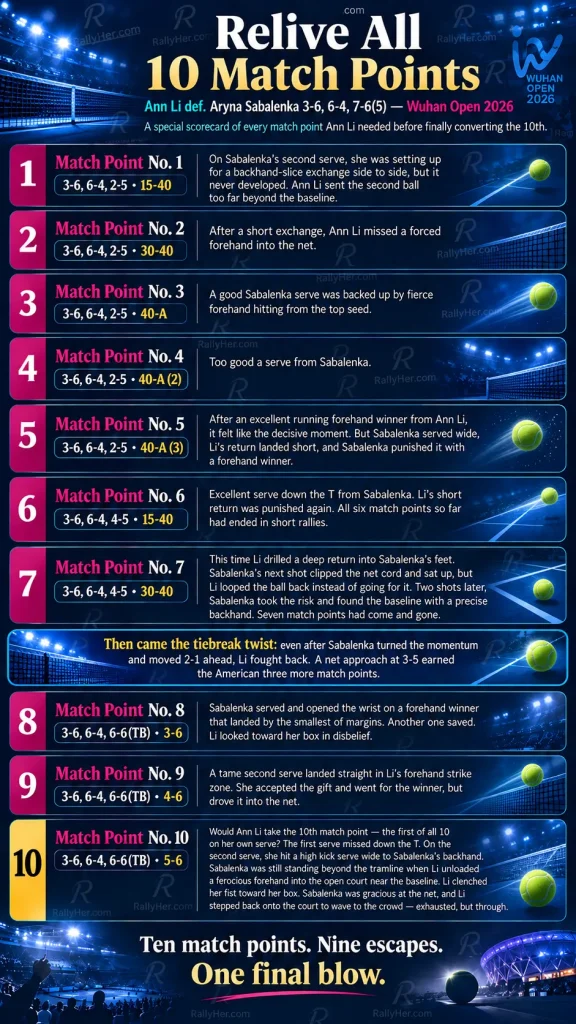
Sabalenka had escaped the finish line nine times and all were on serve.
The tenth was not and it showed.
She could not escape what the defeat now says about her form.
Li Wins the Match Sabalenka Nearly Stole
The numbers show how fine the margins were.
Sabalenka actually won more points overall, 108 to 105, and produced more winners, 36 to 31.
The difference was control.
Li committed 28 unforced errors to Sabalenka’s 44 and struck eight aces to the Belarusian’s two.
Sabalenka saved an extraordinary 13 of 17 break points, another indication of how often she found herself under pressure. Yet Li kept forcing her back into those situations.
The American’s persistence mattered more than efficiency.
She converted only four of 17 break opportunities and needed 10 match points.
She only needed the last one to count.
Full Match Stats Aryna Sabalenka vs Ann Li
| Sabalenka | Statistic | Li |
|---|---|---|
| Full Match Duration: 2h28m | ||
| 0.94 | Dominance Ratio | 1.06 |
| 36 | Winners | 31 |
| 44 | Unforced Errors | 28 |
| 247 | Serve Rating | 260 |
| 2 | Aces | 8 |
| 6 | Double Faults | 4 |
| 54% (66/122) | 1st Serve % | 60% (55/91) |
| 67% (44/66) | 1st Serve Points Won | 73% (40/55) |
| 55% (31/56) | 2nd Serve Points Won | 50% (18/36) |
| 76% (13/17) | Break Points Saved | 50% (4/8) |
| 154 | Return Rating | 127 |
| 27% (15/55) | 1st Return Points Won | 33% (22/66) |
| 50% (18/36) | 2nd Return Points Won | 45% (25/56) |
| 4/8 | Break Points Won | 4/17 |
| 108 | Total Points Won | 105 |
Sabalenka Has Been Through These Runs Before
The supplied career record shows five previous stretches since 2017 in which Sabalenka lost her opening match at consecutive tournaments.
| Date | Opening Loss | Next Event(s), Also Lost First Match | Straight Opening Losses |
|---|---|---|---|
| 2022-3 | Indian Wells, lost to Paolini | Miami, lost to Begu | 2 |
| 2022-1 | Adelaide 1, lost to Juvan | Adelaide 2, lost to Peterson | 2 |
| 2019-6 | ‘s-Hertogenbosch, lost to Aiava | Birmingham, lost to Hsieh | 2 |
| 2019-5 | Madrid, lost to Kuznetsova | Rome, lost to Cornet | 2 |
| 2018-4 | Istanbul, lost to Hercog | Madrid, Rome and Roland Garros (Pera, Hsieh, Bertens) | 4 |
The most severe came in 2018, when she was still a teenager and lost her first match at four straight events: Istanbul, Madrid, Rome and Roland Garros.
There were two-event runs in 2019 and again in 2022.
This current spell is technically different.
Sabalenka beat Zarazua in her first Beijing match before losing to Bartunkova. Wuhan, however, has now ended immediately against Li.
That distinction is important statistically, but less comforting editorially.
At Beijing, there was still an easy explanation available: one bad tournament.
A deep Wuhan run could have reinforced it.
Instead, Sabalenka has followed one early exit with another, this time after being dragged through 10 match points by a player in Ann Li ranked No. 31.
The Blip Has Become Something Bigger
Calling a difficult fortnight a crisis is easy.
Calling two poor tournaments a crisis can still be premature but not when the player involved has spent 99 weeks at No. 1 and has repeatedly shown an ability to reset quickly.
That is why Wuhan mattered.
Sabalenka had a chance to answer Beijing immediately. Had she survived Li, found rhythm and gone deep, the previous defeat could have been reduced to little more than an interruption.
Instead, she is out again.
That does not erase the player Sabalenka has been for years.
It does change the question.
This is no longer about one strange result in Beijing.
Sabalenka was cruising to a routine win.
Then somehow the wheels came off.
Again.
Therefore, the crisis is now official.