
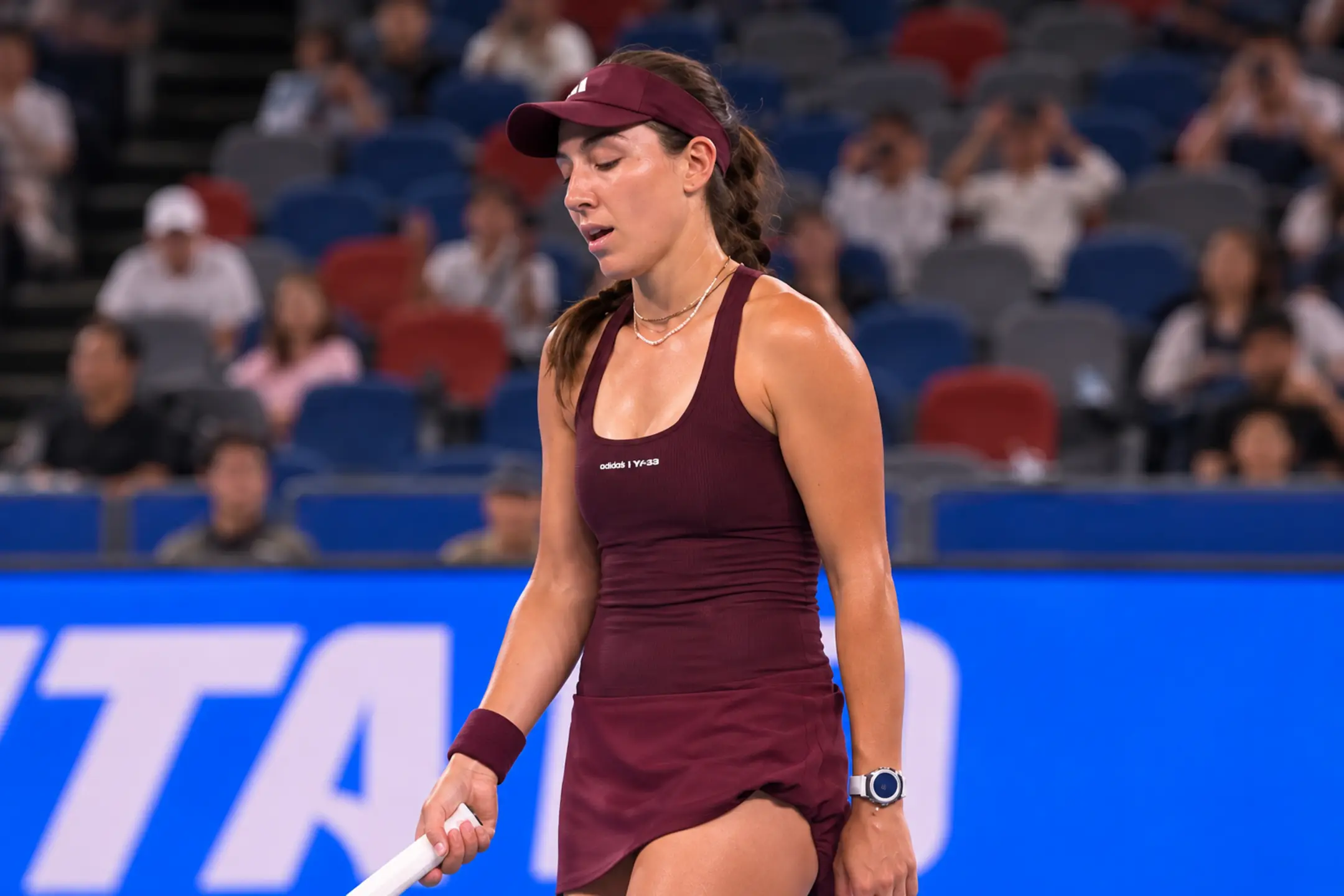
Jelena Ostapenko vs. Jessica Pegula — Wuhan Open 2026 Second-Round Match Report
For almost two sets, Jelena Ostapenko was chasing Jessica Pegula.
Even her team in the box felt her frustration, receiving their fair share of sharp words and looks.
Then she saved three match points in the breaker.
After that, she looked liberated.
The Latvian came back to stun world No. 3 Jessica Pegula 2-6, 7-6(7), 6-3, backing up her thunderous first-round demolition of Daria Kasatkina with a much more dramatic statement in Wuhan.
Against Kasatkina, Ostapenko had been in control almost from the first ball.
This time she had to survive first.
Once she did, the match changed.
Pegula Controls the Opening Set
Pegula made the first move immediately, breaking Ostapenko in the opening game and consolidating for 2-0.
Ostapenko held for 1-2, but Pegula remained comfortable on serve and moved through 3-1.
Another break gave the American 4-1, and from there she never allowed the set to become complicated.
Ostapenko held once more for 2-5, but Pegula served it out 6-2.
The world No. 3 had established the cleaner patterns and, at that stage, Ostapenko was still searching for a way to impose herself.
Four Straight Breaks Turn the Second Set Wild
The second set stayed on serve through 2-2.
Then the match became much less orderly.
Pegula broke Ostapenko for 3-2.
Ostapenko immediately broke back for 3-3.
Pegula struck again for 4-3.
Ostapenko answered again for 4-4.
Four successive games had gone against serve.
The Latvian finally stopped that sequence by holding for 5-4, but Pegula refused to blink. She held for 5-5, Ostapenko made it 6-5 and Pegula forced the tiebreak.
That was where the match appeared to be over.
Three Match Points Change Everything
Pegula raced to 3-0 in the breaker and kept herself in front.
At that point, Ostapenko looked totally out of it.
Yet Ostapenko recovered to 3-3, before Pegula edged ahead again and eventually reached 6-4.
Two match points.
The first match point will probably become one of Jessica Pegula’s highlights of the season, as she likes to mock herself when the moment is right.
Pegula’s serve sent Ostapenko into her right hand corner, where the Latvian scraped the ball just over the net. Pegula’s next shot went all the way to the other side. Ostapenko could only get her racket to it in desperation.
The ball came back perfectly for a winning volley.
Pegula put the volley into the net.
This was a sitter. And Pegula had missed it.
Ostapenko saved the second one.
The Latvian then hit a double fault, gifting another match point to the American at 7-6.
Ostapenko saved it with… a forehand drop shot.
Three match points had come and gone.
And suddenly Ostapenko looked like a different player.
She levelled at 7-7, moved ahead for the first time in the decisive stretch and then closed the tiebreak 9-7.
Pegula had been one point away from the next round three separate times.
Instead, they were going to a third set.
Ostapenko Finally Stops Chasing
The momentum shift carried straight into the decider.
Pegula held the opening game, Ostapenko answered for 1-1, and then the Latvian broke for 2-1.
For the first time in the match, she had real separation.
She consolidated for 3-1.
Pegula held for 3-2, but Ostapenko answered for 4-2 and then broke again for 5-2.
Pegula managed one final response, breaking back for 5-3.
It did not last.
Ostapenko broke once more to finish the match 6-3.
Once she had survived those three match points, the player who had spent so much of the afternoon reacting was suddenly dictating.
Forty-Five Winners Explain the Risk
Ostapenko did not win this by becoming conservative.
Quite the opposite.
She struck 45 winners to Pegula’s 15.
That came with the usual danger. Ostapenko also made 37 unforced errors and 11 double faults, compared with only 12 errors from Pegula.
But after saving the match in the second-set tiebreak, her aggression increasingly paid off.
She converted five of seven break points, won 58 percent of the pressure points and finished with a 1.07 dominance ratio against Pegula’s 0.94.
The overall point count was almost even, 96-94.
That fits the match perfectly.
This was not a rout.
It was a two-point difference stretched across three sets, with three saved match points sitting right in the middle of it.
Full Match Stats Ostapenko vs Pegula
| Ostapenko | Statistic | Pegula |
|---|---|---|
| Full Match Duration: 2h23m | ||
| 1.07 | Dominance Ratio | 0.94 |
| 45 | Winners | 15 |
| 37 | Unforced Errors | 12 |
| 229 | Serve Rating | 226 |
| 10 | Aces | 2 |
| 11 | Double Faults | 4 |
| 51% (47/92) | 1st Serve % | 55% (52/95) |
| 66% (31/47) | 1st Serve Points Won | 69% (36/52) |
| 49% (22/45) | 2nd Serve Points Won | 37% (16/43) |
| 44% (4/9) | Break Points Saved | 29% (2/7) |
| 198 | Return Rating | 177 |
| 31% (16/52) | 1st Return Points Won | 34% (16/47) |
| 63% (27/43) | 2nd Return Points Won | 51% (23/45) |
| 5/7 | Break Points Won | 5/9 |
| 96 | Total Points Won | 91 |
Kasatkina Was Power, Pegula Was Proof
Ostapenko’s first-round win over Kasatkina had been spectacular.
She won 6-1, 6-1 in 59 minutes, hit 35 winners and broke Kasatkina in every service game the qualifier played.
That showed the power was there.
Beating Pegula showed something else.
This time Ostapenko had to absorb pressure, trail, recover, save match points and then find another level after nearly going out.
That makes the Wuhan form card considerably more convincing.
One crushing win can happen.
Following it by taking out the world No. 3 after surviving three match points is something more.
Pegula Keeps No. 3, Ostapenko Can Keep Climbing
The defeat does no immediate damage to Pegula’s world No. 3 ranking.
For Ostapenko, though, Wuhan now offers another opportunity to climb.
She entered the tournament at world No. 34 and has already removed Kasatkina and Pegula.
Next comes either Han Shi of China or Leylah Fernandez of Canada.
After two very different wins, Ostapenko has already shown both versions of herself in Wuhan.
First, the one who overwhelms.
Then, the one who refuses to leave.
Saving three match points may prove to be the moment that connected the two.