
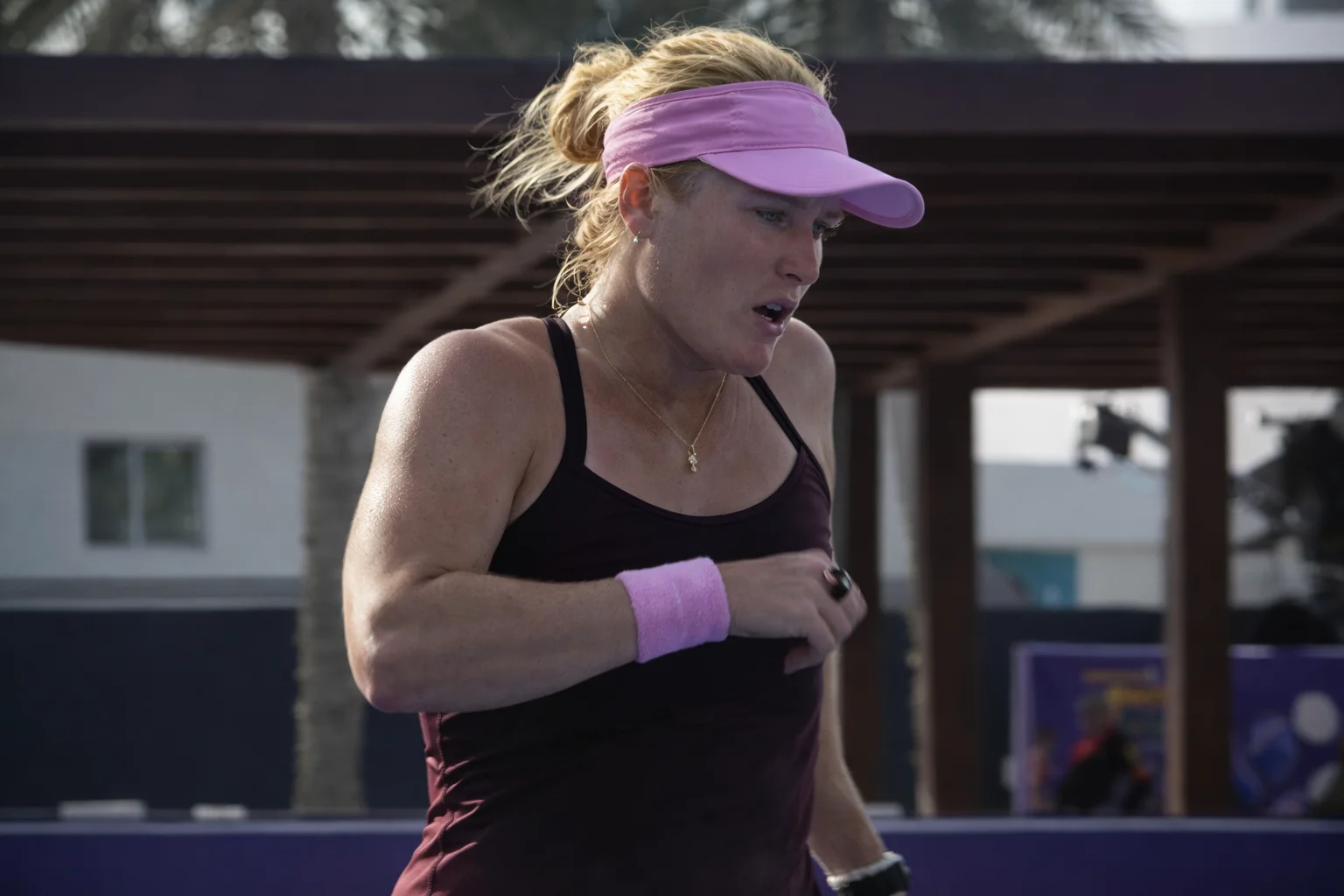
Peyton Stearns had the kind of season that looks better on a list of achievements than it does on a calendar.
She won the title in Austin and reached a WTA 500 final in Guadalajara. In between, there were plenty of weeks when she struggled to win a match.
She began 2026 ranked No. 64 and finished her last event at No. 37.
That was a good recovery from a 2025 season that had ended at No. 63, although the previous year had also taken her as high as No. 28.
Stearns turned 25 in October.
Born in Cincinnati, she played college tennis at the University of Texas, where she became the school’s first NCAA Division I singles champion in 2022.
Her first WTA title came in Rabat two years later.
The second would arrive much closer to her old college home.
A Better Melbourne, Then a Title in Texas
Her first match of the year was a loss to qualifier Kaitlin Quevedo in Auckland. Hobart brought a hard-earned win over Barbora Krejcikova before Olga Danilovic stopped her in the next round.
Melbourne was better. Stearns beat Sofia Kenin 6-3, 6-2 and Petra Marcinko 6-2, 7-5 to reach the Australian Open third round.
Amanda Anisimova, then No. 4 in the world, beat her 6-1, 6-4.
That was two rounds further than she had managed in 2025. Against Kenin, Stearns won nearly 86% of the points behind her first serve. Against Anisimova, she won fewer than 29% behind her second. It was an early look at both sides of her game.
February did not begin smoothly.
Stearns lost from a set up to Vera Zvonareva in Doha. She won a match as a lucky loser in Dubai, then fell to Clara Tauson.
Austin changed everything for a week.
Stearns came through three-set matches against Francesca Jones, Oksana Selekhmeteva and Kimberly Birrell. She also swept past Kaja Juvan 6-0, 6-2.
In the final, Taylor Townsend pushed her through two tight sets. Stearns won them both, 7-6(8), 7-5, to claim her second tour-level singles title.
There was something fitting about winning in the city where she had played her college tennis. The question was whether that form would travel.
Spring Brings Back the Early Exits
It barely made it to California. Solana Sierra beat Stearns in the first round at Indian Wells, 7-5, 7-5. In Miami, she beat Viktorija Golubic but lost to Jaqueline Cristian.
Charleston followed a similar course. Stearns survived Ashlyn Krueger in two close sets, then lost to McCartney Kessler in three.
Her clay season had better moments. She dismissed Lois Boisson 6-1, 6-3 in Madrid before running into world No. 1 Aryna Sabalenka.
In Rome, she beat Janice Tjen but lost to Madison Keys after winning the opening set.
Rome was a particularly hard comparison. Stearns had made the semifinals there in 2025, beating Keys along the way. Twelve months later, the same opponent stopped her in the second round.
Strasbourg brought another quick swing in fortune. Stearns beat Maria Sakkari 6-3, 6-1, then lost 6-1, 6-3 to Daria Kasatkina. She managed only 20% of second-serve points against Kasatkina.
At Roland Garros, she put together two solid wins over Kenin and Daria Snigur. Belinda Bencic ended her run in the third round, 6-3, 6-3.
Paris was an improvement on her first-round loss in 2025.
Still, it did not make up for the ground lost at Rome.
Summer Offers Little Relief
Stearns won one qualifying match at Eastbourne before Kimberly Birrell beat her 7-5, 6-0.
At Wimbledon, Nikola Bartunkova sent her home in the first round, winning 6-4, 3-6, 7-5.
Grass had once again given her very little. Wimbledon remained the Slam where she had yet to find a way past the opening round.
Back on hard courts, she reached the quarterfinals in Memphis. Wins over Mary Stoiana and Tatiana Prozorova were followed by a three-set loss to Elvina Kalieva, ranked No. 132.
Toronto lasted just one match. Elena-Gabriela Ruse beat her 6-0, 7-5.
In Cincinnati, Stearns beat Harriet Dart but lost a close three-setter to Tauson.
Then came the US Open. Dart, now a qualifier, turned the Cincinnati result around and won 3-6, 6-3, 6-2.
Stearns had taken the first set but could not hold on. She won only a third of her second-serve points. For a player who had made the Rome semifinals the year before, it was a disappointing way to leave New York.
Guadalajara Gives Her Another Chance
September finally brought some rhythm.
Stearns arrived in Guadalajara ranked No. 60. She beat Emiliana Arango, then No. 30 Diane Parry, before holding off Sloane Stephens in two tight sets.
The semifinal was her best win of the week. Against Liudmila Samsonova, she took a tense first-set tiebreak 9-7 and ran away with the second set, 6-2.
That put her in her first WTA 500 final, against Iva Jovic. The younger American, ranked No. 16, won 6-4, 6-2.
Stearns had fallen short of the trophy, but four straight wins mattered. They helped push her back towards the Top 40 after a summer that had offered little encouragement.
The Finish Is Flat Again
The lift did not last.
Viktorija Golubic beat her in Beijing, and wildcard Han Shi, ranked No. 217, came from behind to knock her out in Wuhan qualifying.
Her last match of the season ended with a retirement against Katerina Siniakova in Osaka. The score stood at 6-4, 0-6, 4-0 to Siniakova.
Stearns was No. 37 at that final event. She had recovered her ranking, but the closing weeks did little to strengthen her case for a return to the Top 30.
Peyton Stearns Assessment
Across her 2026 record, Stearns won 24 matches and lost 22, including qualifying. Nine of those wins came in Austin and Guadalajara.
That explains a good deal about her season. She could play well enough to win a title or reach a major final. She just did not find that level often enough.
The comparison with 2025 cuts both ways.
Stearns added a singles title and a WTA 500 final in 2026.
She also improved her Grand Slam results in Australia and Paris, reaching the third round at both after first-round exits the previous year.
But the Rome semifinal from 2025 remained unmatched. There was no equivalent run at a WTA 1000, and she lost all six matches against Top 20 opponents in the rest of the 2026 season.
The second serve was often a problem when stronger opponents took charge. Anisimova won comfortably in Melbourne, Kasatkina ran through her in Strasbourg, and Dart turned their US Open match around. In all three losses, Stearns won fewer than 34% of points behind her second delivery.
Her three-set record was 5-9. She has the nerve to fight through long matches, as Austin showed, but she did not win enough of them over the full year.
This is still a dangerous player, especially on hard courts and clay. She has the power to take matches away from opponents. The missing piece is a steadier standard when the first few games do not go her way.
Final Verdict
A title, a WTA 500 final and a climb from No. 63 at the end of 2025 to No. 37 at her final event make this a positive season.
It was not a complete one. Stearns failed to beat a Top 20 opponent, won only four Grand Slam matches and had too many weeks without a meaningful run.
Letter Grade: B+
GPA: 3.3
Austin and Guadalajara showed what Stearns can do.
Her next step is making the weeks between those performances count for more.