
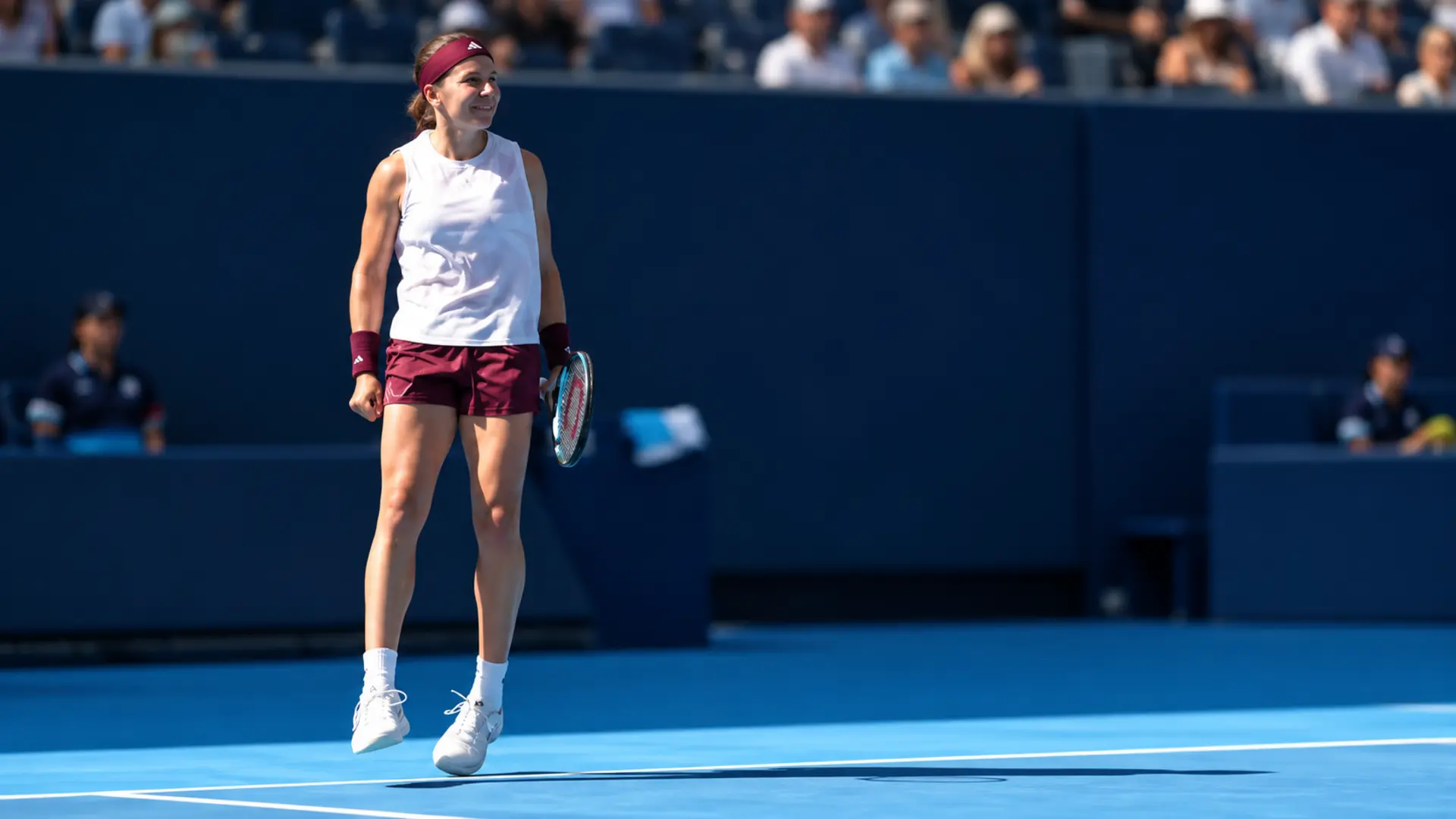
In June, Nikola Bartunkova led Aryna Sabalenka by a set in Berlin and lost. In Beijing she met her again, landed just over a third of her first serves in the second set and won in straight sets.
Those two matches explain her season better than any ranking table. The talent was never in doubt. The finishing was.
By any normal measure, the season was excellent. Bartunkova started 2026 at No. 129 and finished it at No. 30 in the live WTA rankings.
She went 30-18, beat three Top 10 players, reached a WTA 1000 semifinal and made the third round at three Grand Slams.
She is also the second Czech in RallyHer’s 2026 WTA Season Assessments, after Sara Bejlek. Few players in the countdown play anything like her.
A Game Built on Surprise
Bartunkova was a Wimbledon junior finalist in 2023, so the talent is not new. What changed in 2026 was the level at which she could express it.
She has a two-handed backhand and enough pace to hold her own from the baseline.
Her best tennis, though, happens between the conventional strokes: the slice that changes the height of a rally, the drop shot that drags a baseliner forward, the willingness to follow it to the net. Opponents rarely know what the next ball will be. For a 20-year-old, that is a rare kind of discomfort to inflict.
The catch is that a game built on surprise needs a reliable foundation underneath it. Hers did not always have one.
Melbourne Introduces Her
Bartunkova arrived at the Australian Open as a qualifier ranked No. 126, playing her first Grand Slam main draw. She beat Daria Kasatkina and then the No. 10 seed Belinda Bencic.
Both times she lost the second set 6-0, and both times she won the decider.
It was not tidy. It was, however, a useful early sign that she does not panic when a match turns against her.
Elise Mertens ended the run in the third round, 6-0, 6-4. Bartunkova won barely one in five points behind her second serve, and an attacking game has little to work with when every second ball becomes an invitation. That weakness would return.
A Thin Spring, Then Rome
Ostrava and Austin brought a quarterfinal, a round and two heavy defeats, 6-1, 6-3 to Diane Parry and 6-1, 6-4 to Taylor Townsend. Neither was a disgrace. Both showed how quickly her tennis thins out when the first strike does not land.
Rome changed the mood. Bartunkova lost in the final round of qualifying, came back in as a lucky loser and then beat Madison Keys 6-3, 1-6, 6-4 in her first WTA 1000 main draw.
Keys won more points, 75 to 71. Bartunkova won the match. Neither player broke in the first eight games of the decider, and the Czech took the one late opening that came her way.
It was the first sign of a quality she would need all year: making a small number of chances count.
Elina Svitolina restored order 6-2, 6-3 in the fourth round. Bartunkova double-faulted on roughly one service point in seven.
At Roland Garros, Victoria Mboko needed 69 minutes to beat her 6-1, 6-2.
Grass: The Gift and the Warning
Grass should suit a player who likes to change pace and come forward, and largely it did.
At the WTA 125 event in Birmingham, she won four matches, all of them decided in a final set or a tiebreak. Alexandra Eala then beat her 5-7, 6-3, 7-5 in the final.
That was her second WTA 125 final in two years, after losing to Kaja Juvan in Samsun in 2025. A week later, Hanne Vandewinkel came from a set down to beat her in ‘s-Hertogenbosch.
Berlin brought the most revealing match of her year. As a wildcard, she beat Diana Shnaider and then dismissed Mertens 6-1, 6-4, a neat reversal of Melbourne. In the quarterfinals she took the first set from world No. 1 Sabalenka 6-2.
Sabalenka won the next two, 7-6(2), 6-4. It would be easy to call it nerves. The numbers suggest something more practical.
Bartunkova won fewer than three in ten second-serve points. Once Sabalenka started attacking that delivery, the Czech had no safer way to play. Bold tennis had built the lead. There was no plan B to protect it.
Wimbledon was steadier. She beat Peyton Stearns and Katerina Siniakova before Barbora Krejcikova won 6-3, 7-5 in the third round.
Summer Near Misses
The North American summer read like a list of matches that got away.
In Prague, the fourth seed lost to Lanlana Tararudee 7-6(4), 3-6, 7-6(6) after three hours and 17 minutes.
In Toronto, she took the first set from Amanda Anisimova, the No. 10, and lost 3-6, 6-0, 6-4.
Monterrey, a WTA 500, was the clearest example. Bartunkova won three matches to reach the semifinals, then took the first set from Mertens 6-1 and led 3-0 in the second. At 4-2, she had five game points to move within a game of the final.
She converted none of them. The crowd, sensing a longer evening, began cheering for Mertens, who won 1-6, 6-4, 6-2. Bartunkova’s drop shot had pulled the Belgian apart for a set and a half. By the end, Mertens was simply sending everything back.
At the US Open, she beat Mayar Sherif and Tatjana Maria before Mirra Andreeva won 6-2, 7-6(5).
That made three Grand Slam third rounds in one season, which is consistency of a sort most players her age would gladly take.
Beijing: The Answer
Seeded 26th at the China Open, Bartunkova beat Magdalena Frech 6-2, 6-2 and then met Sabalenka again, this time as the world No. 2.
On paper, she should have struggled.
She landed only 36% of her first serves in the second set. In practice, Sabalenka never broke her. Bartunkova saved five break points in the opening set, won 83% of points when her first serve did land and made 14 unforced errors to Sabalenka’s 25. She won 6-4, 6-3 in 95 minutes.
There was no collapse this time, and no tiebreak to lose. Berlin had shown she could trouble Sabalenka. Beijing showed she could finish the job.
After a three-set win over Sinja Kraus, she beat Karolina Muchova 6-3, 6-0 in 67 minutes.
The comparison between the two Czechs is obvious: both play with slice, drop shots and a taste for the net. On the day, the younger version was sharper. Bartunkova won 60% of points on return, and Muchova made 37 unforced errors to her 15.
A caveat belongs here. Two days earlier, Muchova had needed nine match points and nearly three hours to beat Naomi Osaka, cramping along the way. Bartunkova still had to take advantage, and she did.
Andreeva then beat her 6-2, 6-2 in the semifinals, breaking her three times in the first set. It was a sharp reminder of the gap to the very top. It did not undo the week, which took her into the Top 30 for the first time.
The Last Weeks
Wuhan and Tokyo produced one win.
Paolini beat her 7-6(5), 6-3, and qualifier Aliaksandra Sasnovich won 6-4, 6-7(5), 6-3 in Tokyo.
It was an unremarkable ending to a far from unremarkable year.
Nikola Bartunkova Assessment
Bartunkova’s greatest strength is not the range of her shots. It is her willingness to use them when a safer option is available. Against Keys and Muchova, that willingness decided the match.
The weaknesses are just as clear. Her second serve is the soft spot that good returners find: below 30% of points won against Sabalenka in Berlin and Svitolina in Rome, and 34% in the Monterrey semifinal. When the serve gives way, the variety has nowhere to start from.
Then there is the closing. She won 16 of her 24 deciding sets, so stamina and fight are not the problem. The problem is the short, high-pressure passages. She won only 6 of her 18 tiebreaks. Five times she won the first set of a match and still lost it, including the Birmingham final, Berlin against Sabalenka and the Monterrey semifinal.
Those are not unlucky defeats. She creates the advantage by playing boldly, and when the opponent adjusts, she has not yet found a quieter way to keep it.
The fix is not to make her more conventional. A cautious Bartunkova would be a less dangerous one. What she needs is a better second serve and a clearer sense of which balls deserve ambition and which only need to go back over the net.
Final Verdict
Bartunkova finished 2025 at No. 129 after a Guadalajara semifinal and a WTA 125 final in Samsun. A good 2026 would have meant a regular place in tour main draws.
She did considerably more. She won two rounds in Melbourne as a qualifier, made three Grand Slam third rounds, beat Bencic, Sabalenka and Muchova and reached a WTA 1000 semifinal on the way to No. 30.
What keeps the grade below the very top is what she left behind: no tour-level final, a lost WTA 125 final and too many matches that were hers for a set. Bejlek, three places below her in the rankings, earned an A with a WTA 500 title and a win over the No. 1. Bartunkova’s better Grand Slam record balances the missing title, so she sits level.
Letter Grade: A
GPA: 3.7
For 2027, the goal should be a first WTA Tour title and a place in the second week of a Grand Slam. Neither requires a new game. She already has the shots to beat Sabalenka and the nerve to try them.
She now has to learn when to stop looking for the brilliant shot and simply win the match.
Leave a Reply