
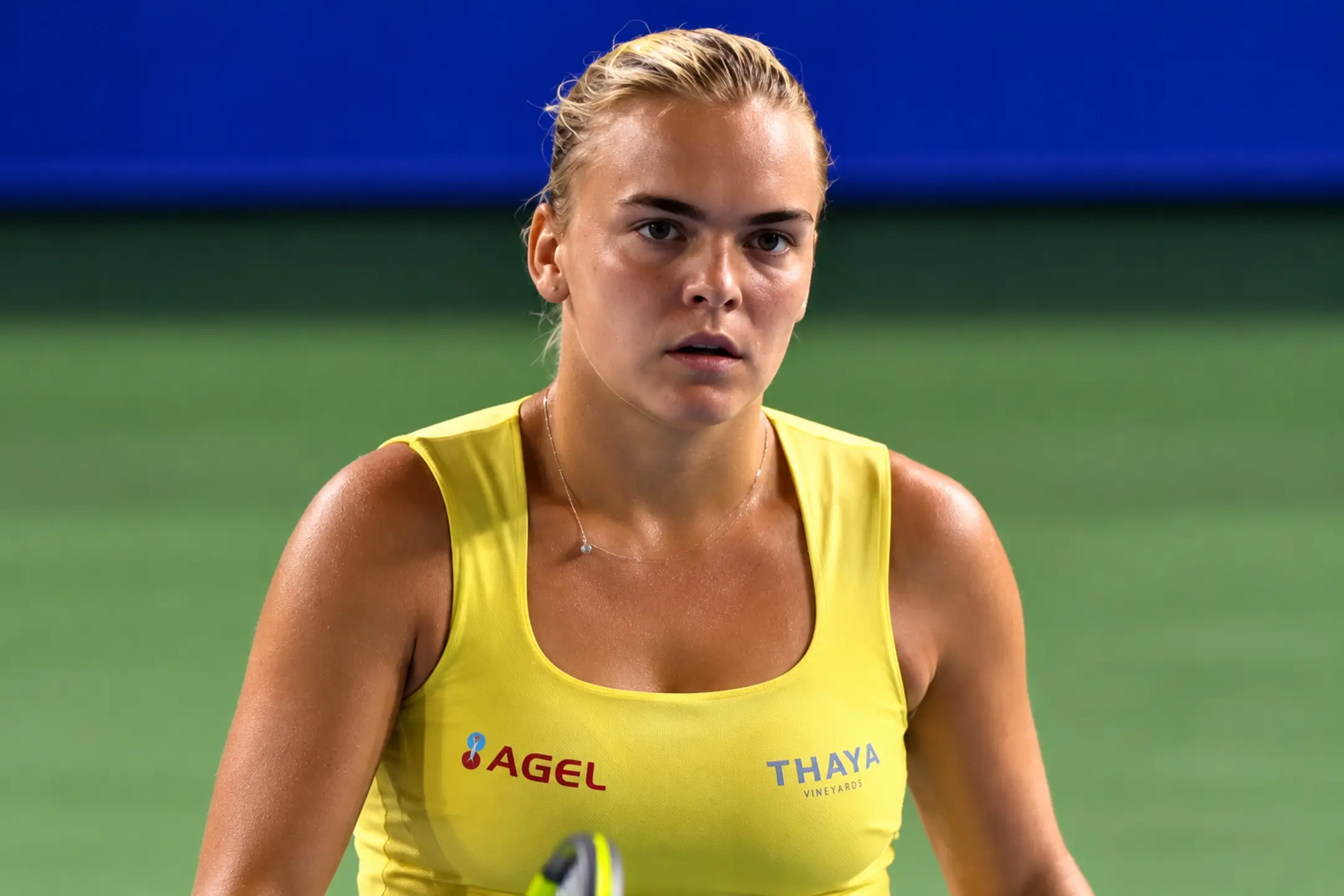
Sara Bejlek stands just 1.63 metres tall (5 ft 4 in). In 2026, she became a WTA 500 champion and beat the world’s No. 1. Her greatest weapon was not overwhelming power. It was knowing how to make stronger hitters uncomfortable.
The 20-year-old is our first Czech in RallyHer’s Season 2026 WTA Assessments. Four more Czech players await us as we work our way up the rankings. What a way to begin.
Bejlek finished 2025 at No. 76, having claimed three WTA 125 titles. She opened the new season outside the Top 90, then climbed to a career-high No. 28 before finishing at world No. 33.
Two remarkable weeks made that rise possible. Yet a disappointing Grand Slam record showed that the next stage of her development would not be straightforward.
Abu Dhabi Turns a Promising Talent Into a Champion
Bejlek opened in Auckland with a win over Panna Udvardy before losing to Iva Jovic. The Australian Open brought another early exit. Ashlyn Krueger beat her 6-3, 6-3 in the first round.
A fortnight later, Bejlek met Krueger again. This time, the result was very different.
The Czech came through qualifying in Abu Dhabi and beat the American 6-3, 6-0. She then defeated world No. 24 Jelena Ostapenko 6-4, 6-3.
Her quarterfinal against Sonay Kartal lasted just 63 minutes. Bejlek won 6-0, 6-2, dropping only two games.
Clara Tauson, ranked No. 16, proved much harder to overcome. Bejlek survived a three-set semifinal, winning 7-5, 3-6, 7-5 after nearly three hours.
The final against Ekaterina Alexandrova revealed what makes her tennis so interesting.
Bejlek does not try to match a powerful opponent stroke for stroke. Her left-handed angles create awkward positions. Slice and short balls draw opponents away from their preferred baseline positions. She can then use a lob or passing shot to punish the movement forward.
Against Alexandrova, she repeatedly broke up the Russian’s rhythm with that variety. Rather than allowing a succession of heavy baseline exchanges, she made the final a contest of movement, touch and decisions.
She also handled the most important points beautifully. Trailing 4-2 in the opening tiebreak, Bejlek won five of the next six points.
The second set was almost one-way traffic. She completed a 7-6(5), 6-1 victory and celebrated her first WTA singles title.
The qualifier had won seven matches in eight days, including the two qualifying rounds. Her ranking jumped from No. 101 at the start of the tournament to No. 52 afterwards.
Bejlek had only just turned 20. Suddenly, the biggest stage no longer looked intimidating.
A First Title Does Not Solve Everything
The weeks after Abu Dhabi were considerably less impressive.
Bejlek beat Zeynep Sonmez in Dubai, then withdrew before meeting Belinda Bencic. Miami was particularly painful.
Qualifier Talia Gibson overwhelmed her 6-1, 6-0 in just 69 minutes. Bejlek landed only 37.1% of first serves and won 18.2% of second-serve points.
Her double-fault rate was 17.1%. Those numbers explain why she never established a foothold.
The contrast with Abu Dhabi was striking. There, Bejlek had used her first serve well enough to introduce variety into rallies. Against Gibson, too many points began with her already under pressure.
Charleston brought a straightforward victory over Akasha Urhobo, followed by a 7-6(4), 6-2 defeat to Bencic.
The Swiss player was ranked No. 12. Bejlek competed closely in the first set but could not sustain that resistance.
Her first WTA title had transformed her ranking. It had not yet transformed her week-to-week reliability.
A Difficult Clay Season Exposes the Limits
Clay should offer Bejlek opportunities. Her movement, defensive instincts and ability to change pace suit longer rallies.
But her 2026 clay results were disappointing.
Laura Siegemund beat her in Rome, 6-4, 6-4. Bejlek’s double-fault rate reached 11.1%, while she won only 43.5% of second-serve points.
Qualifying player Alina Charaeva then defeated her 6-4, 6-0 at the Paris WTA 125.
In Strasbourg, eventual champion Emma Navarro won 6-1, 6-4. Bejlek managed just 31.6% of second-serve points.
The pattern was becoming familiar. Her left-handed variety could complicate exchanges, but she needed a more reliable platform from which to use it.
At Roland Garros, she beat Sloane Stephens 6-3, 6-2 in the first round. That earned her a meeting with world No. 3 Iga Swiatek.
The Pole won 6-2, 6-3.
Twelve months earlier, Bejlek had made the second round in Paris after beating Marta Kostyuk, then ranked No. 25. She had also won two of her three WTA 125 titles on clay in 2025.
In 2026, despite being a much higher-ranked player, she made no further progress at Roland Garros. The clay-court breakthrough she might have expected never arrived.
Grass Brings Effort but Little Reward
The grass season was equally demanding.
Dayana Yastremska beat her 6-1, 6-2 at ‘s-Hertogenbosch. Then Karolina Pliskova came from a set down to win their Nottingham encounter 2-6, 7-6(3), 6-2.
Eastbourne finally offered a victory. Bejlek defeated Siegemund 3-6, 7-6(2), 7-6(3) after three hours and 22 minutes.
It was an impressive escape. Bejlek survived long exchanges and two tiebreaks, refusing to concede the match.
Her next opponent, Sonmez, advanced by walkover.
At Wimbledon, Sorana Cirstea ended Bejlek’s campaign 6-1, 7-6(6). The Czech improved considerably after losing the opening set, but could not force a decider.
There were signs of resilience, particularly at Eastbourne. Results remained modest.
For a player whose ranking was approaching the Top 40, that was becoming the season’s most uncomfortable contradiction.
The Summer Hard Courts Offer a Reset
Bejlek returned to hard courts in July. Athens brought wins over Viktoria Morvayova and Lilli Tagger, before Tauson beat her 6-2, 6-3.
In Prague, she survived a three-set match against Anna Blinkova. She then swept past Maria Timofeeva 6-1, 6-1.
Tagger avenged her Athens defeat in the quarterfinals, winning 6-3, 6-4.
Toronto followed. Bejlek needed three hours to beat Xiyu Wang, recovering from a second-set setback to win 6-3, 4-6, 7-5.
Swiatek then delivered another emphatic lesson, winning 6-0, 6-3. Bejlek managed only 31.8% behind her second serve.
The discrepancy between her best and worst performances had not disappeared.
Then came Cincinnati.
Cincinnati Gives Bejlek the Win of Her Life
Cincinnati began with a 6-0, 6-2 demolition of Karolina Pliskova. Bejlek won 70.8% of first-serve points and 59.1% behind her second delivery.
Next came Barbora Krejcikova, another decorated Czech player. Bejlek won 7-6(5), 6-4.
Alexandrova, whom she had beaten in the Abu Dhabi final, stood in her way again. Bejlek lost the first set 6-4, then took the next two 6-1, 6-2.
Her dominance ratio was 1.32. She won 70.6% of first-serve points and 51.6% behind the second serve. Both figures were strong enough to keep the Russian from dictating every exchange.
Then she faced world No. 1 Aryna Sabalenka.
For a player ranked No. 35, it was a formidable assignment. Sabalenka’s immense power would test Bejlek’s defense and expose any weakness on serve.
But Bejlek refused to give her a predictable target.
Her left-handed game brought changes of direction and rhythm. She stayed in exchanges that Sabalenka might normally have finished quickly, forcing the Belarusian to strike another ball.
Sabalenka led 2-0 in the opening set. Bejlek broke back. They eventually reached a tiebreak, where the Czech moved 5-1 ahead.
Sabalenka recovered to 5-5. Bejlek held firm and took it 9-7.
The world No. 1 then led 4-1 in the second set. Again, Bejlek refused to surrender. She won five consecutive games to complete a stunning 7-6(7), 6-4 victory.
For once, Sabalenka had been made to play someone else’s match.
Bejlek had beaten the world No. 1 for the first time. She had also reached her first WTA 1000 quarterfinal.
The Keys Escape Takes Her Into the Semifinals
The next opponent was Madison Keys, another player capable of taking control with overwhelming groundstroke power.
Keys won the first set 6-3. Her first serve was particularly effective, and she kept many points short.
Bejlek needed a different match.
She began extending exchanges, forcing Keys to strike more balls. The American still produced more winners, but errors increasingly became part of the equation.
Keys finished with 41 winners to Bejlek’s 23. She also committed 47 unforced errors, compared with 28 from the Czech.
The two players split 214 points exactly: 107 each.
Bejlek won the second set 6-4. In the deciding tiebreak, she trailed 4-2 before recovering to win 7-5.
The final score was 3-6, 6-4, 7-6(5).
It was another example of her most valuable quality. Bejlek does not need to overpower an opponent when she can disturb their rhythm and keep herself alive long enough to exploit mistakes.
Her run finally ended against Coco Gauff. The American won 6-4, 6-1, limiting Bejlek to 45.7% of first-serve points and 40.9% behind her second delivery.
Gauff prevented the Czech from establishing the control she had found against Sabalenka and Keys.
Even so, Cincinnati was extraordinary. Bejlek had beaten four former WTA 1000 champions and reached the semifinals.
The girl who began the year outside the Top 90 was now being taken seriously by the very best.
The Grand Slams Remain the Missing Piece
The US Open brought a harsh return to reality.
Cristina Bucsa beat Bejlek in the first round, 7-5, 4-6, 6-1. The Czech lost the deciding set convincingly, despite fighting her way back into the match.
That defeat left her with just one Grand Slam singles victory in 2026.
She had lost in the opening round in Melbourne, Wimbledon and New York. Roland Garros provided her only main-draw win.
For a player who had won a WTA 500 title and reached a WTA 1000 semifinal, the contrast was remarkable.
In 2025, Bejlek had reached the Roland Garros second round as a qualifier. The following season, she had not improved her best Grand Slam result.
Bejlek had reached a higher level of tennis, but she had not yet learned to reproduce it across the four biggest tournaments.
Asia Ends With a Czech Derby
September began with a victory over Alycia Parks in Guadalajara. Bucsa then beat Bejlek for the second time in a matter of weeks, this time 6-0, 6-4.
Beijing brought a win over Maddison Inglis, followed by a competitive defeat to Naomi Osaka. The Japanese player won 7-6(4), 6-4.
In Wuhan, Jasmine Paolini proved too strong, winning 6-3, 6-4.
Ningbo offered a more encouraging finish. Bejlek recovered from a set down against Parks, then defeated Cirstea 7-6(3), 6-4.
It was a satisfying response to her Wimbledon defeat against the Romanian.
The season ended in an all-Czech quarterfinal against Marie Bouzkova. Bejlek lost 6-3, 6-4.
Her final match showed how much work remained. She won only 55.8% of first-serve points and struggled to sustain pressure against her compatriot.
Yet she had finished the season inside the world’s Top 40, having reached No. 28 in September.
The progress was unmistakable, even if the final months had exposed its limits.
Sara Bejlek Assessment
Bejlek’s greatest strength is her ability to make tennis uncomfortable for opponents who prefer predictable patterns.
She is left-handed, quick and unusually inventive. Her slice changes the height and pace of rallies. Short balls can tempt powerful baseliners forward, where her passing shots and lobs become dangerous.
The Abu Dhabi final against Alexandrova was the clearest example. Bejlek used variety to break up the Russian’s preferred baseline rhythm.
Cincinnati provided an even bigger demonstration. Against Sabalenka and Keys, she absorbed power without allowing every rally to become a hitting contest.
Her decision-making under pressure was impressive. She recovered from significant deficits against both players, winning important tiebreak points and refusing to abandon her approach.
But the weaknesses are equally clear.
Her second serve can become vulnerable when opponents attack aggressively. Against Gibson in Miami, she won only 18.2% of second-serve points. The figure was 31.8% against Swiatek in Toronto and 40.9% against Gauff in Cincinnati.
These were different matches against different opponents, yet the problem recurred. When Bejlek cannot protect her serve, she loses opportunities to introduce her variety.
Her surface results also deserve attention. The young Czech built her breakthrough on hard courts, winning Abu Dhabi and reaching the Cincinnati semifinals.
Clay and grass offered far less reward.
That is particularly interesting given her 2025 season. She had won three WTA 125 titles, two on clay, and recorded her first Grand Slam victory at Roland Garros.
In 2026, she moved decisively beyond that level. But the skills that had served her well on clay did not produce an equivalent breakthrough at the biggest clay tournaments.
Her ranking improvement was significant. So was the change in the quality of her best victories.
Final Verdict
A year earlier, Bejlek was celebrating WTA 125 titles and her first appearance in the Top 100. A successful 2026 would have meant establishing herself on the main tour.
She achieved considerably more.
At 20, she became a WTA 500 champion as a qualifier. She reached a WTA 1000 semifinal, beat the world No. 1 and climbed to a career-high No. 28.
Those are major accomplishments for a player still building her place among the sport’s established names.
But the season was not without significant shortcomings. She won only one Grand Slam match, struggled through much of the clay and grass calendar, and suffered several emphatic defeats when opponents attacked her serve.
Those weaknesses keep an excellent breakthrough season short of RallyHer’s extraordinary category.
Letter Grade: A
GPA: 3.7
What makes Bejlek so interesting is that she is not trying to become another towering hitter. She already has a distinctive way of winning points, using intelligence, movement and variety to frustrate stronger opponents.
In 2027, she must prove she can make that style work more consistently, especially at the Grand Slams.