
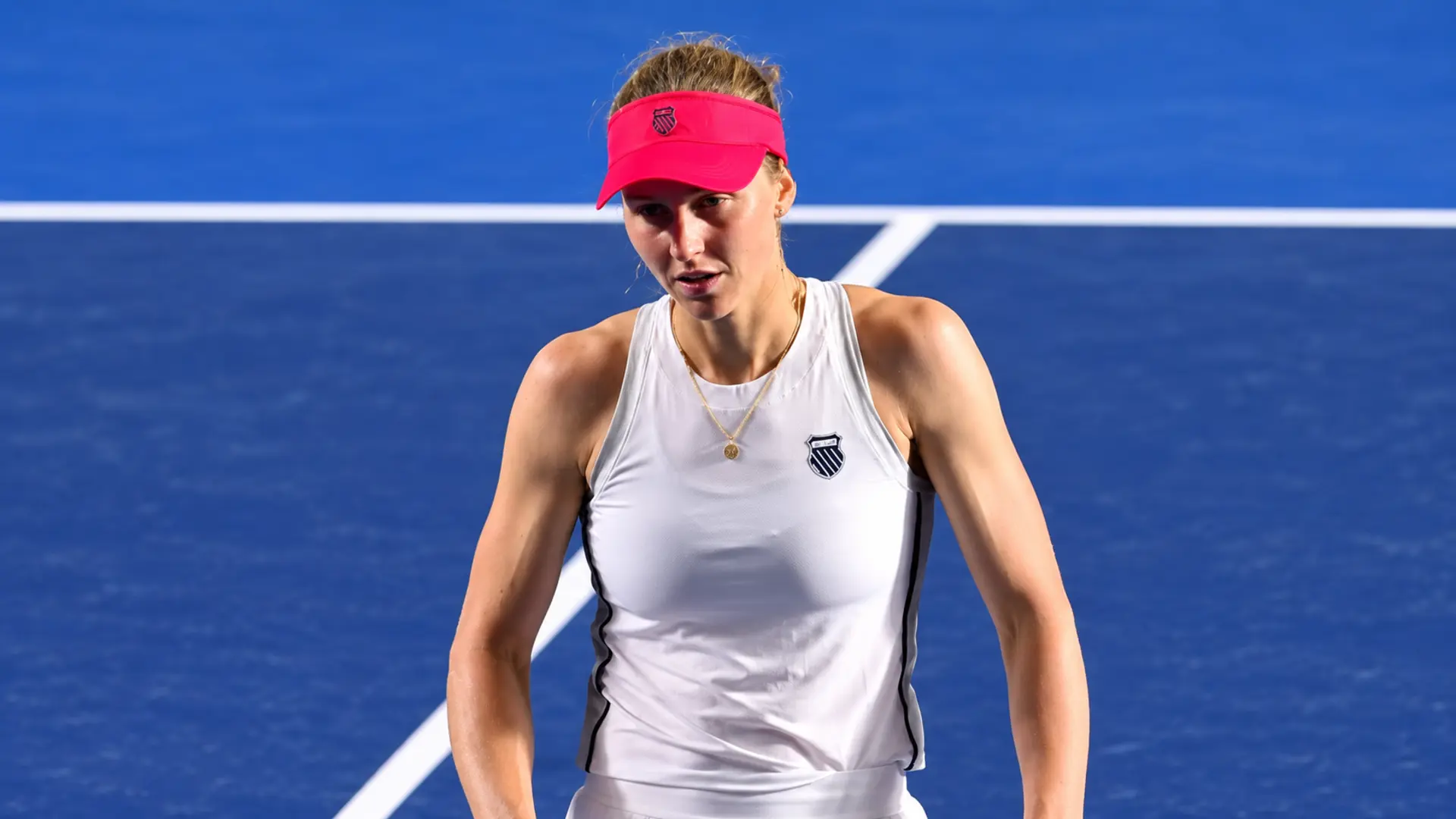
Winning the first set should have been an advantage. For Liudmila Samsonova in 2026, it became an alarmingly unreliable indicator of what would happen next.
Twelve times, she took the opening set and still lost the match.
One of those defeats came at the Australian Open, where she started by handing Laura Siegemund a 6-0 set before going out in the first round.
By her final listed tournament in Hong Kong, the same story was playing out against a qualifier ranked No. 136.
Samsonova began 2026 at world No. 17, the position where she had finished 2025. That previous season brought a Strasbourg final, a Wimbledon quarterfinal and a B grade from RallyHer.
The question was whether she could turn her formidable first strike into more reliable, week-to-week tennis.
Instead, the verified 2026 record ends with her ranked No. 40, 21 wins against 27 played-match losses, and no singles final.
January and the Gulf Expose the Fault Lines
The year initially looked respectable.
Samsonova reached the Brisbane quarterfinals with wins over Emerson Jones and Aliaksandra Sasnovich, before world No. 6 Jessica Pegula beat her 6-3, 7-6(3). But Adelaide brought an opening loss to Marketa Vondrousova, and Melbourne supplied the first unmistakable warning.
Against Siegemund, ranked No. 48, Samsonova won the first set 6-0 and still lost 0-6, 7-5, 6-4. The sequence was especially troubling after her 2025 Australian Open had at least delivered a second-round appearance.
Abu Dhabi offered two commanding wins, over Sofia Kenin and Janice Tjen, followed by a three-set quarterfinal defeat to Hailey Baptiste.
Then came three Gulf and early-spring exits without a win: Magdalena Frech in Doha, Leylah Fernandez in Dubai and, soon afterward, Ashlyn Krueger at Indian Wells. The Fernandez and Krueger defeats both came after Samsonova had won the first set.
The Sunshine Double and Clay Undo Last Year’s Progress
Indian Wells had been a 2025 highlight. Samsonova beat Daria Kasatkina and Jasmine Paolini to reach the quarterfinals before Aryna Sabalenka stopped her.
In 2026, she lost her opening match to world No. 82 Krueger, 3-6, 7-5, 6-2. Miami added a straight-sets loss to Baptiste.
Clay did little to change the direction.
Wildcard Lilli Tagger, ranked No. 117, beat her in Linz.
Samsonova defeated Antonia Ruzic in Stuttgart but fell to Coco Gauff.
In Madrid she beat Tjen before an unplayed walkover against Linda Noskova.
Rome brought a win over Ann Li and a comprehensive 6-3, 6-2 defeat to Anastasia Potapova.
The real damage came at the tournaments where she had raised her clay-court standard in 2025. A Strasbourg finalist and Roland Garros fourth-round player that year, she fell to Kasatkina in the Strasbourg first round of 2026 and then to world No. 170 Jil Teichmann in the opening round in Paris.
There was no sustained clay revival this time, just isolated victories between early departures.
Even Grass Could Not Rescue Her
The contrast grew sharper on grass.
In 2025, Samsonova had beaten Naomi Osaka, Jessica Pegula and Amanda Anisimova during a Berlin semifinal run, then reached the Wimbledon quarterfinals. Grass had seemed the clearest route from dangerous outsider to genuine title contender.
In 2026, world No. 160 Harriet Dart beat her at Queen’s Club after Samsonova won the first set.
Berlin was worse: she opened against Elise Mertens by taking the first set 6-1, then lost the next two 6-3, 6-0. At Bad Homburg, she beat Katerina Siniakova before another lead evaporated against world No. 8 Elina Svitolina.
Wimbledon briefly restored some authority. She dispatched Polina Kudermetova and produced a worthwhile three-set win over No. 15 Diana Shnaider. Yet even that progress ended in a familiar way: Marie Bouzkova came from a set down to win their third-round match 4-6, 7-6(3), 6-4 after three hours and 25 minutes.
It was not a disastrous grass campaign in isolation.
Compared with Berlin and Wimbledon in 2025, however, it represented a clear retreat.
North America Proves the High Level Remains
Samsonova’s best sustained tennis arrived after her ranking had slipped to No. 70 at Washington.
She fought back to beat world No. 22 Madison Keys, then overwhelmed Wang Xinyu 6-2, 6-2. Against Wang, she won 84.8% of first-serve points and posted a 1.61 dominance ratio, a reminder of how efficient her attacking game could still be.
Diana Shnaider ended the quarterfinal run.
Toronto gave her three more victories, including a straight-sets win over Barbora Krejcikova, before world No. 2 Elena Rybakina prevailed 6-4, 4-6, 6-4 in the fourth round.
In Cincinnati, Samsonova survived Yulia Putintseva in three sets and took the opener 6-2 against world No. 4 Gauff, only to lose 6-4, 6-1 in the next two.
Those matches made the season more frustrating, not less. Samsonova was not incapable of troubling elite opposition. She could make Rybakina work, take a set off Gauff and beat an established name such as Keys. What she could not do was turn those performances into a deep run at a major event.
At the US Open, Maya Joint, ranked No. 72, beat her 3-6, 6-2, 6-2.
It was Samsonova’s third first-round Grand Slam exit of the season.
One Last Surge Gives Way to Familiar Exits
Guadalajara provided her only semifinal of 2026.
Samsonova survived a pair of close matches against Elsa Jacquemot and Kayla Day, then earned her standout win of the year: 4-6, 6-2, 7-5 over world No. 10 Marta Kostyuk. But the run stopped against No. 60 Peyton Stearns, 7-6(7), 6-2. Samsonova won only 31.0% of points behind her second serve in that semifinal.
A win over Linda Fruhvirtova in Beijing was followed by a three-set defeat to world No. 8 Karolina Muchova after Samsonova had taken the first set.
Wuhan followed the same smaller pattern: victory over Siniakova, then defeat to No. 6 Svitolina, against whom Samsonova won just 28.0% of second-serve points.
The final stretch was bleak.
Tagger beat her again in Osaka, this time 6-3, 6-3.
Heather Watson, ranked No. 373, defeated her in Tokyo qualifying after Samsonova had won the first set.
In Hong Kong, qualifier Alexandra Shubladze came back to win 5-7, 6-1, 6-2. Samsonova won only 33.3% of second-serve points in that last recorded match.
The late-season ranking recovery from No. 70 to No. 40 mattered. It did not disguise the fact that the closing weeks brought more of the same problems.
Liudmila Samsonova Assessment
The biggest change from 2025 was not the disappearance of Samsonova’s peak level. It was the disappearance of enough substantial results to make that level count.
The 2025 season featured a Strasbourg final, a Berlin semifinal, a Wimbledon quarterfinal and an Indian Wells quarterfinal.
In 2026, her deepest run was a Guadalajara semifinal; she made three quarterfinals but no final, while three of four Slams ended in the first round.
Two year-on-year reversals stand out.
First, the grass-court breakthrough did not hold: Berlin fell from semifinal to first-round defeat, and Wimbledon from quarterfinal to third round.
Second, the clay progress proved fragile: Strasbourg went from final to opening defeat, while Roland Garros went from fourth round to first. Those were not marginal ranking fluctuations. They were substantial losses of tournament performance.
Her 2025 review had identified the second serve and momentum management as the unresolved problems. The 2026 evidence made both harder to excuse. She went 8-17 in completed three-set matches and lost 12 of those after taking the opening set.
Against Stearns in Guadalajara, Svitolina in Wuhan, Watson in Tokyo and Shubladze in Hong Kong, the proportion of second-serve points won fell to 31.0%, 28.0%, 34.1% and 33.3% respectively. These are individual match figures, not a full-season second-serve average, but their recurrence helps explain the fragility.
There were exceptions. Wins over No. 10 Kostyuk and No. 15 Shnaider showed she could still beat high-level opponents, and the Toronto encounter with Rybakina demonstrated real resistance. Yet her record against opponents ranked in the Top 20 was only 2-8. Even the strongest performances were too scattered to change the season’s direction.
The question ahead is no longer merely whether Samsonova can produce top-10-caliber tennis. The 2025 season already answered that. She now needs a second serve and match-management structure strong enough to protect the advantages her first strike creates.
Final Verdict
The expectations were reasonable, not extravagant: build on a No. 17 finish, sustain the improved Slam results and make the explosive tennis less intermittent.
Instead, Samsonova lost more matches than she won, reached no final and finished her recorded schedule at No. 40.
The Guadalajara semifinal, three quarterfinals and victories over Kostyuk and Shnaider prevent the verdict from becoming a complete write-off.
They do not make this an acceptable follow-up to 2025.
We graded her 2025 season B / 3.0.
The sharper decline in Slam performance, grass-court results and deciding-set reliability warrants C- / 1.7 for 2026.
Letter Grade: C-
GPA: 1.7
In 2025, Samsonova’s power made her a threat even when her form was unpredictable.
In 2026, it too often earned her an early lead and nothing more.
Her next step is not finding another spectacular first set.
It is learning how to make that advantage count.