
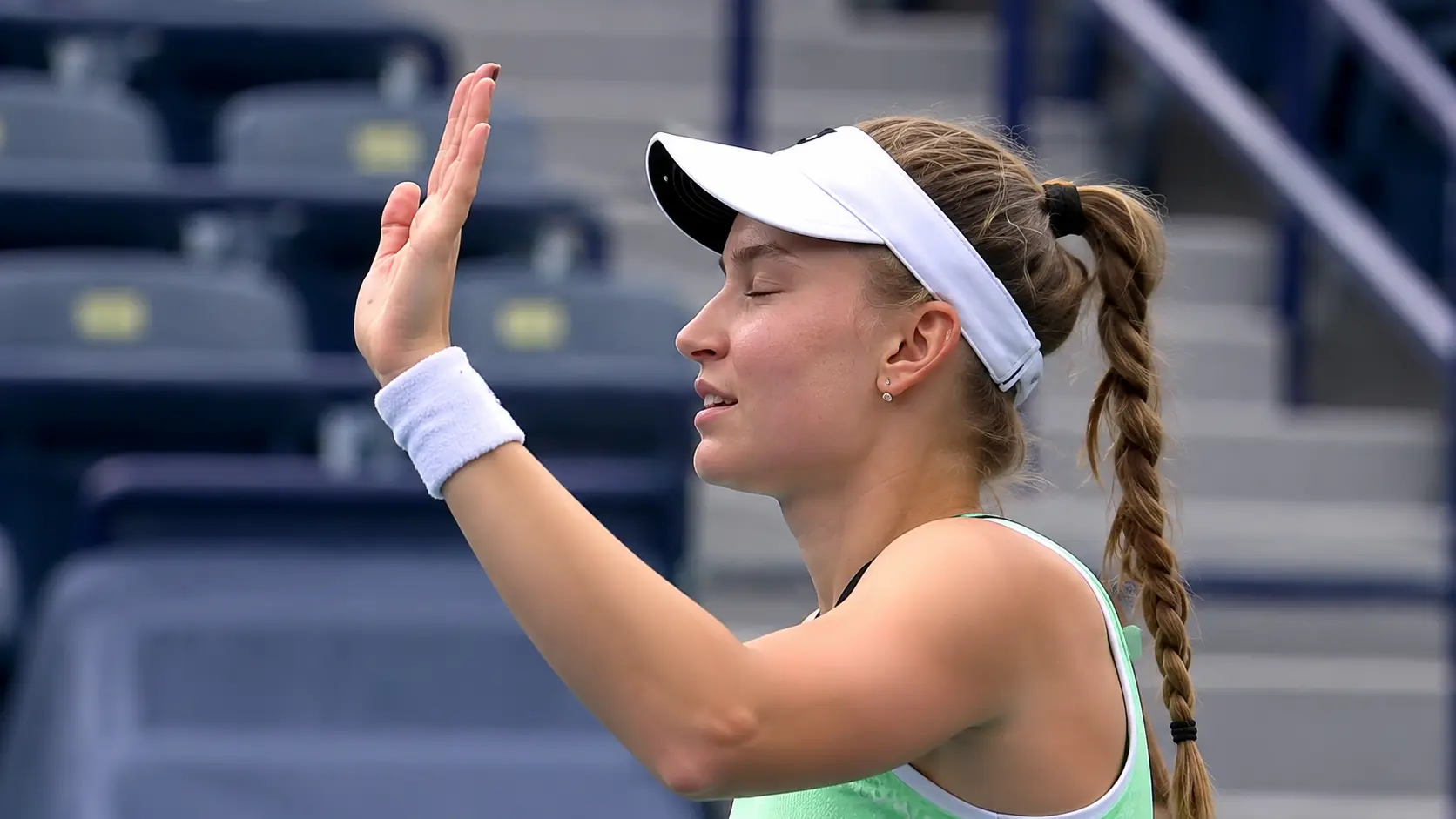
Ask what makes Elena Rybakina dangerous and the answer usually starts with the serve: the effortless power, the free points, the aces that can turn a game before an opponent has settled into it.
Sunday in Toronto demanded something different.
Rybakina beat Liudmila Samsonova 6-4, 4-6, 6-4 in a bruising contest that lasted nearly three hours, surviving long stretches in which her forehand repeatedly broke down and Samsonova looked capable of taking control.
Rybakina still struck 11 aces, but this was not one of those matches she simply blasted through from the baseline. She had to absorb pressure, recover from a 3-0 deficit in the deciding set and keep asking questions after opportunities slipped away.
Samsonova played well enough to win. Rybakina simply refused to make that easy.
Rybakina Edges a First Set Without Ever Taking Control
The opening set established the pattern immediately. Neither player could hold onto momentum for long.
Samsonova held to begin the match before Rybakina leveled at 1-1. Rybakina then broke for 2-1, only for Samsonova to answer immediately. Samsonova moved ahead 3-2 with another break, but Rybakina pulled her back again.
At 4-4, the set remained completely unsettled.
Rybakina finally created some separation when it mattered, holding for 5-4 before closing out the set 6-4.
It was not dominant tennis. Both players had chances to impose themselves, and neither managed it consistently. Rybakina simply played the cleaner final stretch.
Samsonova vs Rybakina – Set 1 Key Stats
| Statistic | Samsonova | Rybakina |
|---|---|---|
| Dominance Ratio | 0.92 | 1.09 |
| Winners | 10 | 11 |
| Unforced Errors | 21 | 14 |
| Serve Rating | 154 | 182 |
| Aces | 1 | 3 |
| Double Faults | 4 | 4 |
| 1st Serve % | 46% (23/50) | 39% (12/31) |
| 1st Serve Points Won | 61% (14/23) | 67% (8/12) |
| 2nd Serve Points Won | 30% (8/27) | 37% (7/19) |
| Break Points Saved | 56% (5/9) | 63% (5/8) |
| Service Games | 20% (1/5) | 40% (2/5) |
| Ace % | 2% | 9.7% |
| Double Fault % | 8% | 12.9% |
| Return Rating | 194 | 233 |
| 1st Return Points Won | 33% (4/12) | 39% (9/23) |
| 2nd Return Points Won | 63% (12/19) | 70% (19/27) |
| Break Points Won | 38% (3/8) | 44% (4/9) |
| Return Games | 60% (3/5) | 80% (4/5) |
| Pressure Points | 41% (12/29) | 59% (17/29) |
| Service Points | 44% (22/50) | 48% (15/31) |
| Return Points | 52% (16/31) | 56% (28/50) |
| Total Points | 47% (38/81) | 53% (43/81) |
| Set 1 Duration | 0h59m | |
The Match Changed in the Second Set
Rybakina broke early to lead 2-1, but Samsonova responded immediately and began striking the ball with greater conviction. Her service games became more comfortable, her court position improved and Rybakina found herself spending more points on the defensive.
Samsonova won four of the next five games and took the set 6-4.
For the first time all afternoon, one player appeared to have established a clear rhythm.
Samsonova vs Rybakina – Set 2 Key Stats
| Statistic | Samsonova | Rybakina |
|---|---|---|
| Dominance Ratio | 1.09 | 0.92 |
| Winners | 5 | 8 |
| Unforced Errors | 14 | 17 |
| Serve Rating | 283 | 258 |
| Aces | 0 | 5 |
| Double Faults | 2 | 1 |
| 1st Serve % | 64% (23/36) | 42% (14/33) |
| 1st Serve Points Won | 78% (18/23) | 79% (11/14) |
| 2nd Serve Points Won | 50% (6/12) | 53% (10/19) |
| Break Points Saved | 100% (2/2) | 67% (2/3) |
| Service Games | 100% (5/5) | 80% (4/5) |
| Ace % | 0% | 15.2% |
| Double Fault % | 5.6% | 3% |
| Return Rating | 121 | 72 |
| 1st Return Points Won | 21% (3/14) | 22% (5/23) |
| 2nd Return Points Won | 47% (9/19) | 50% (6/12) |
| Break Points Won | 33% (1/3) | 0% (0/2) |
| Return Games | 20% (1/5) | 0% (0/5) |
| Pressure Points | 75% (9/12) | 25% (3/12) |
| Service Points | 67% (24/36) | 64% (21/33) |
| Return Points | 36% (12/33) | 33% (12/36) |
| Total Points | 52% (36/69) | 48% (33/69) |
| Set 1 Duration | 0h53m | |
Samsonova Takes a 3-0 Lead as Rybakina’s Forehand Breaks Down
That momentum followed Samsonova into the deciding set.
She raced to a 3-0 lead while Rybakina’s forehand, normally one of the foundations of her baseline game, became increasingly unreliable. Routine balls were mistimed. Attacking opportunities disappeared into errors. Whenever Rybakina hesitated rather than committing fully to the shot, Samsonova was ready to punish her.
Samsonova was also using the front of the court intelligently. She picked the right moments to move forward and finished points with confident volleys instead of allowing Rybakina to reset from the baseline.
At 3-0, the match appeared to be tilting decisively in the Russian’s favor.
Rybakina steadied herself.
She won the next two games to cut the deficit to 3-2, then turned Samsonova’s following service game into the most important battle of the match.
What might have been a routine hold became an extended deuce game. Samsonova’s pre-serve routine grew longer as the pressure mounted, while Rybakina kept forcing her to play another point.
Advantage came and went.
Rybakina eventually broke through to level the set at 3-3.
It was the first moment in the deciding set when Samsonova’s control looked fragile.
Samsonova Escapes at 0-40, but Rybakina Keeps Coming
Rybakina backed up the break with a comfortable hold for 4-3.
Then Samsonova produced an escape of her own.
Serving at 3-4, she fell behind 0-40 and faced three consecutive break points. Rybakina seemed to have the match opening in front of her.
Instead, Samsonova won five straight points, helped by another run of Rybakina forehand errors, and held for 4-4.
It was the kind of game that can reverse an entire match. Rybakina did not allow it to.
She held for 5-4, punctuating the game with an ace, then immediately attacked Samsonova’s serve again.
Three more break points arrived.
On the final point, Samsonova directed the ball toward Rybakina’s backhand, looking for room to relieve the pressure. Rybakina redirected it sharply into the open court.
Samsonova could only watch it go.
After nearly three hours, Rybakina had the match.
Samsonova vs Rybakina – Set 3 Key Stats
| Statistic | Samsonova | Rybakina |
|---|---|---|
| Dominance Ratio | 0.86 | 1.16 |
| Winners | 9 | 7 |
| Unforced Errors | 18 | 15 |
| Serve Rating | 184 | 224 |
| Aces | 0 | 3 |
| Double Faults | 3 | 1 |
| 1st Serve % | 57% (21/37) | 63% (19/30) |
| 1st Serve Points Won | 57% (12/21) | 63% (12/19) |
| 2nd Serve Points Won | 33% (6/18) | 36% (4/11) |
| Break Points Saved | 67% (4/6) | 0% (0/2) |
| Service Games | 40% (2/5) | 60% (3/5) |
| Ace % | 0% | 10% |
| Double Fault % | 8.1% | 3.3% |
| Return Rating | 241 | 203 |
| 1st Return Points Won | 37% (7/19) | 43% (9/21) |
| 2nd Return Points Won | 64% (7/11) | 67% (12/18) |
| Break Points Won | 100% (2/2) | 33% (2/6) |
| Return Games | 40% (2/5) | 60% (3/5) |
| Pressure Points | 77% (10/13) | 23% (3/13) |
| Service Points | 46% (17/37) | 53% (16/30) |
| Return Points | 47% (14/30) | 54% (20/37) |
| Total Points | 46% (31/67) | 54% (36/67) |
| Set 3 Duration | 1h03m | |
The Numbers Reflect Just How Little Separated Them
The scoreboard was tight because the match itself was tight.
Rybakina won 111 of the 216 points played, compared with Samsonova’s 105. Her dominance ratio was 1.08 to Samsonova’s 0.92, another indication that there was little sustained separation between them.
Samsonova won 57 percent of the pressure points, compared with Rybakina’s 43 percent, yet could not turn that advantage into the victory.
One statistic did give Rybakina breathing room: the serve.
Even on an afternoon when it did not overwhelm Samsonova from start to finish, Rybakina produced 11 aces to Samsonova’s one. Those free points mattered, particularly on a day when her forehand was creating problems of its own.
But the match was decided less by one dominant statistic than by Rybakina’s ability to keep competing after the momentum had repeatedly moved against her.
She trailed 3-0 in the deciding set. She watched three break points disappear at 4-3. Her forehand never became fully trustworthy.
She still found a way through.
Rybakina Wins Without Looking Like the Best Version of Herself
That may be the most significant part of the afternoon.
Rybakina’s reputation has been built around first-strike tennis. When the serve is flowing and the forehand is clean, few players on tour can take time away from an opponent as quickly as she can.
Toronto showed the other side of her game.
She kept creating pressure even after failing to capitalize on earlier opportunities. She recovered from a poor start to the third set without rushing. And when Samsonova escaped from 0-40 at 3-4, Rybakina responded by holding serve and immediately generating three more chances.
That is not spectacular tennis. It is winning tennis.
Samsonova leaves Toronto having pushed one of the game’s most dangerous players to the edge. She served with increasing confidence through the middle of the match, attacked the net effectively and was within three games of completing the comeback.
What she could not do was finish Rybakina off.
Against a player willing to keep returning to the same door until it finally opens, that can be the hardest part.
Rybakina moves into the quarterfinals, where she will face the winner of Naomi Osaka and Leylah Fernandez.