
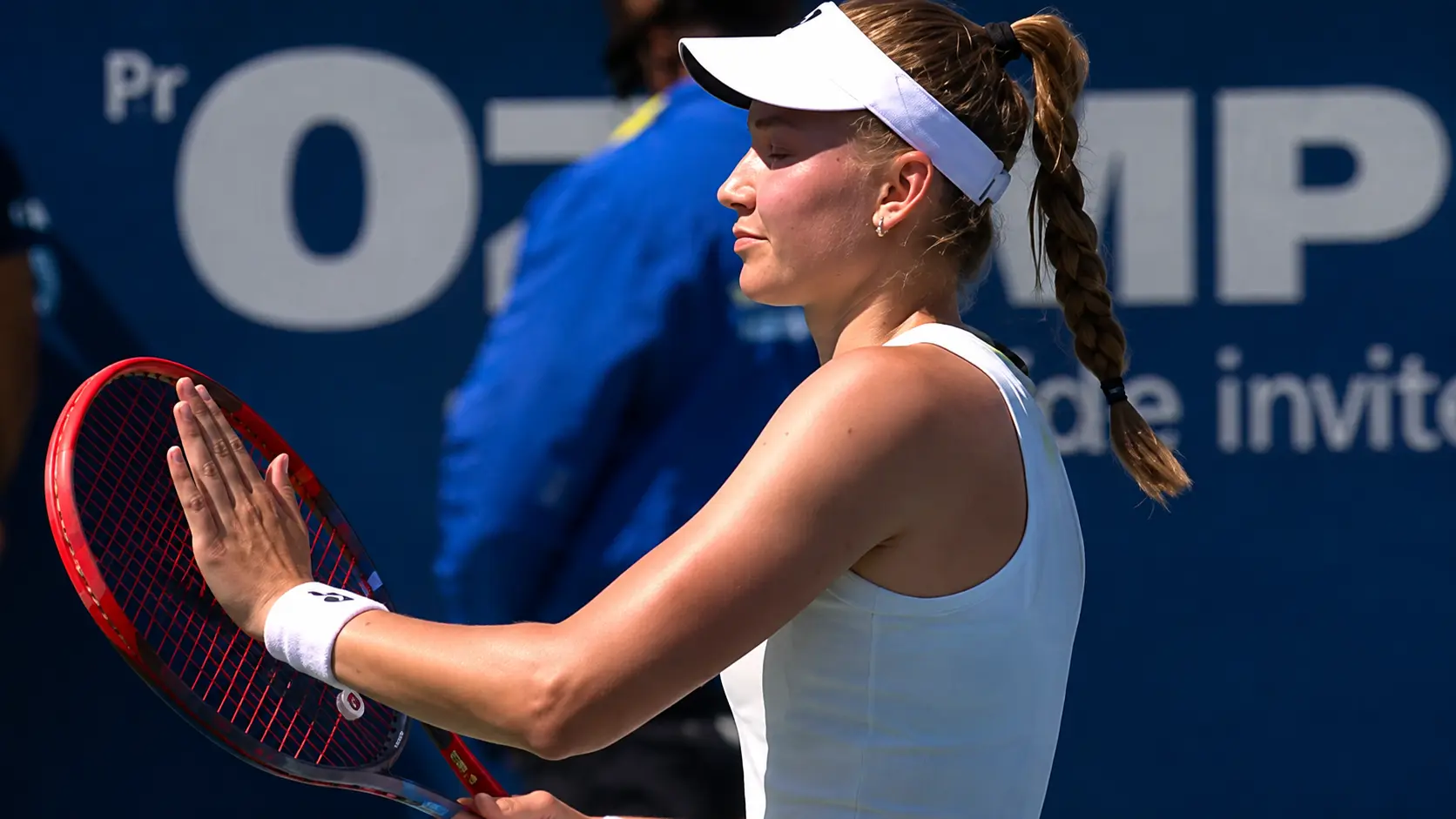
Elena Rybakina won two sets against Daria Kasatkina in Toronto. She just couldn’t win them in a row.
Rybakina advanced 6-3, 5-7, 6-4. It’s a scoreline that’s become familiar this season, and not always in a good way. She’s now dropped the second set after winning the first seven times in 2026. Toronto was only the third of those seven where she actually completed the recovery. The other four cost her the match outright.
Kasatkina, for her part, arrived in Toronto playing her first tournament back. She married her longtime partner, Natalia Zabiiako, at a seaside ceremony in Greece last month. She didn’t play like someone still on the honeymoon.
Rybakina Races to 3-0, and Kasatkina Digs In
Rybakina held her opening service game comfortably, then went to work on Kasatkina’s.
It took a couple of chances to get there. Rybakina had to convert her second break point of the game before the score read 2-0. She followed it with a hold to love-and-a-bit for 3-0. For a few minutes, this looked like it might get out of hand fast.
Kasatkina had other ideas.
Serving to avoid going down 4-0, she played the game of the set. The score swung through six different game points and just as many deuces. Kasatkina finally held, surviving what had briefly threatened to become a bagel. It was the kind of hold that barely shows up as anything more than “3-1” on a scoreboard. It changed the tone of the set completely.
Rybakina Survives Break Points of Her Own to Close It Out
The set settled into a rhythm after that, one Kasatkina couldn’t quite break.
Rybakina held for 4-1. Kasatkina held again for 4-2, still finding a way through her own service games even as Rybakina cruised through hers. At 4-2, serving for a two-break cushion, Rybakina ran into her own long game. She saved break points before finally closing it out. Two break points faced, two break points saved, still 5-2. Kasatkina held once more for 5-3. Rybakina served out the set 6-3 without dropping serve a single time all set.
The headline number was one break against the Australian’s serve. The story underneath it was two players who each had to work considerably harder for their holds than the scoreline let on.
Kasatkina vs Rybakina – Set 1 Key Stats
| Statistic | Kasatkina | Rybakina |
|---|---|---|
| Dominance Ratio | 0.72 | 1.40 |
| Winners | 6 | 23 |
| Unforced Errors | 5 | 17 |
| Serve Rating | 244 | 282 |
| Aces | 0 | 5 |
| Double Faults | 3 | 3 |
| 1st Serve % | 62% (21/34) | 47% (18/38) |
| 1st Serve Points Won | 67% (14/21) | 83% (15/18) |
| 2nd Serve Points Won | 46% (6/13) | 50% (11/22) |
| Break Points Saved | 83% (5/6) | 100% (2/2) |
| Service Games | 75% (3/4) | 100% (5/5) |
| Ace % | 0% | 13.2% |
| Double Fault % | 8.8% | 7.9% |
| Return Rating | 67 | 129 |
| 1st Return Points Won | 17% (3/18) | 33% (7/21) |
| 2nd Return Points Won | 50% (11/22) | 54% (7/13) |
| Break Points Won | 0% (0/2) | 17% (1/6) |
| Return Games | 0% (0/5) | 25% (1/4) |
| Pressure Points | 53% (10/19) | 47% (9/19) |
| Service Points | 56% (19/34) | 68% (26/38) |
| Return Points | 32% (12/38) | 44% (15/34) |
| Total Points | 43% (31/72) | 57% (41/72) |
| Set 1 Duration | 0h46m | |
Rybakina Breaks Immediately, Then Watches the Lead Vanish
The second set didn’t wait to get interesting.
Rybakina broke to open it, 1-0, the kind of start that could have put the match away early. Kasatkina broke straight back. Both players held through the next two games to level at 2-2. Then Kasatkina found another gear. She held for 3-2 and broke again for 4-2, suddenly two games clear and firmly in control of a set that had opened with Rybakina in front.
Rybakina wasn’t finished.
The Australian champion broke back immediately to close to 4-3, then held to level the set at 4-4. Kasatkina held again for 5-4. Rybakina held again to tie it at 5-5. Five times in this set alone, the lead changed hands or got pulled back level. Nobody could hold a two-game cushion for more than a single game.
Kasatkina Closes It Out With the Break That Mattered Most
At 5-5, serving to stay in touching distance, Rybakina finally couldn’t hold the line.
Kasatkina held to lead 6-5, then broke Rybakina’s serve to close the set out 7-5. It was her third break of Rybakina’s serve in the set, against two breaks the other way.
A set that started with Rybakina up a break inside the first two minutes had somehow gone entirely the other way.
The pattern is familiar: whenever Rybakina gains the upper hand in a close match against a player outside the top 10, her level seemingly drops and the advantage slips away. A thing that should not happen to a World No.2 at all.
Kasatkina vs Rybakina – Set 2 Key Stats
| Statistic | Kasatkina | Rybakina |
|---|---|---|
| Dominance Ratio | 1.19 | 0.84 |
| Winners | 2 | 21 |
| Unforced Errors | 7 | 23 |
| Serve Rating | 247 | 204 |
| Aces | 1 | 7 |
| Double Faults | 2 | 7 |
| 1st Serve % | 65% (24/37) | 43% (18/42) |
| 1st Serve Points Won | 54% (13/24) | 67% (12/18) |
| 2nd Serve Points Won | 62% (8/13) | 44% (11/25) |
| Break Points Saved | 50% (2/4) | 40% (2/5) |
| Service Games | 67% (4/6) | 50% (3/6) |
| Ace % | 2.6% | 16.7% |
| Double Fault % | 5.3% | 16.7% |
| Return Rating | 199 | 167 |
| 1st Return Points Won | 33% (6/18) | 46% (11/24) |
| 2nd Return Points Won | 56% (14/25) | 38% (5/13) |
| Break Points Won | 60% (3/5) | 50% (2/4) |
| Return Games | 50% (3/6) | 33% (2/6) |
| Pressure Points | 63% (10/16) | 38% (6/16) |
| Service Points | 59% (22/37) | 50% (21/42) |
| Return Points | 50% (21/42) | 43% (16/37) |
| Total Points | 54% (43/79) | 47% (37/79) |
| Set 2 Duration | 0h56m | |
Rybakina Breaks Once in the Third, and This Time It’s Enough
The decider opened with Kasatkina holding for 1-0, a small reminder that set two hadn’t fully left her game.
Rybakina responded by holding her own opener, then found the break that would define the set. Serving at 1-1, Kasatkina dropped her serve to fall behind 1-2. Rybakina held again to push the lead to 3-1. Kasatkina wasn’t done competing. She held for 3-2, then again for 4-3, and again for 5-4, refusing to let the set get away from her on the scoreboard even as she couldn’t find another look at Rybakina’s serve.
That’s the number that mattered most: one break, created once, defended five times.
Rybakina served out the match at 5-4, closing the third set 6-4. She didn’t face a single break point of her own the entire set. Whatever had gone wrong in set two, for one set at least, it simply didn’t return.
Kasatkina vs Rybakina – Set 3 Key Stats
| Statistic | Kasatkina | Rybakina |
|---|---|---|
| Dominance Ratio | 1.02 | 0.98 |
| Winners | 7 | 23 |
| Unforced Errors | 3 | 18 |
| Serve Rating | 289 | 265 |
| Aces | 3 | 3 |
| Double Faults | 1 | 6 |
| 1st Serve % | 74% (25/34) | 61% (28/46) |
| 1st Serve Points Won | 60% (15/25) | 64% (18/28) |
| 2nd Serve Points Won | 73% (8/11) | 43% (10/23) |
| Break Points Saved | 67% (2/3) | 100% (5/5) |
| Service Games | 80% (4/5) | 100% (5/5) |
| Ace % | 8.8% | 6.5% |
| Double Fault % | 2.9% | 13% |
| Return Rating | 93 | 120 |
| 1st Return Points Won | 36% (10/28) | 40% (10/25) |
| 2nd Return Points Won | 57% (13/23) | 27% (3/11) |
| Break Points Won | 0% (0/5) | 33% (1/3) |
| Return Games | 0% (0/5) | 20% (1/5) |
| Pressure Points | 37% (7/19) | 63% (12/19) |
| Service Points | 62% (21/34) | 61% (28/46) |
| Return Points | 39% (18/46) | 38% (13/34) |
| Total Points | 49% (39/80) | 51% (41/80) |
| Set 3 Duration | 0h53m | |
A Pattern That’s Cost Her More Than It’s Saved Her
The habit is real, and the record on it isn’t flattering.
Rybakina won the first set and lost the second six times before Toronto. It happened too many times:
- at Wimbledon against Lois Boisson
- at Roland Garros against Yuliia Starodubtseva
- in the Rome quarter-final against Elina Svitolina
- in the Indian Wells final against Aryna Sabalenka
- in the third round at Indian Wells against Hailey Baptiste
- at Dubai against Antonia Ruzic.
She only recovered to win twice, against Boisson and Baptiste. The other four times, the match slipped away entirely, including a retirement against Ruzic and a final lost to Sabalenka.
Iga Swiatek’s rough 2026 has mostly shown up as outright losses to lower-ranked players. Aryna Sabalenka, not always even at her best, tends to simply overwhelm opponents in straight, convincing sets.
Rybakina’s issue looks different, and more precarious than either. The lost second set keeps showing up. Whether she survives it or not has been close to a coin flip all year. Toronto landed on the right side of that flip.
Kasatkina Made Her Earn Every Bit of It
The numbers tell a stranger story than the scoreline suggests.
Rybakina finished with 67 winners to Kasatkina’s 15, the kind of gap that usually points to a one-sided match. But she also made 58 unforced errors to Kasatkina’s 15. Their dominance ratios ended up almost identical, 1.04 to 0.97.
This wasn’t Rybakina cruising past an overmatched opponent. It was a high-wire, high-error performance from the Kazakh, one that happened to produce enough winners to survive its own mistakes. Kasatkina, for her part, simply didn’t give her many free points to work with.
Kasatkina’s serve told a similar story. She held 73% of her own service games, not far behind Rybakina’s 81%. She actually won more of her second-serve return points than Rybakina managed.
For a player just back from her wedding in Greece, facing a two-time Grand Slam champion, that’s a genuinely strong week one performance.
Two Different Stories, One Winner
Rybakina moves through carrying a scoreline that flatters her more than the match itself did.
Kasatkina moves on with her head held high. She won a set off a major champion, and her performance suggests her time away from the tour hasn’t cost her much.
For Rybakina, the lost second set keeps coming back to haunt her, and the odds of surviving it have not been in her favor this year. Toronto went her way, but the path to becoming World No. 1 one day remains complicated.