
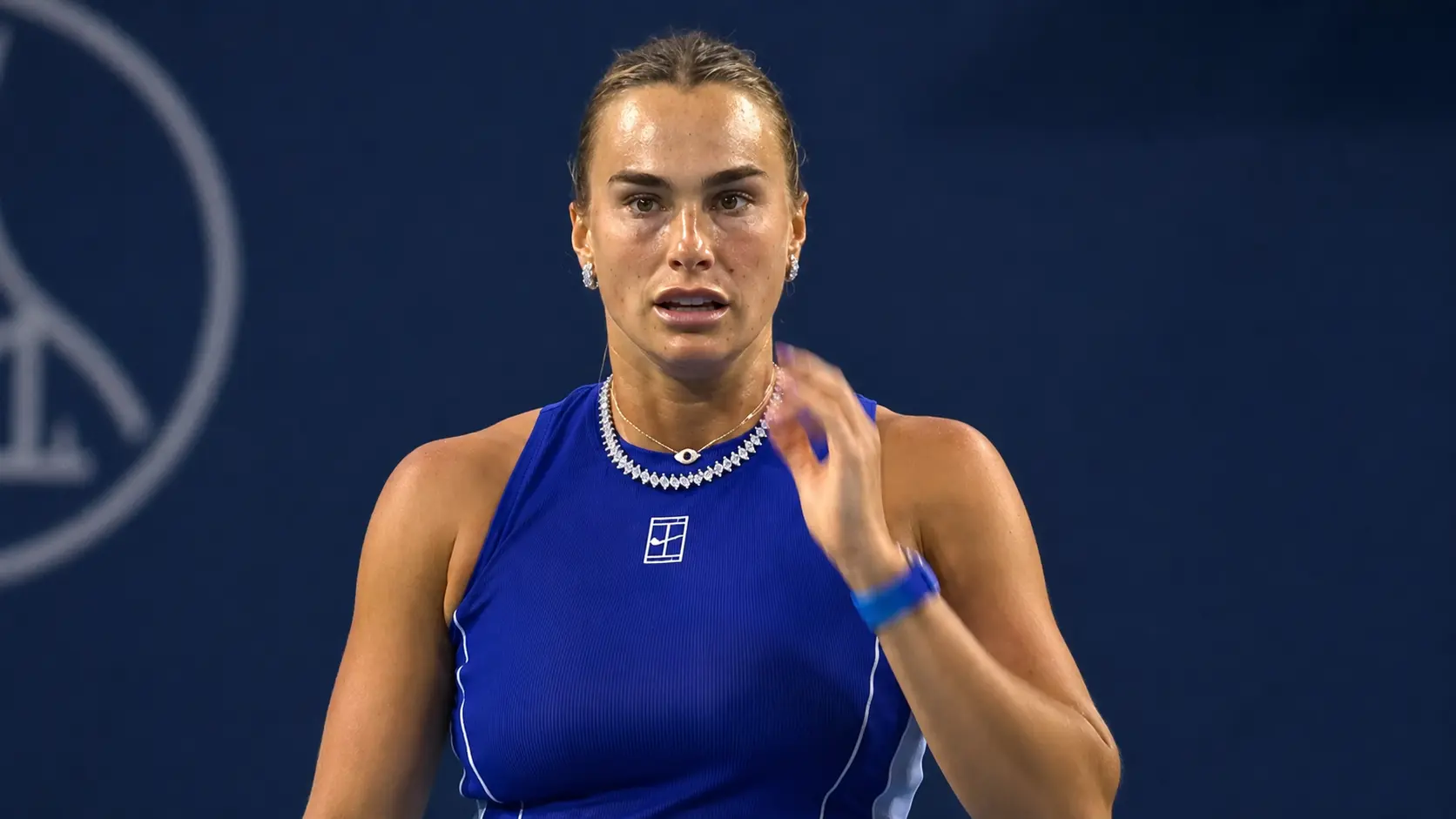
A first-round loss to Naomi Osaka at Wimbledon would read as a minor blip for most players. For the world No. 1, it briefly interrupted one of the more remarkable seasons the tour has seen in years.
Sabalenka beat Moyuka Uchijima 6-3, 6-3 in her Toronto opener. It won’t make headlines on its own, but it’s exactly the kind of routine follow-up win a No. 1 needs after an off for several weeks.
Her 2026 season already includes an Australian Open final and a third straight Brisbane title.
It also includes a genuine piece of tennis history. Her Indian Wells-Miami double this spring made her the first player, man or woman, to hold the Sunshine Double in both singles and doubles. She’d already won the doubles version back in 2019. She’s held the No. 1 ranking for 92 straight weeks. A single early exit doesn’t undo any of that.
It also doesn’t mean the match itself was a formality.
Sabalenka Survives an Early Break to Take Set One
The opener started with a jolt in the wrong direction.
Uchijima broke Sabalenka’s very first service game, a long deuce battle that swung on repeated advantage points. It was the kind of start that could have set an uncomfortable tone. Instead, Sabalenka broke straight back to level at 2-2. She took control from there, winning three of the next four games to close out the set 6-3.
By the finish, the shaky opening game looked like an outlier rather than a warning sign.
Four Straight Breaks Open Set Two, Before Sabalenka Steadies
If set one had one wobble, set two started with four.
Uchijima was broken to open the set. Sabalenka was broken right back. Uchijima’s next service game went the same way. She was broken again. Sabalenka then dropped her own serve a second time to level at 2-2. Neither player held a service game for the first four games combined. It was scrappy, occasionally chaotic tennis, with the set’s shape changing every few minutes.
Sabalenka settled it from there. She held to lead 3-2, then broke Uchijima again to push out to 4-2. She closed out the match by breaking one final time, completing a 6-3, 6-3 win. In total, she broke Uchijima’s serve six times across two sets. Uchijima managed the reverse three times.
The Numbers Show a Win That Wasn’t Always Clean
Sabalenka’s dominance ratio of 1.36 to Uchijima’s 0.73 tells the basic story of the match. So does the total points count: Sabalenka took 70 of 123 points played, a clear if not overwhelming margin.
Look closer, though, and the numbers hint at something else. This is the kind of rust a top player might carry into a first match back from a shock loss. Sabalenka actually committed more unforced errors than Uchijima did, 19 to 12. Her six double faults were three times Uchijima’s total. Her first-serve percentage sat at a modest 59%.
None of that stopped her from winning comfortably, because when her shots did land, they landed with real weight. Her serve rating of 231 dwarfed Uchijima’s 175, and her first-serve-points-won figure of 74% comfortably beat her opponent’s 65%.
Even the pressure points were closer than the final score suggests, 53% to 47%. This was a win built on class showing up in the moments that mattered most, even on a day when the rest of the game wasn’t fully sharp yet.
Uchijima Made Her Work For It
Give Uchijima her due.
The Japanese No. 2, currently ranked around No. 111, has had a genuinely good season of her own: two WTA 125 titles already in 2026, in Saint-Malo and Antalya, and a career-high ranking of No. 47 that shows the level she’s capable of touching. None of that shows up on a seeding sheet next to the world No. 1’s name, but it showed up on court.
The opening four games of set two were all breaks, Sabalenka’s serve going twice and Uchijima’s serve going twice right back. That’s not one player imposing herself on the other. That’s two players trading blows, neither able to find a foothold. For a stretch of set two, Uchijima had every reason to believe this match could turn.
What actually separated them was Sabalenka’s serve rating almost doubling her opponent’s, and a first-serve conversion rate that turned routine points into won ones far more often than Uchijima could manage. Take that gap away and this scoreline looks very different. Uchijima didn’t have it.
Against a No. 1 who’s completed a Sunshine Double no one else in tennis history has managed, that gap was always going to be the difference eventually.
It just took longer to show up than the final score suggests.