
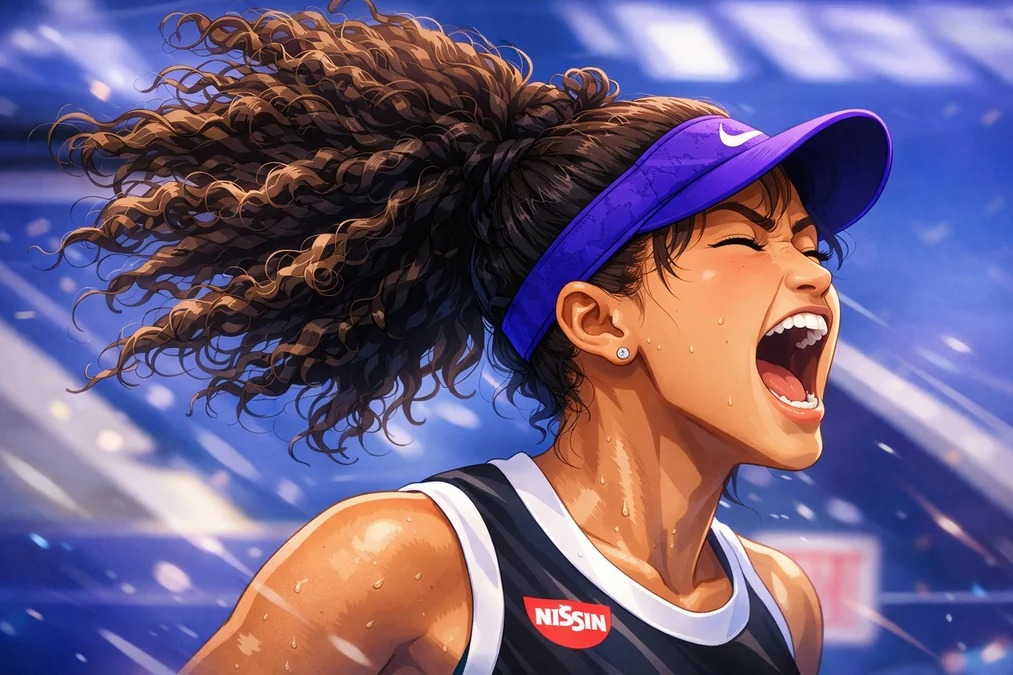
Naomi Osaka has spent much of her comeback trying to rebuild the old danger around her name.
At Wimbledon, against the world No. 1, she found it.
Osaka stunned Aryna Sabalenka 6-2, 7-6(2) to reach the Wimbledon quarter-finals, producing one of the cleanest and most significant wins of her return.
Sabalenka arrived unbeaten in sets at the tournament after wins over Teodora Kostovic, McCartney Kessler and Jelena Ostapenko. She left after being out-served, out-hit in the biggest phases and rushed out of her comfort zone by a player who looked fully at home on the Centre Court grass.
This was not a lucky escape.
Osaka won 70 of the 127 points. She held all 10 of her service games. She saved both break points she faced. She hit 21 winners to Sabalenka’s 15 and finished with a dominance ratio of 1.52, compared with Sabalenka’s 0.66.
The quarter-final is now set.
Osaka will face Karolina Muchova, who beat Barbora Krejcikova 7-5, 5-7, 6-3 in an all-Czech battle.
Osaka Breaks the Match Open Early
Sabalenka held to love in the opening game, but that was about as comfortable as the first set would get for her.
Osaka held for 1-1, then started finding Sabalenka’s service games with alarming speed. She broke for 3-1 after Sabalenka had chances to hold, then consolidated for 4-1. The scoreboard moved quickly because Osaka was not letting Sabalenka dictate the first strike often enough.
By 5-1, the set had already tilted.
Sabalenka held once more for 2-5, but Osaka served out the opener with authority. The first set ended 6-2, and the tone was clear: the opponent on the other side of the net was being made to chase.
Sabalenka vs Osaka – Set One Stats
| Statistic | Sabalenka | Osaka |
|---|---|---|
| Dominance Ratio | 0.79 | 1.27 |
| Winners | 6 | 8 |
| Unforced Errors | 10 | 8 |
| Serve Rating | 232 | 296 |
| Aces | 2 | 3 |
| Double Faults | 1 | 1 |
| 1st Serve % | 82% (18/22) | 61% (17/28) |
| 1st Serve Points Won | 61% (11/18) | 71% (12/17) |
| 2nd Serve Points Won | 38% (3/8) | 62% (8/13) |
| Break Points Saved | 0% (0/2) | 100% (2/2) |
| Service Games | 50% (2/4) | 100% (4/4) |
| Ace % | 9.1% | 10.7% |
| Double Fault % | 4.5% | 3.6% |
| Return Rating | 67 | 252 |
| 1st Return Points Won | 29% (5/17) | 39% (7/18) |
| 2nd Return Points Won | 38% (5/13) | 63% (5/8) |
| Break Points Won | 0% (0/2) | 100% (2/2) |
| Return Games | 0% (0/4) | 50% (2/4) |
| Pressure Points | 13% (1/8) | 88% (7/8) |
| Service Points | 59% (13/22) | 68% (19/28) |
| Return Points | 32% (9/28) | 41% (9/22) |
| Net Points | 100% (1/1) | 100% (2/2) |
| Total Points | 44% (22/50) | 56% (28/50) |
| Set 1 Duration | 0h32m | |
Osaka’s service rhythm was central to the set, but the bigger story was how little Sabalenka could do on return. Across the match, Sabalenka won only 23 percent of return points.
That is a brutal number against any opponent.
Against Osaka on grass, it is almost fatal.
Sabalenka Pushes the Second Set, but Osaka Owns the Tiebreak
The second set was far tighter, but it never felt as if Osaka had lost control of her own service games.
Sabalenka held first and kept edging ahead on the scoreboard. She had break points at 3-2, the kind of window that could have changed the match’s emotional direction. Osaka saved them and held for 3-3.
From there, the set became a hold-by-hold chase.
Sabalenka led 4-3, then 5-4, then 6-5. Each time, Osaka answered. She held to love for 1-1, held smoothly for 3-3, and kept the match away from the messy exchanges Sabalenka needed.
Once the tiebreak arrived, Osaka was ruthless.
Sabalenka led 1-0, but Osaka took control quickly. She moved ahead 4-1, then 6-1, earning five match points. Sabalenka saved one, but Osaka finished it 7-2.
A set that had stayed close on the scoreboard ended with no doubt at all.
Sabalenka vs Osaka – Set Two Stats
| Statistic | Sabalenka | Osaka |
|---|---|---|
| Dominance Ratio | 0.48 | 2.10 |
| Winners | 9 | 13 |
| Unforced Errors | 12 | 17 |
| Serve Rating | 296 | 336 |
| Aces | 3 | 5 |
| Double Faults | 0 | 0 |
| 1st Serve % | 57% (25/44) | 82% (27/33) |
| 1st Serve Points Won | 68% (17/25) | 89% (24/27) |
| 2nd Serve Points Won | 68% (15/22) | 60% (6/10) |
| Break Points Saved | 100% (2/2) | – (0/0) |
| Service Games | 100% (6/6) | 100% (6/6) |
| Ace % | 6.8% | 15.2% |
| Double Fault % | 0% | 0% |
| Return Rating | 51 | 64 |
| 1st Return Points Won | 11% (3/27) | 32% (8/25) |
| 2nd Return Points Won | 40% (4/10) | 32% (7/22) |
| Break Points Won | – (0/0) | 0% (0/2) |
| Return Games | 0% (0/6) | 0% (0/6) |
| Pressure Points | 67% (4/6) | 33% (2/6) |
| Service Points | 68% (30/44) | 85% (28/33) |
| Return Points | 15% (5/33) | 32% (14/44) |
| Net Points | 100% (4/4) | 75% (3/4) |
| Total Points | 45% (35/77) | 55% (42/77) |
| Set 2 Duration | 0h57m | |
The Serve Numbers Were Ruthless
Osaka’s serving performance was elite.
She hit eight aces, won 87 percent of her first-serve points and 61 percent behind her second serve. Her serve rating was 314, far ahead of Sabalenka’s 266. She did not drop serve once.
That is the sort of serving day that makes Osaka one of the most dangerous players in women’s tennis on fast courts.
But the win was not just about the serve.
Osaka also did more damage in return games than Sabalenka. She won 35 percent of return points, compared with Sabalenka’s 23 percent, and converted two of her four break points. Sabalenka went 0-for-2 on break points.
Osaka protected her own serve almost perfectly and still found enough pressure on return to crack Sabalenka twice. Sabalenka, by contrast, kept looking for a way in and rarely found one.
Sabalenka Admits She Was Not at No. 1 Level
Sabalenka did not dress up the defeat afterward.
Asked about her status as the world No. 1, she separated ranking from level.
“By now I am world No. 1. Level-wise today I wasn’t world No. 1,” Sabalenka said. “Yesterday I was world No. 1. I feel like I just… I don’t even want to think about ranking at this point. I just want to go get completely drunk, forget about tennis, and try to get in better shape.”
It was a blunt answer, and very Sabalenka: frustrated, honest, and not trying to hide the scale of the disappointment.
She also admitted that she had little emotional space left after the loss.
“No emotions,” Sabalenka said. “Just know that I can handle myself much better than last year. So obviously, guys, if you were expecting something really fun, it’s not going to happen. Probably just going to be short answers. I messed it up this year. Next year I’ll try a little bit better.”
The defeat ends one of her strongest early Wimbledon runs before it could become a second-week surge. It was also a rare straight-sets Grand Slam loss for a player who has made a habit of forcing major matches deep.
Osaka’s Win Feels Bigger Than a Quarter-Final Spot
For Osaka, this is one of the biggest victories of her comeback.
She had already reached the second week of Roland Garros for the first time last month. Now she has her first Wimbledon quarter-final, and she has reached it by beating the world No. 1 in straight sets.
That gives the win extra weight.
Osaka has always had the power and serve to trouble anyone, but this match showed more than raw ball-striking. It showed discipline. She did not chase unnecessary drama. She did not give Sabalenka repeated return chances. She kept the scoreboard pressure steady and then played the tiebreak like a player who knew exactly where the finish line was.
The Centre Court win also changes the conversation around her grass game.
For years, Osaka’s strongest Grand Slam identity was built around hard courts. Wimbledon had never quite become her stage in the same way. This run is rewriting that.
Muchova Waits in a Quarter-Final Full of Style Contrast
The next test is fascinating.
Osaka will face Muchova, who beat Krejcikova in three sets to win the Czech showdown and reach the quarter-finals. Muchova brings a very different problem from Sabalenka. She will not simply trade power and dare Osaka to hit through her. She will change height, use slice, move forward, vary rhythm and make Osaka solve more than one pattern.
That makes the quarter-final one of the best matchups of the women’s draw.
Osaka brings serve, first strike and the confidence of beating the world No. 1.
Muchova brings variety, feel and grass-court intelligence.
One player just took out the top seed with power and control. The other survived a three-set tactical battle against a former Wimbledon champion in Krejcikova.
The quarter now has a completely different feel.
Sabalenka was the No. 1 seed. Ostapenko was already gone. Kasatkina was gone. Krejcikova is gone too.
Osaka and Muchova are left to decide who takes over the section.
Wimbledon Gets the Osaka Version Everyone Was Waiting For
This was the Osaka version the comeback had been waiting to see on grass.
The serve was there. The return pressure was there. The emotional control was there. The finish was ruthless. Against Sabalenka, she did not look like a player borrowing confidence for one afternoon. She looked like someone starting to own the tournament.
That is dangerous for everyone left.
Osaka has not won Wimbledon. Until now, she had not even reached the quarter-finals. But after beating Sabalenka 6-2, 7-6(2), the question around her has changed.
It is no longer whether she can make grass work.
It is how far this version of Osaka can go.