
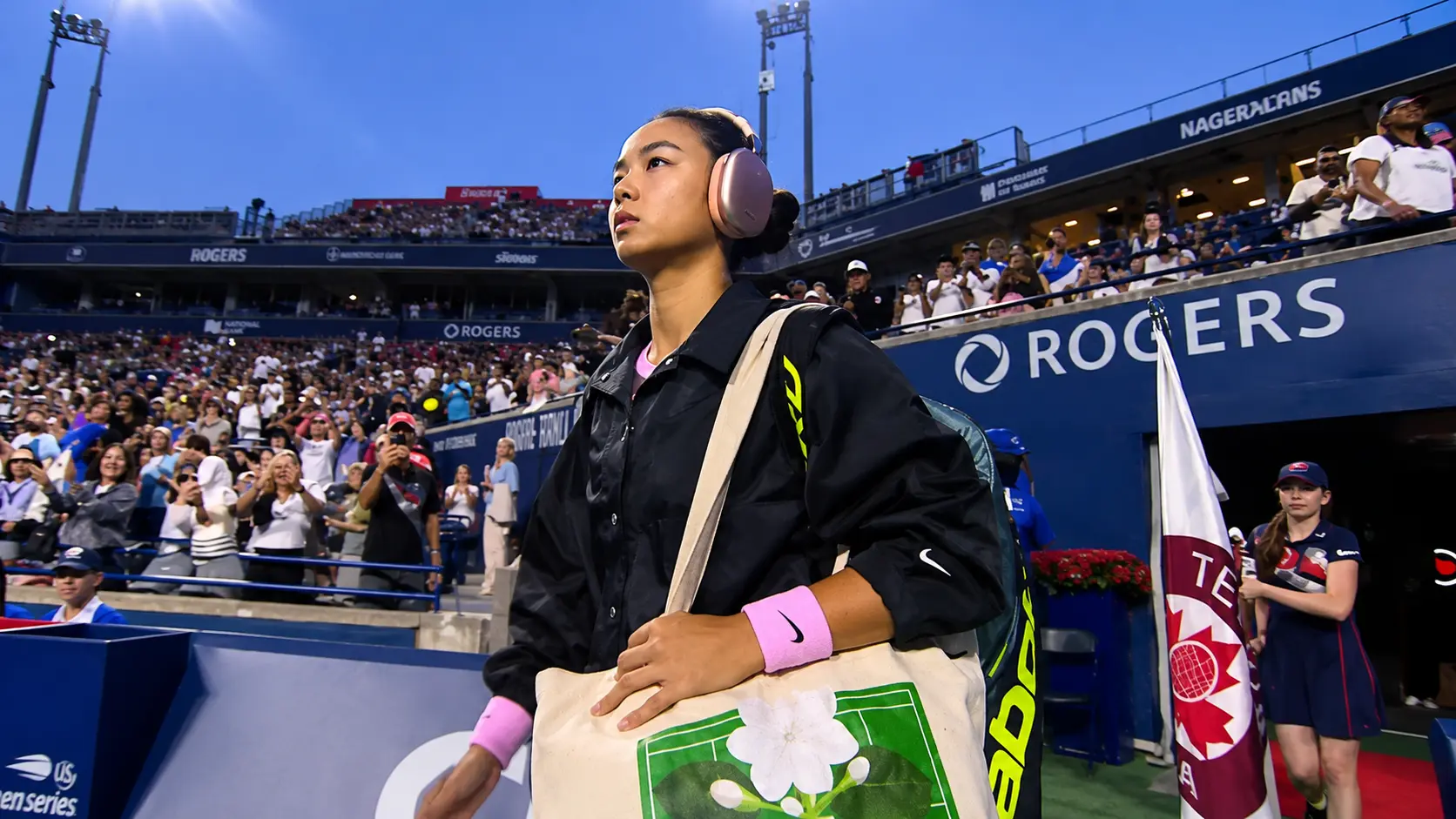
Try this thought experiment for a second. Imagine two or three more players in women’s tennis who could sell out a Centre Court session in the second or third round on their own. Not on the strength of their seeding. Just because of who they are. The sport wouldn’t just be healthier. It would look completely different.
Right now, there’s exactly one player doing that, and her name is Alexandra Eala.
She faces Belinda Bencic on Sunday, August 9, in the evening session under the Toronto floodlights, following the match between Leylah Fernandez and Naomi Osaka. The Filipino star is therefore not expected on court before 8:30 p.m. local time.
It’s a first-ever meeting between the two. It’s the next step for a 21-year-old who has turned a single summer into the most talked-about story in the sport. Somehow, she’s generating as many headlines for what happens off the court as for what happens on it.
The Results Are Finally Catching Up to the Hype
A year of rapid stardom is one thing. Backing it up with results is another. Lately, Eala’s been doing both at once.
She won her first WTA title in Washington just over a week ago, then carried that momentum straight into Toronto. Her winning streak now sits at seven matches, the latest a gritty win over Caty McNally, 6-3, 5-7, 6-4, in a match that stretched to two hours and 39 minutes. She led by a set and a break at one point, but McNally clawed all the way back to force a decider anyway. Eala still found a way through it.
Four of her last seven wins have needed three sets. That’s not the profile of a player coasting on reputation. That’s a player who keeps finding answers when matches get hard, over and over, against increasingly stubborn opposition.
A Scare on the Ankle, and an Honest Answer About It
The win over McNally came with a genuine fright attached.
Eala rolled her right ankle in the second set. She’d landed awkwardly out of a forehand and needed a medical timeout to get checked out mid-match. She played through it anyway and finished the job.
Afterward, in her press conference, she downplayed the damage directly: “there’s nothing wrong with it, and it was no serious problems.”
She was considerably more candid about the accumulated fatigue of the stretch she’s been on. Seven matches inside two weeks, four of them going the distance. Whatever’s left in the tank, she’s made clear she intends to keep drawing on it.
What People Who Know the Sport Are Saying About Her
The praise isn’t just coming from fans anymore. It’s coming from people who’ve spent careers around elite tennis and don’t hand out compliments lightly.
Danielle Collins and Steve Johnson broke down her McNally win for Tennis Channel. Both zeroed in on the same thing: the gap between how fierce she looks competing and how warm she comes across everywhere else.
Collins put it simply, admiring “how she wears her heart on her sleeve.”
Johnson focused on something rarer at 21. He pointed to the composure it takes to carry a crowd, a spotlight, and constant scheduling upgrades to the biggest courts in the building, all without it visibly rattling her.
Not everyone is only praising the finished product, though.
Rick Macci once coached Serena Williams, Venus Williams and Maria Sharapova, and he took to social media with a detailed technical breakdown of what he sees as a real flaw in Eala’s service motion.
The timing between her leg drive and racquet entry, he argues, is costing her real pace. His verdict, delivered with his usual flourish, was that fixing it could unlock a genuine “115 mph lefty laser.”
Eala can be a breakout star and still have obvious technical room to grow. Macci’s point does not undercut the excitement around her; it helps explain how much more there may be to come.”
The Fans Are Genuinely Unlike Anything Toronto Has Seen
None of the results or the praise fully explain the atmosphere she’s creating just by showing up.
Tournament director Karl Hale is twenty years into running the event. He said he’d never seen anything like the crowd for Eala’s opening match, sea of Philippine flags included.
Karl Hale’s own words were blunt about it: “I have never seen such an incredible, alive, enthusiastic, passionate crowd.”
Even Caty McNally, freshly beaten in a match she’d clearly wanted, had nothing but gratitude for the environment afterward. She wrote online that “I left my whole heart out on the court,” thanking the Filipino fans specifically for the reception.
It hasn’t been universal praise, though. A handful of opponents have flagged specific etiquette complaints.
Laura Siegemund raised one earlier this season. Alycia Parks did too, after their Australian Open match, mostly around crowd noise between points and reactions to missed serves. Parks was measured about it rather than scathing. She said it “definitely wasn’t the worst” she’d experienced. It’s a real conversation worth having as the crowds keep growing. That’s a separate question from whether the excitement itself is good for the sport.
Most people watching seem to think it clearly is.
What Comes Next, and the Bigger Question Hanging Over It
Sunday’s match against Bencic is straightforward on paper and complicated underneath it.
Bencic is a former Canadian Open champion. This will be the first competitive meeting between the two.
The winner likely faces Coco Gauff or Alina Korneeva for a quarterfinal spot.
Beyond Toronto sits Cincinnati, then the US Open. That’s a brutal summer stretch for anyone, let alone a player already carrying this much physical and emotional weight match after match.
Eala has shown she’ll fight through pain and fatigue rather than protect herself from it. That’s part of what makes her must-watch tennis right now. It’s also exactly the kind of habit that catches up with a player eventually. Especially one carrying the weight of an entire fanbase’s expectations every time she walks on court.
For now, none of that is slowing her down, and neither is Toronto’s appetite for more of it.