
Aryna Sabalenka vs. Sara Bejlek — Cincinnati 2026 R16 Match Report
Aryna Sabalenka had the first set in her hands. Then she had the second set in her hands. Somehow, she lost both.
Sara Bejlek produced the biggest win of her career by defeating the World No. 1 7-6(7), 6-4 in Cincinnati, overturning a 1-5 deficit in the opening tiebreak and then recovering from 1-4 in the second set.
For Sabalenka, it was another bewildering result in a 2026 season that has increasingly mixed commanding tennis with abrupt reversals.
For Bejlek, the contrast could hardly have been greater. The 20-year-old left-hander from Znojmo had never previously faced the world No. 1. Given the opportunity for the first time, she refused to go away.
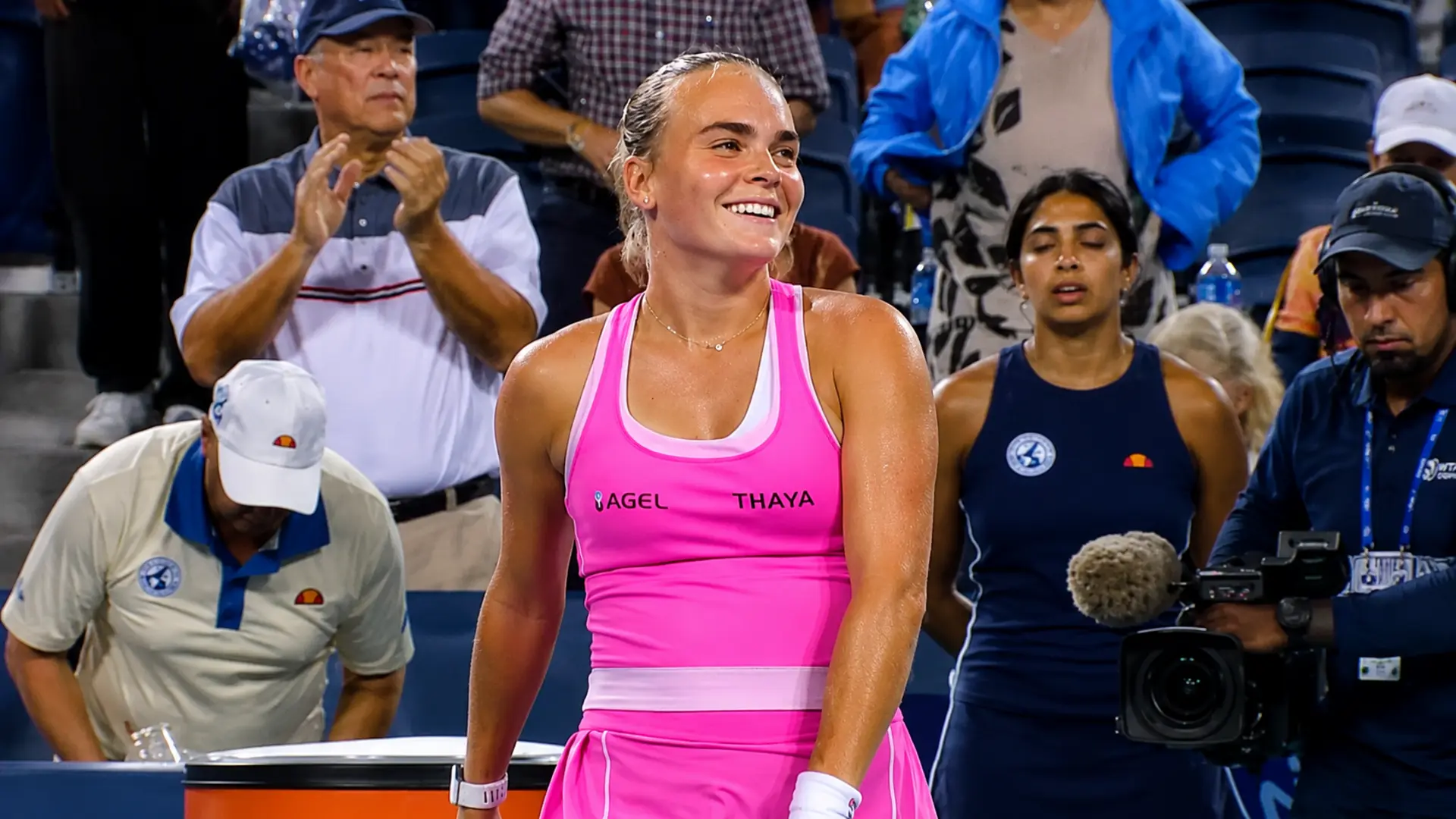
At times, she was breathtaking — a pink whirlwind outwitting Sabalenka.
Bejlek had already built an impressive Cincinnati run, beating Karolina Pliskova 6-0, 6-2, Barbora Krejcikova 7-6(5), 6-4 and then recovering from a set down to defeat 16th seed Ekaterina Alexandrova 4-6, 6-1, 6-2. Sabalenka had beaten Talia Gibson 6-2, 7-6(2) and Xinyu Wang 6-1, 6-3.
Sabalenka Lets a 5-1 Tiebreak Lead Disappear
The opening set was unstable almost from the first ball.
Sabalenka broke immediately for 1-0, but Bejlek responded at 2-1 and levelled the set at 2-2. Sabalenka struck again for 4-3, only to surrender that advantage in the very next game.
From 4-4, neither player gave way.
Bejlek held for 5-4, and after Sabalenka answered for 5-5, the Czech created a set point at 6-5. Sabalenka survived it to force 6-6 and send the 68-minute opening set into a tiebreak.
That was when the match appeared to tilt decisively towards the top seed.
Sabalenka surged to 5-1 and stood only two points from the set. Against a player experiencing this level of occasion for the first time, it looked like the moment when experience and weight of shot would finally tell.
Instead, Bejlek began climbing back.
Bejlek then turned the tiebreak on its head. From 1-5 down, she reeled off five straight points to lead 6-5 and earn her first set point. Sabalenka saved it, but Bejlek created another at 7-6 before finally converting her third set point at 8-7, wrong-footing Sabalenka into the backhand corner after a strong first serve to take the breaker 9-7.
From 1-5 down, she had won eight of the final ten points.
Set 1 at a Glance
- Sabalenka hit 23 winners to Bejlek’s 10, though also committed more unforced errors, 26 to 12.
- Sabalenka won 60% of pressure points (6/10) compared with Bejlek’s 40% (4/10).
- Sabalenka narrowly edged the total points race, 44-43 (51%).
Full Set 1 Stats
| Sabalenka | Statistic | Bejlek |
|---|---|---|
| Set 1 Duration: 1h08m | ||
| 1.03 | Dominance Ratio | 0.97 |
| 23 | Winners | 10 |
| 26 | Unforced Errors | 12 |
| 230 | Serve Rating | 238 |
| 0 | Aces | 2 |
| 2 | Double Faults | 0 |
| 47% (20/43) | 1st Serve % | 61% (27/44) |
| 70% (14/20) | 1st Serve Points Won | 67% (18/27) |
| 48% (11/23) | 2nd Serve Points Won | 41% (7/17) |
| 50% (2/4) | Break Points Saved | 33% (1/3) |
| 192 | Return Rating | 165 |
| 33% (9/27) | 1st Return Points Won | 30% (6/20) |
| 59% (10/17) | 2nd Return Points Won | 52% (12/23) |
| 2/3 | Break Points Won | 2/4 |
| 44 | Total Points Won | 43 |
Sabalenka Builds Another Lead — and Loses That One Too
A player of Sabalenka’s experience might have been expected to respond forcefully.
For a while, she did.
Bejlek broke in the opening game of the second set, but Sabalenka immediately broke back. The World No. 1 then held for 2-1 and broke again for 3-1.
A service hold made it 4-1.
This time there was no tiebreak involved, no narrow late-stage deficit and seemingly far more room for Sabalenka to regain control of the match.
Yet the same problem returned.
Bejlek held for 4-2 and then broke Sabalenka for 4-3. Sabalenka had chances in that game but could not stop the Czech from pulling herself back into the set.
Bejlek levelled at 4-4.
Then came the decisive blow.
Sabalenka served at 4-4 and again found herself under pressure. Bejlek broke for 5-4, turning a set she had trailed 1-4 into an opportunity to serve for the biggest victory of her career.
She did not hesitate.
Bejlek held to love and completed the upset 6-4 after 49 minutes.
Sabalenka had gone from 4-1 up to losing five consecutive games.
The cold handshake at the net after Bejlek’s winning ace said it all.
Set 2 at a Glance
- Bejlek landed 76% of first serves (19/25) compared with Sabalenka’s 54% (21/39).
- Bejlek won five straight games to finish the match.
- Bejlek won 55% of total points (35/64), despite Sabalenka hitting more winners, 18 to 10.
Full Set 2 Stats
| Sabalenka | Statistic | Bejlek |
|---|---|---|
| Set 2 Duration: 0h49m | ||
| 0.78 | Dominance Ratio | 1.28 |
| 18 | Winners | 10 |
| 17 | Unforced Errors | 10 |
| 186 | Serve Rating | 238 |
| 0 | Aces | 1 |
| 2 | Double Faults | 0 |
| 54% (21/39) | 1st Serve % | 76% (19/25) |
| 52% (11/21) | 1st Serve Points Won | 68% (13/19) |
| 44% (8/18) | 2nd Serve Points Won | 33% (2/6) |
| 57% (4/7) | Break Points Saved | 33% (1/3) |
| 206 | Return Rating | 207 |
| 32% (6/19) | 1st Return Points Won | 48% (10/21) |
| 67% (4/6) | 2nd Return Points Won | 56% (10/18) |
| 2/3 | Break Points Won | 3/7 |
| 29 | Total Points Won | 35 |
Bejlek Wins the Numbers That Mattered
Sabalenka still produced considerably more outright attacking tennis, finishing with 41 winners to Bejlek’s 20.
But she also committed 43 unforced errors, almost twice Bejlek’s 22. That imbalance helped leave Sabalenka with a 0.91 dominance ratio, while Bejlek finished at 1.10.
The serving numbers also favoured the Czech.
Bejlek landed 67 per cent of first serves, compared with Sabalenka’s 50 per cent, and won 67 per cent of those first-serve points. She also struck three aces without committing a double fault.
Sabalenka, unusually, finished without an ace and committed four double faults.
Bejlek won 58 per cent of her service points, compared with Sabalenka’s 54 per cent, and broke five times from 11 opportunities. Sabalenka converted four of six break points.
The total-point margin was small but meaningful: Bejlek won 78 of 151 points, or 52 per cent, while Sabalenka took 73.
That five-point difference says plenty about the match. Sabalenka had more winners, more pressure points won and several commanding scoreboard positions. Bejlek simply refused to let any of them become decisive.
Another Strange Sabalenka Defeat Opens the No. 1 Door
For Sabalenka, the timing is especially awkward.
Cincinnati was supposed to be another opportunity to steady herself before the US Open. Instead, she leaves after squandering a 5-1 tiebreak lead and then a 4-1 advantage in the second set.
It also reopens the fight for the World No. 1 ranking.
Sabalenka entered Cincinnati having held the top spot for 96 consecutive weeks since October 21, 2024, taking her career total to 104 weeks at No. 1.
Elena Rybakina now has a route to ending that run. She needs to reach the Cincinnati final to move ahead of Sabalenka in the post-tournament rankings. Before she can think about the final, however, Rybakina must get through Iga Swiatek in the quarterfinals, not the semifinals.
That correction matters because the ranking pressure starts immediately.
If Rybakina reaches the final, Sabalenka’s 96-week uninterrupted reign at No. 1 will end. If she does not, Cincinnati merely postpones the argument and sends the ranking battle into the US Open with everything still to play for.
Bejlek Turns Her First Shot at No. 1 Into a Career Win
For Bejlek, this was something entirely different: a breakthrough.
The Czech had never faced a reigning World No. 1 before. On the first occasion she did, she came back from 1-5 in a tiebreak and then erased another three-game deficit in the second set.
That resilience fits the trajectory of a player already enjoying the strongest season of her career. Bejlek won her first WTA title earlier in 2026 and has established herself inside the broader top-50 conversation.
Now she has the signature victory to go with it.
The Czech lefthander moves into her first Cincinnati quarterfinal, where Madison Keys awaits after the American defeated Wang Xiyu 7-6(3), 6-4.
With the US Open approaching, Sabalenka has questions. Bejlek has momentum.