
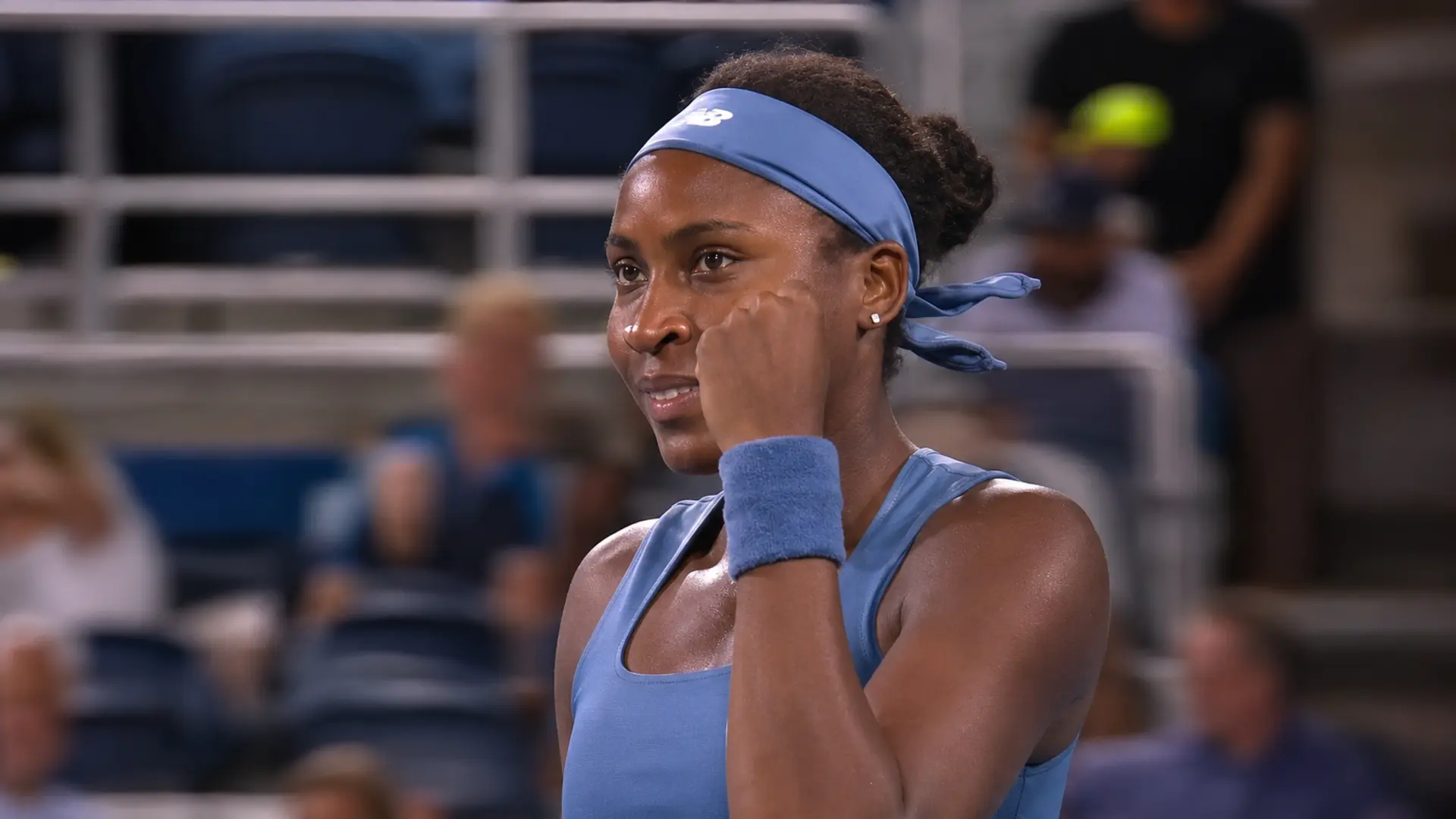
Coco Gauff could hardly arrive in New York with more momentum.
She has just won Cincinnati, finished the tournament by sweeping Jessica Pegula 6-2, 6-4 and suddenly looks much closer to the player who won the US Open three years ago.
Then the draw arrived.
Gauff may be the No. 4 seed, but her US Open section is loaded almost immediately.
Daria Kasatkina or Paula Badosa could be waiting in the second round. Sara Bejlek is the projected third-round opponent. Iva Jovic could arrive in the Round of 16. Or Alexandra Eala. And the quarterfinal could bring either Mirra Andreeva or 2025 US Open finalist Amanda Anisimova.
Among the tournament’s top four seeds, only Elena Rybakina appears to have been handed a more difficult route.
And for Gauff, there is another layer to all of it: if she wins the US Open and Rybakina fails to reach the semifinals, she could leave New York as World No. 1 for the first time.
Gauff’s US Open Women’s Main Draw Bracket Section
This is the complete 16-player section containing Gauff:
Jovic I. (Usa) (14) v Frech M. (Pol)
Linette M. (Pol) v Qualifier
Oliynykova O. (Ukr) v Brantmeier R. (Usa) (WC)
Qualifier v Eala A. (Phi) (17)
Bejlek S. (Cze) (28) v Bucsa C. (Esp)
Kalinina A. (Ukr) v Qualifier
Kasatkina D. (Aus) v Badosa P. (Esp)
Sonmez Z. (Tur) v Gauff C. (Usa) (4)
There is very little empty space in that section.
The seedings point toward Gauff against Iva Jovic in the Round of 16, but Alexandra Eala sits only three places below Jovic in the seedings, while Sara Bejlek occupies Gauff’s immediate third-round path.
And before Gauff can think about any of them, she may have to get through a former Top 10 player in Round 2.
Gauff’s Projected US Open Path by Seeding
1st Round: Zeynep Sonmez
2nd Round: Daria Kasatkina / Paula Badosa
3rd Round: Sara Bejlek
Round of 16: Iva Jovic
Quarterfinal: Mirra Andreeva
Semifinal: Elena Rybakina
Final: Aryna Sabalenka
That is the path projected by the seedings rather than a prediction that every seeded player will advance.
And in Gauff’s quarter especially, that distinction matters.
The Draw Gets Serious in Round 2
Gauff starts against Zeynep Sonmez, but her second-round possibilities are considerably more interesting.
Daria Kasatkina against Paula Badosa is one of those first-round matches capable of changing the look of an entire section.
Neither carries a seed, yet both have spent significant time among the leading players on tour. Badosa has been ranked as high as World No. 2, while Kasatkina is a former Top 10 player and Grand Slam semifinalist.
The winner gets Gauff if the American takes care of her opener.
For a No. 4 seed, that is an unusually substantial opponent to encounter after only one match.
Sara Bejlek Could Be Waiting Again
Then there is a name Gauff has seen very recently.
Sara Bejlek.
The 20-year-old produced one of the stories of Cincinnati, beating Aryna Sabalenka and Madison Keys during a remarkable run to the semifinals. Gauff finally stopped her 6-4, 6-1.
Now they could meet again in the US Open third round.
That recent result obviously makes Gauff the favorite if the rematch happens, but it also illustrates why this section is uncomfortable. Bejlek has already demonstrated that ranking and reputation are not enough to remove her from a tournament.
She beat the World No. 1 in Cincinnati. Then she beat Keys. Then Gauff had to deal with her herself.
New York could require her to do it again.
Jovic and Eala Make the Round of 16 Difficult to Predict
By seeding, Gauff’s Round of 16 opponent is Iva Jovic.
The 18-year-old American is no longer merely an interesting prospect. She reached the Australian Open quarterfinals earlier this season and has continued producing meaningful results against established players. The US Open itself has highlighted Jovic as one of the young Americans who has already made a major breakthrough in 2026.
But Jovic has her own problem.
Alexandra Eala, seeded No. 17, is positioned in the same eight-player section.
That makes Jovic-Eala the projected third-round match and creates two very different potential Round of 16 tests for Gauff.
Jovic brings pace, composure and a rapidly expanding Grand Slam résumé. Eala brings aggressive left-handed tennis and the confidence of a player whose ranking has climbed far enough that she narrowly missed a Top 16 seed.
Either would make the second week begin with a genuine test.
Andreeva Is Only Half the Quarterfinal Story
The projected quarterfinal is:
Coco Gauff vs. Mirra Andreeva.
That alone would make this a demanding quarter.
Andreeva is the reigning Roland Garros champion and the No. 5 seed in New York, one place behind Gauff.
But Gauff cannot simply pencil Andreeva into the last eight.
This is the adjacent 16-player section:
Andreeva M. (Wrl) (5) v Tjen J. (Ina)
Qualifier v Lys E. (Ger)
Bartunkova N. (Cze) v Sherif M. (Egy)
Maria T. (Ger) v Ostapenko J. (Lat) (30)
Potapova A. (Aut) (24) v Valentova T. (Cze)
Qualifier v Jeanjean L. (Fra) (WC)
Tagger L. (Aut) v Korpatsch T. (Ger)
Krueger A. (Usa) v Anisimova A. (Usa) (10)
Amanda Anisimova is sitting at the bottom of it.
The No. 10 seed reached the Wimbledon and US Open finals in 2025 and has already proved that her first-strike game translates extremely well to the biggest stages.
By seeding, Andreeva and Anisimova would meet in the Round of 16.
Gauff could therefore reach the quarterfinals and find either the reigning Roland Garros champion or last year’s US Open runner-up waiting for her.
That is a serious last-eight draw whichever way it breaks.
Cincinnati Changes the Way This Draw Looks
There is an obvious counterargument to all of this.
Gauff is playing exceptionally well.
Her Cincinnati title was not scraped together through a series of escapes. After losing the opening set of her first match, she won 12 consecutive sets and finished the tournament by beating Pegula 6-2, 6-4. The title was Gauff’s first of 2026 and her second in Cincinnati.
We watched that transformation develop round by round.
Against Marta Kostyuk, Gauff was unusually assertive, taking control of rallies earlier instead of relying primarily on defense. Against Bejlek, she stayed composed against the player who had just knocked out Sabalenka and Keys. Then she overwhelmed Pegula in the final.
So the draw is difficult.
But Gauff may also be entering it at exactly the right time.
There Is Still a Path to World No. 1
Gauff’s ranking equation is far less forgiving than Rybakina’s.
She cannot simply reach a certain round and take the No. 1 ranking.
Gauff must win the US Open, and Rybakina must lose before reaching the semifinals. Jessica Pegula faces exactly the same equation.
That means the ranking story only becomes relevant if Gauff survives this entire section, gets through the Andreeva-Anisimova quarter and then keeps winning.
But it is remarkable that the possibility exists at all.
A year that has included major changes to her game has suddenly produced a Cincinnati title and a chance, however demanding, to become the top-ranked woman in tennis.
Why Gauff Has the Second-Toughest Draw of the Top Four
Rybakina’s potential sequence of Osaka and Swiatek gives the No. 2 seed the hardest route of the four.
Gauff comes next.
It is the density of her quarter that separates it.
A possible Kasatkina or Badosa match arrives as early as Round 2. Bejlek could follow. Jovic or Eala could be waiting in the Round of 16. Andreeva and Anisimova sit on the other side of the quarter.
There is no single opponent who makes the draw brutal.
There are simply too many of them.
Gauff arrives in New York as the hottest of the top four after Cincinnati. The draw has immediately asked her to prove how much that momentum is worth.