
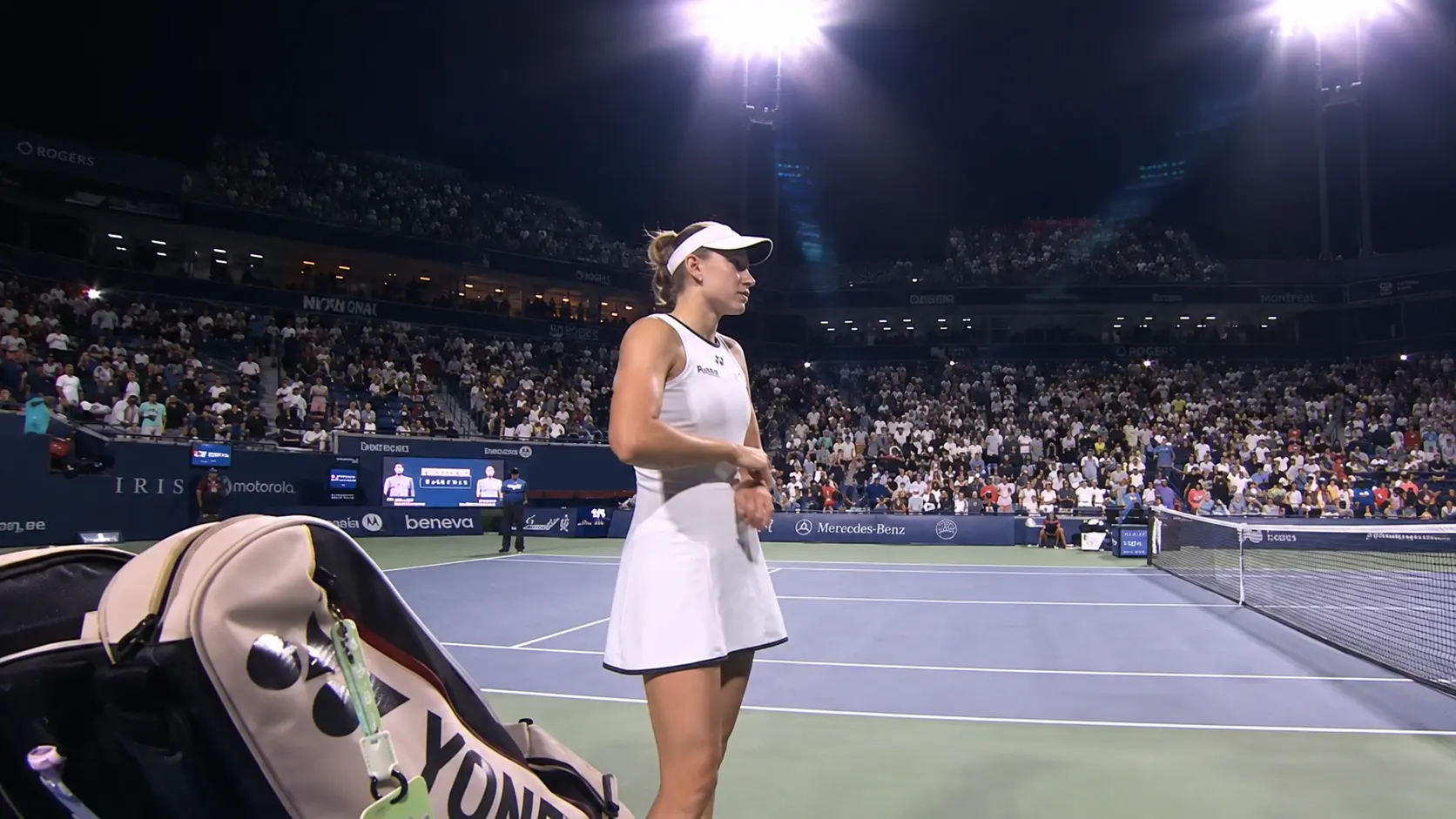
A week ago, Elena Rybakina was unable to finish her Cincinnati Open quarterfinal. Now she has arrived in New York as the No. 2 seed, with the World No. 1 ranking closer than it has ever been and arguably the most difficult US Open draw of any woman in the top four.
The first few rounds offer Rybakina room to find out how well her body has recovered. After that, the draw changes dramatically.
Naomi Osaka could be waiting in the Round of 16. Iga Swiatek is the projected quarterfinal opponent. And those are the same two women Rybakina faced during an exhausting North American hard-court swing that ended with her Cincinnati injury.
The reward for surviving all of that could be enormous. Rybakina does not even need to win the US Open to become the new World No. 1. If she reaches the semifinals, the top ranking is hers regardless of anyone else’s result.
Rybakina’s US Open Women’s Main Draw Bracket Section
This is the complete 16-player section containing Rybakina:
Osaka N. (Jpn) (13) v Zakharova A. (Wrl)
Cocciaretto E. (Ita) v Siniakova K. (Cze)
Qualifier v Timofeeva M. (Uzb)
Quevedo K. (Esp) v Mertens E. (Bel) (23)
Sakkari M. (Gre) (32) v Qualifier
Starodubtseva Y. (Ukr) v Seidel E. (Ger)
Vidmanova D. (Cze) v Bouzas Maneiro J. (Esp)
Frodin T. (Usa) (WC) v Rybakina E. (Kaz) (2)
The seedings point toward Rybakina against Osaka in the Round of 16, although Elise Mertens and Maria Sakkari give this section considerably more depth than the seed numbers alone suggest.
Rybakina’s Projected Path by Seeding
1st Round: Thea Frodin
2nd Round: Darja Vidmanova / Jessica Bouzas Maneiro
3rd Round: Maria Sakkari
Round of 16: Naomi Osaka
Quarterfinal: Iga Swiatek
Semifinal: Coco Gauff
Final: Aryna Sabalenka
That is only the path projected by the seedings, not a prediction that all of those players will advance.
The Opening Rounds Give Rybakina Something She Needs: Time
Rybakina could hardly have asked for a more intriguing first-round opponent.
Thea Frodin, a 17-year-old American wildcard, earned her place by winning the USTA Girls’ 18s National Championship. It will be a huge occasion for the teenager, but for the No. 2 seed the bigger question may have little to do with the player across the net.
How does Rybakina move?
Her Cincinnati quarterfinal against Swiatek lasted only 28 minutes. At 1-4 in the opening set, Rybakina hurt her lower leg after changing direction near the net and required treatment before retiring. What had begun as another major match in the race for World No. 1 suddenly became a race to be healthy for New York.
The concern did not disappear immediately. Rybakina subsequently withdrew from the US Open mixed doubles, where she had been due to partner Taylor Fritz. Fritz instead reunited with Jessica Pegula after both of their original partners withdrew.
She remains in the singles draw, however, and the opening two rounds at least offer the possibility of playing herself into the tournament before the difficulty escalates.
Osaka Is Where the Draw Changes
If the seeds hold, Naomi Osaka awaits in the Round of 16.
That would be a rematch of their Toronto quarterfinal earlier this month, when Rybakina came from behind to beat Osaka 4-6, 7-6(5), 6-4 in a high-level three-set battle.
It is also exactly the kind of match Rybakina probably would have preferred not to see so early after Cincinnati.
Osaka remains one of the most dangerous hard-court players in the draw when her first-strike tennis is working. Her four Grand Slam titles were all won on hard courts, including two at the US Open.
And she is not the only possible obstacle in that part of the bracket. Elise Mertens, seeded No. 23, sits in the opposite half of the section and could prevent the projected Osaka-Rybakina meeting from happening at all.
There are softer Round of 16 possibilities elsewhere in the draw.
Rybakina did not get one of them.
Swiatek Is Waiting in the Quarterfinals
Then comes the part of the bracket that makes Rybakina’s draw particularly unforgiving.
The adjacent section is headed by Iga Swiatek.
Swiatek’s side of the quarter contains:
Swiatek I. (Pol) (8) v Wang Xiyu (Chn)
Podoroska N. (Arg) v Waltert S. (Sui)
Qualifier v Stearns P. (Usa)
Jacquemot E. (Fra) v Bouzkova M. (Cze) (25)
Keys M. (Usa) (22) v Korneeva A. (Wrl)
Qualifier v Bondar A. (Hun)
Qualifier v Qualifier
Putintseva Y. (Kaz) v Bencic B. (Sui) (12)
There are several ways that section could break apart. Belinda Bencic is the No. 12 seed, Madison Keys is No. 22 and Marie Bouzkova is No. 25.
But by seeding, the quarterfinal is Rybakina against Swiatek.
For Rybakina, that would mean facing Swiatek at a third consecutive major North American hard-court tournament.
Their Toronto meeting went decisively to Swiatek, who beat Rybakina 6-2, 6-3 in the final. Cincinnati produced the rematch only seven days later, but Rybakina’s injury ended it with Swiatek leading 4-1 in the opening set.
New York could now provide chapter three.
The World No. 1 Ranking Changes Everything
Normally, the discussion around a difficult Grand Slam draw ends with one question: can the player still win the title?
For Rybakina, there is another prize attached to this bracket.
World No. 1.
Aryna Sabalenka enters the US Open still holding the ranking, but the mathematics heavily favor Rybakina once the points from last year’s tournament are removed.
The scenarios are remarkable:
- Rybakina can become World No. 1 without winning a single US Open match if Sabalenka, Pegula and Gauff all fail to win the title.
- If Rybakina reaches the semifinals, she becomes World No. 1 regardless of what anyone else does.
- Sabalenka must win the US Open and have Rybakina lose before the semifinals to retain No. 1.
- Pegula and Gauff each need to win the title while also having Rybakina fall before the semifinals.
That puts an unusual spin on Rybakina’s brutal quarter.
She may have drawn Osaka and Swiatek, but she does not necessarily have to get through both of them to end the tournament as the best-ranked player in women’s tennis.
The ranking race and the title race are connected, but they are not the same race.
Why Rybakina Has the Toughest Draw of the Top Four
The opener is not what makes this difficult.
Nor is the second round.
It is the sequence that could begin once Rybakina reaches the second week: Osaka in the Round of 16, Swiatek in the quarterfinals, potentially Gauff in the semifinals and Sabalenka in the final.
Even before those projected matches, Mertens, Sakkari, Bencic and Keys give the bottom quarter considerable depth.
For a fully healthy Rybakina, it would be a demanding draw.
For a Rybakina who retired injured only a week before the draw was made, it becomes something else entirely.
The first question in New York is therefore not whether she can beat Osaka or Swiatek.
It is whether the body that failed her in Cincinnati is ready to carry her far enough to meet them.
If it is, the hardest draw among the top four could still lead to the biggest prize of Rybakina’s career beyond another Grand Slam trophy: Elena Rybakina, World No. 1.