
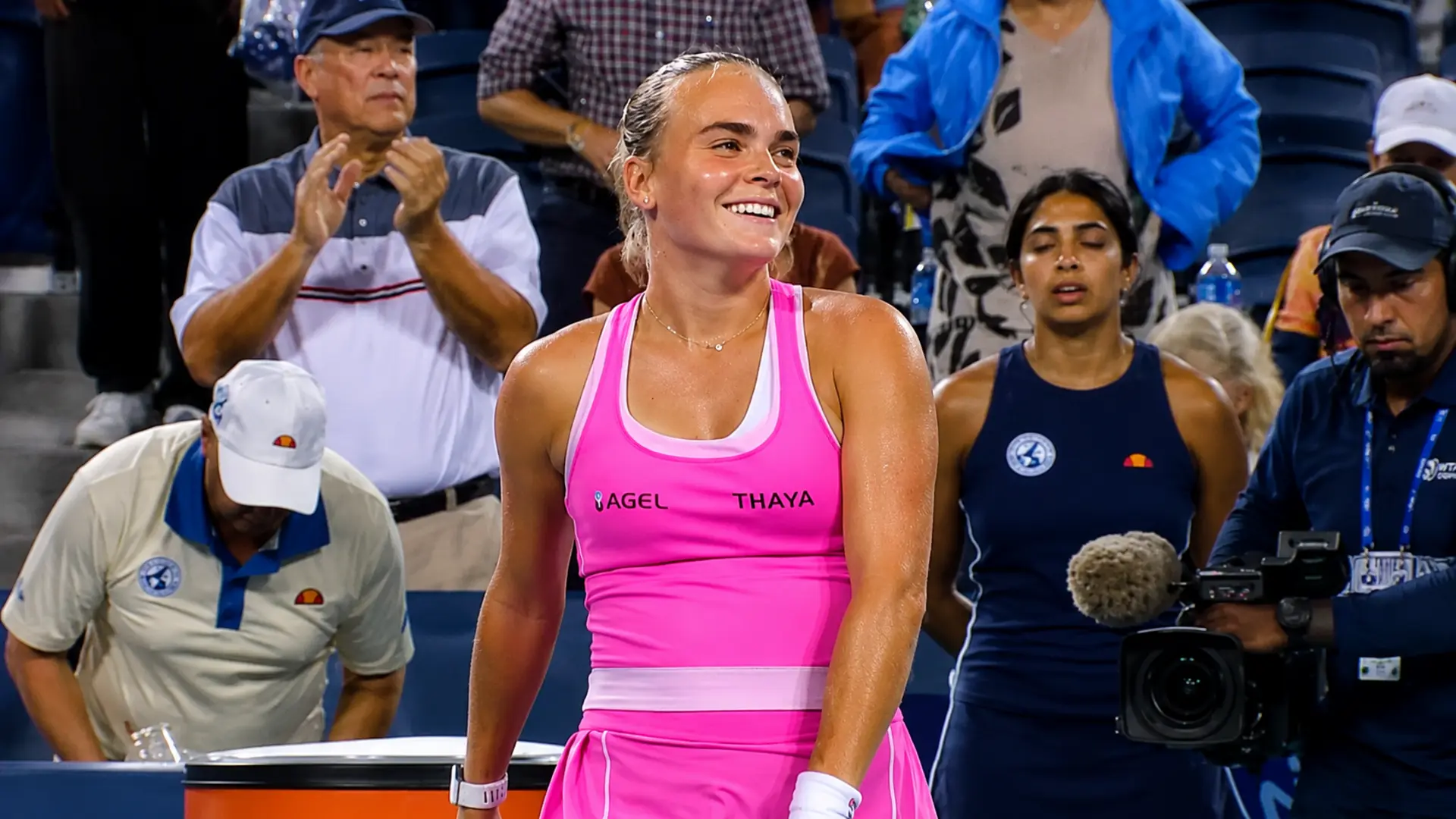
Sara Bejlek vs. Madison Keys — Cincinnati 2026 QF Match Report
Sara Bejlek has apparently decided that beating one of the biggest names in Cincinnati is not enough.
After stunning World No. 1 Aryna Sabalenka, the 20-year-old Czech did it again, recovering from a set down to defeat Madison Keys 3-6, 6-4, 7-6(5) and reach the Cincinnati Open semifinals.
This time there was no spectacular collapse from 5-1 in a tiebreak or 4-1 in a set to exploit. Bejlek had to solve a different problem: Keys was hitting through her, controlling large portions of the match and came within two points of victory in the deciding tiebreak.
Bejlek found the answer anyway.
And when it was over, there was once again precious little warmth waiting for her at the net. Bejlek responded rather differently. She stayed on court and applauded Keys as the American departed.
Another established star beaten. Another lesson in how to handle the result.
Keys Takes Control of the Opening Set
The match initially looked as though experience and firepower would prevail.
Keys held to begin before immediately attacking Bejlek’s serve. The Czech survived a prolonged game at 0-1, but Keys eventually broke and quickly established a 3-0 advantage.
Bejlek finally settled with a hold for 1-3, although she never managed to recover the early break.
Keys kept the points short when she could, used her greater weight of shot to prevent Bejlek from settling into extended patterns and moved comfortably through 4-1 and 5-2.
Bejlek made her serve for it.
Keys did exactly that, completing the opening set 6-3.
The American had established the match on her terms. Bejlek, so fearless against Sabalenka, suddenly needed to find another route.
Set 1 at a Glance
- Keys broke early and established a 3-0 lead.
- Bejlek stayed within one break but never created the recovery she needed.
- Keys won 100% of her first serve points (19/19), a perfect record on the page.
- Keys won 57% of total points (37/65), hitting 15 winners to Bejlek’s 6.
Full Set 1 Stats
| Bejlek | Statistic | Keys |
|---|---|---|
| Set 1 Duration: 0h42m | ||
| 0.66 | Dominance Ratio | 1.51 |
| 6 | Winners | 15 |
| 8 | Unforced Errors | 14 |
| 250 | Serve Rating | 312 |
| 0 | Aces | 1 |
| 2 | Double Faults | 2 |
| 61% (20/33) | 1st Serve % | 59% (19/32) |
| 70% (14/20) | 1st Serve Points Won | 100% (19/19) |
| 46% (6/13) | 2nd Serve Points Won | 58% (7/12) |
| 80% (4/5) | Break Points Saved | 100% (3/3) |
| 42 | Return Rating | 129 |
| 0% (0/19) | 1st Return Points Won | 30% (6/20) |
| 42% (5/12) | 2nd Return Points Won | 54% (7/13) |
| 0/3 | Break Points Won | 1/5 |
| 28 | Total Points Won | 37 |
Bejlek Finds Her Way Back
The second set was much less straightforward.
Bejlek held the opening game before Keys immediately answered. The American then broke for 2-1, threatening to carry the momentum of the first set straight through the match.
This time Bejlek responded.
She broke back for 3-3 and finally began forcing Keys into longer passages rather than allowing her to dictate almost every exchange.
From there, Bejlek held for 4-3 and then 5-4.
Keys served to stay in the set and had chances to extend it, but the game became increasingly uncomfortable. Bejlek stayed aggressive, created set points and eventually converted the break.
Six games to four.
The match had turned from a relatively controlled Keys victory into a one-set shootout.
Set 2 at a Glance
- Keys moved ahead 2-1 with a break, but Bejlek recovered it at 3-3.
- Bejlek broke again at 5-4 to take the set 6-4 and force a decider.
- Bejlek won 72% of her service points (18/25) compared with Keys’ 56% (20/36).
- Bejlek won 56% of total points (34/61), hitting 2 aces to Keys’ 0.
Full Set 2 Stats
| Bejlek | Statistic | Keys |
|---|---|---|
| Set 2 Duration: 0h45m | ||
| 1.59 | Dominance Ratio | 0.63 |
| 5 | Winners | 10 |
| 10 | Unforced Errors | 16 |
| 281 | Serve Rating | 220 |
| 2 | Aces | 0 |
| 1 | Double Faults | 1 |
| 72% (18/25) | 1st Serve % | 50% (18/36) |
| 78% (14/18) | 1st Serve Points Won | 61% (11/18) |
| 50% (4/8) | 2nd Serve Points Won | 50% (9/18) |
| 0% (0/1) | Break Points Saved | 60% (3/5) |
| 169 | Return Rating | 192 |
| 39% (7/18) | 1st Return Points Won | 22% (4/18) |
| 50% (9/18) | 2nd Return Points Won | 50% (4/8) |
| 2/5 | Break Points Won | 1/1 |
| 34 | Total Points Won | 27 |
Keys Leads Again, but Bejlek Refuses to Leave
Bejlek carried the momentum into the deciding set.
She held for 1-0 and broke Keys immediately for 2-0 before consolidating to build a 3-0 advantage.
Now it was Keys who needed the response.
She found one.
The American broke back for 3-1 and gradually worked herself into the set. Bejlek protected her remaining advantage through 4-2, but Keys continued applying pressure and broke again for 4-3.
At 4-4, the match had effectively reset.
Bejlek held for 5-4. Keys answered for 5-5. Neither could create the final separation, and after almost two hours of tennis the semifinal place would be decided by a tiebreak.
That was when the noise from the Keys box increased.
Instructions came down between points. Cut the angle short. Go through the middle. More information, more direction, more attempted solutions.
There is a point at which coaching can help. There is also a point at which the player on court, the person actually feeling the pace, spin, positioning and pressure of the match, may be better served by being allowed to solve the problem herself.
Keys had been doing plenty right without the running commentary.
And she came agonizingly close to finishing the job.
Bejlek Solves the Final Puzzle Herself
Keys moved to 5-4 in the deciding tiebreak, leaving herself in position to serve out the match.
She never reached match point.
Bejlek won both points on the Keys serve to turn 4-5 into 6-5 and earn a match point of her own.
The final shot suited the occasion.
Bejlek stepped into the ball and drove an emphatic forehand winner into the corner.
No hesitation. No waiting for Keys to miss. No need for somebody in the stands to tell her where the ball should go.
The courageous one solved the puzzle the Czech way.
After knocking out Sabalenka, Bejlek had now beaten Keys as well.
Set 3 at a Glance
- Bejlek raced to a 3-0 lead, only for Keys to recover both breaks and level at 4-4.
- Keys moved 5-4 ahead in the deciding tiebreak and had the chance to serve out the match.
- Bejlek won 55% of pressure points (6/11) compared with Keys’ 45% (5/11).
- Bejlek committed just 10 unforced errors compared with Keys’ 17.
Full Set 3 Stats
| Bejlek | Statistic | Keys |
|---|---|---|
| Set 3 Duration: 1h12m | ||
| 1.06 | Dominance Ratio | 0.95 |
| 12 | Winners | 16 |
| 10 | Unforced Errors | 17 |
| 273 | Serve Rating | 249 |
| 2 | Aces | 1 |
| 1 | Double Faults | 3 |
| 73% (32/44) | 1st Serve % | 68% (30/44) |
| 69% (22/32) | 1st Serve Points Won | 63% (19/30) |
| 47% (7/15) | 2nd Serve Points Won | 37% (7/19) |
| 75% (3/4) | Break Points Saved | 50% (1/2) |
| 167 | Return Rating | 126 |
| 37% (11/30) | 1st Return Points Won | 31% (10/32) |
| 63% (12/19) | 2nd Return Points Won | 53% (8/15) |
| 1/2 | Break Points Won | 1/4 |
| 46 | Total Points Won | 44 |
The Numbers Were Almost Absurdly Even
The final statistics reveal just how little separated them.
They played 214 points.
Bejlek won 107.
Keys won 107.
Keys played the more aggressive match, producing 41 winners to Bejlek’s 23, but she also committed 47 unforced errors, compared with 28 from the Czech.
That difference helped Bejlek finish with the slightly better dominance ratio, 1.03 to 0.97.
The service numbers were similarly close. Bejlek won 63 per cent of her service points; Keys won 62 per cent. Both players saved seven of 10 break points and both converted three of 10 chances on return.
Even the pressure-point count finished level at 10 apiece from 20.
Bejlek did hold an advantage in first-serve percentage, landing 68 per cent compared with Keys’ 59 per cent, while she also struck four aces against four double faults. Keys hit two aces and six double faults.
The statistics identify a match that eventually demanded one person make the right decisions at the very end.
Bejlek did.
Another Big Name Falls, Followed by Another Cold Reception
There was an uncomfortable echo after match point.
Sabalenka had offered Bejlek little warmth after losing to her in the previous round. Keys was hardly overflowing with congratulations either.
Maybe losing to a 20-year-old newcomer on a major stage is difficult to process. But Bejlek herself supplied the better example of how these moments can be handled.
After the handshake, she applauded Keys off the court.
That contrast was difficult to miss.
Sportsmanship is easiest when everything has gone your way. It arguably says more when it has not.
Keys certainly had reason to be frustrated, although most of it belonged with the opportunities that disappeared during the match rather than with the player on the other side of the net.
She had regained control of the deciding set. She had moved 5-4 ahead in the tiebreak. And she still could not finish Bejlek off.
Bejlek Is No Longer Just the Cincinnati Surprise
One upset can happen. Two consecutive victories over players of the calibre of Sabalenka and Keys begin to look like something else entirely.
The Abu Dhabi champion has now shown two different forms of resilience in Cincinnati. Against Sabalenka she recovered from seemingly lost positions. Against Keys she absorbed 41 winners, surrendered leads of her own and still found the courage to attack when the match reached its decisive point.
Keys leaves with plenty to regret, particularly a 5-4 lead in the final tiebreak that disappeared without producing a match point.
Bejlek moves on to the biggest semifinal of her career against Coco Gauff.
At 20, she is no longer merely enjoying a surprising Cincinnati run. She is repeatedly looking across the net at established stars and finding a way to beat them.