
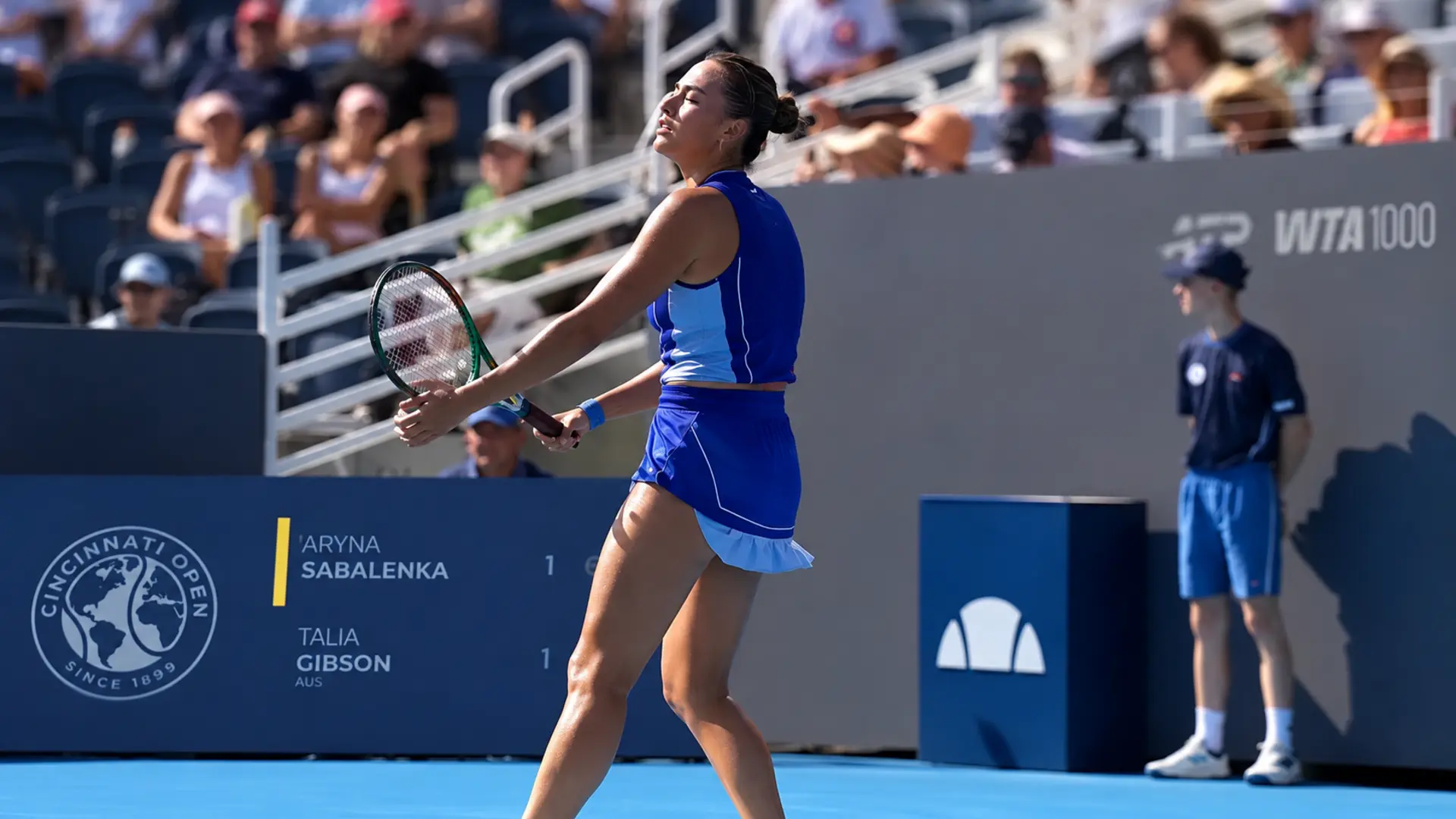
There is one fairly substantial problem with the idea that Aryna Sabalenka is enduring a bad 2026 season.
On hard courts, she is 22-3.
That is an 88.0% winning percentage, the highest Sabalenka has recorded at this point of any season since our comparison begins in 2018. Her dominance ratio sits at 1.44, virtually level with the career-high 1.45 she produced in 2023 and 2024. She is winning 57.0% of her second-serve points, another high across the nine seasons examined.
And when the opposition gets better, the argument does not improve.
Sabalenka is 8-1 against Top-16 opponents, 10-2 against the Top 32 and 16-3 against the Top 64 on hard courts this year.
So is Sabalenka really in a slump?
Perhaps right now.
But if the suggestion is that 2026 has somehow been a poor hard-court season for the world No. 1, the numbers are pointing somewhere else entirely.
First, One Rule Changes This Entire Analysis: Hard Courts Only
There is a deliberate line running through this comparison.
We are analyzing hard-court tennis and nothing else.
The sample starts in 2018, when Sabalenka had established herself inside the Top 100, and compares her hard-court results from the Australian Open through Cincinnati in every season.
Qualifying matches are included. Team competitions are not.
Clay is not included.
Grass is not included.
And that distinction is essential rather than cosmetic.
Grass can almost feel like a different sport. The movement changes. The bounce changes. Return positions change. Timing changes. The value of the first strike changes. Clay presents an entirely different set of demands again.
Throwing Wimbledon, Roland Garros, Madrid, Berlin and Miami into one statistical pot may tell us what Sabalenka’s complete season looks like, but it makes it harder to answer the question we are interested in here.
Is Sabalenka playing worse hard-court tennis than she used to?
For that, the fairest comparison is Sabalenka against Sabalenka, on the same surface and at the same stage of the season.
And the answer is difficult to reconcile with the word “slump.”
Sabalenka’s Hard-Court Seasons Compared
Here is the first piece of evidence.
Aryna Sabalenka’s Hard-Court Seasons Compared
Australian Open through Cincinnati only, comparing the same hard-court window in every season from 2018 to 2026.
| Year | Avg. Opp. Rank | W-L | Win % | DR | Ace % | DF % | 1st In % | 1st Won % | 2nd Won % |
|---|---|---|---|---|---|---|---|---|---|
| 2018 | 59 | 11-7 | 61.1% | 1.08 | 7.2% | 6.4% | 58.6% | 69.5% | 48.0% |
| 2019 | 82 | 12-8 | 60.0% | 1.17 | 5.6% | 7.1% | 61.5% | 70.0% | 45.7% |
| 2020 | 54 | 9-4 | 69.2% | 1.20 | 5.5% | 6.3% | 60.7% | 67.6% | 47.0% |
| 2021 | 52 | 12-7 | 63.2% | 1.22 | 8.4% | 8.2% | 59.5% | 71.8% | 49.1% |
| 2022 | 56 | 11-8 | 57.9% | 1.14 | 4.9% | 12.3% | 60.0% | 69.8% | 41.4% |
| 2023 | 54 | 21-5 | 80.8% | 1.45 | 9.9% | 6.1% | 60.4% | 75.6% | 50.5% |
| 2024 | 74 | 19-5 | 79.2% | 1.45 | 8.3% | 5.1% | 61.5% | 73.7% | 52.9% |
| 2025 | 37 | 21-5 | 80.8% | 1.38 | 5.1% | 2.2% | 64.4% | 68.0% | 54.2% |
| 2026 | 67 | 22-3 | 88.0% | 1.44 | 8.1% | 3.3% | 64.2% | 72.7% | 57.0% |
The 88.0% jumps off the page, but it should not be read in isolation.
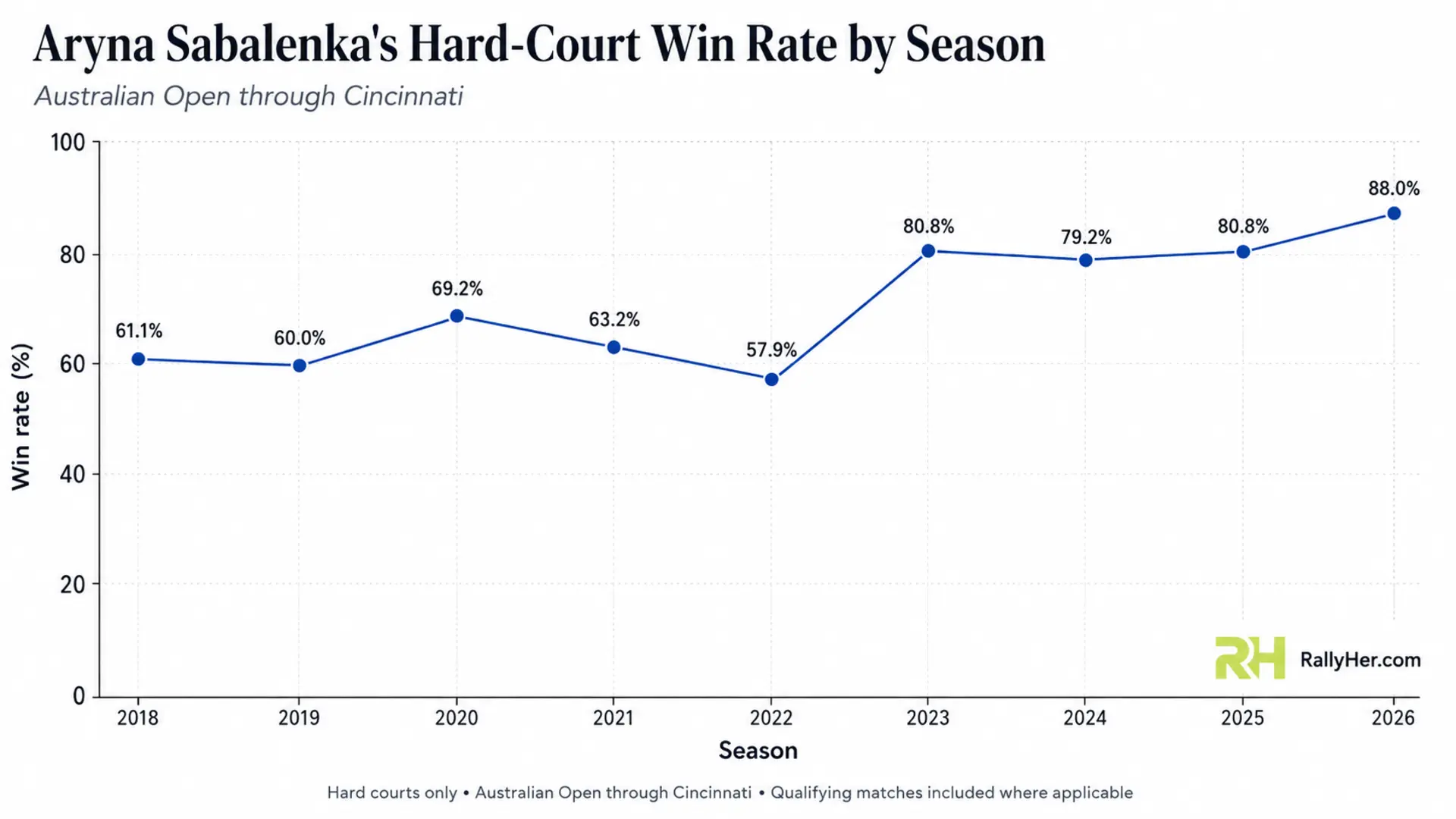
Sabalenka’s 1.44 dominance ratio is only 0.01 below the highest figure in the entire study. Dominance ratio compares the percentage of return points a player wins with the percentage of points she loses on serve. A DR of 1.00 represents an even balance; the further it rises above 1.00, the more dominant the player’s overall performance.
Her supposedly troubled 2026 therefore looks almost indistinguishable from her statistical peak. Then look at the serve.
Sabalenka is landing 64.2% of first serves, fractionally below last year’s 64.4% and well above where she spent most of the first half of her career.
She is producing aces on 8.1% of service points while double-faulting on only 3.3%.
And the second serve may be the most revealing number on the page.
She is winning 57.0% of second-serve points.
That is the best figure of any season in the comparison.
The Second Serve Tells a Story of Its Own
Sabalenka’s second serve was once capable of turning a match into a battle against herself.
The nadir is sitting right there in 2022.
That year she double-faulted on 12.3% of service points in this hard-court sample and won only 41.4% of points behind her second serve. Her winning percentage fell to 57.9% and her dominance ratio to 1.14.
Now follow the second-serve progression:
- 2022: 41.4%
- 2023: 50.5%
- 2024: 52.9%
- 2025: 54.2%
- 2026: 57.0%
That is not the statistical profile of a serve disintegrating.
It is a five-year transformation.
The double-fault rate tells the same story from the opposite direction. Sabalenka has gone from 12.3% in 2022 to 3.3% this year.
She has not merely removed one of the great vulnerabilities of her early career. In 2026, the second serve has become a weapon from which she is winning more points than in any previous hard-court season in this study.
But Has She Simply Faced Easier Opposition?
This is where the average opponent ranking initially raises a reasonable objection.
Sabalenka’s average hard-court opponent in 2026 has been ranked No. 67. In 2025, it was No. 37.
Perhaps 22-3 is flattering her.
Except average ranking is a blunt instrument.
One match against the world No. 702 can move an average dramatically without telling us anything about how a player performs when the serious tests arrive.
So instead of relying on the average, we divided Sabalenka’s opponents into three cumulative ranking brackets: Top 16, Top 32 and Top 64.
The results strengthen the case for 2026.
How Sabalenka Has Performed Against Better Players
How Sabalenka Has Performed Against Better Players
Hard-court win-loss records against Top-16, Top-32 and Top-64 opponents, Australian Open through Cincinnati.
| Year | vs. Top 16 | Win % | vs. Top 32 | Win % | vs. Top 64 | Win % |
|---|---|---|---|---|---|---|
| 2018 | 4-3 | 57.1% | 5-4 | 55.6% | 6-5 | 54.5% |
| 2019 | 0-2 | 0.0% | 4-2 | 66.7% | 7-7 | 50.0% |
| 2020 | 1-1 | 50.0% | 5-1 | 83.3% | 7-3 | 70.0% |
| 2021 | 1-5 | 16.7% | 3-6 | 33.3% | 7-7 | 50.0% |
| 2022 | 0-3 | 0.0% | 1-4 | 20.0% | 7-6 | 53.8% |
| 2023 | 7-1 | 87.5% | 10-4 | 71.4% | 17-4 | 81.0% |
| 2024 | 5-0 | 100.0% | 8-2 | 80.0% | 12-4 | 75.0% |
| 2025 | 7-3 | 70.0% | 9-4 | 69.2% | 18-5 | 78.3% |
| 2026 | 8-1 | 88.9% | 10-2 | 83.3% | 16-3 | 84.2% |
This may be the data that does the most damage to the slump argument.
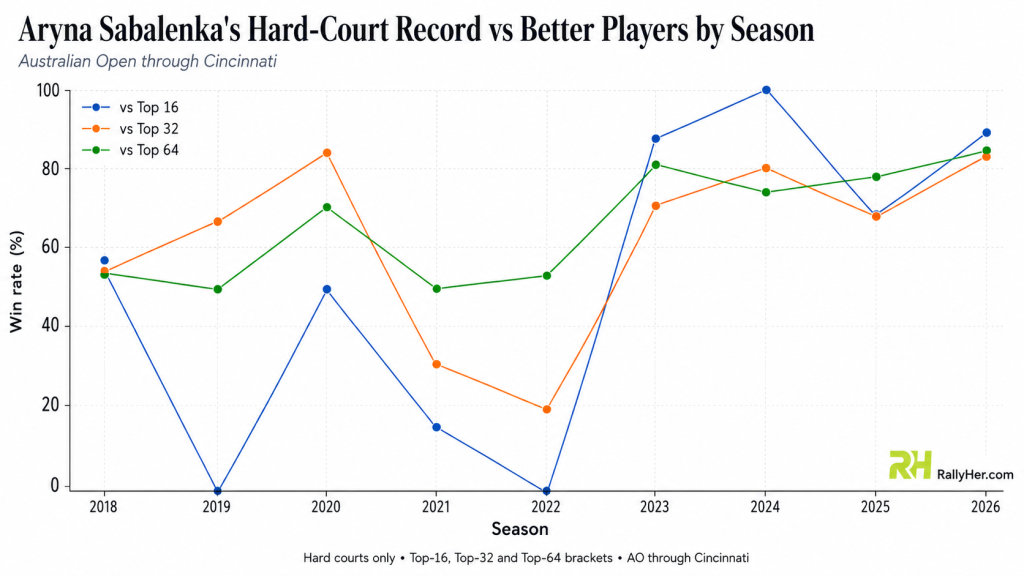
Sabalenka has already faced nine Top-16 opponents on hard courts in 2026. She has beaten eight of them.
Her 8-1 record and 88.9% winning percentage is surpassed percentage-wise only by her 5-0 record in 2024, which came across a smaller sample.
Against the Top 32, she is 10-2. Her 83.3% success rate ties the best percentage in the study, achieved in 2020 when she played only six such matches.
And against the Top 64?
16-3. An 84.2% winning percentage.
That is the best percentage of Sabalenka’s nine hard-court seasons in this comparison.
The average-opponent-ranking objection therefore largely disappears once the quality of opposition is examined properly.
Sabalenka is not 22-3 because she has spent eight months avoiding good players. She has been beating them.
Her Only Top-16 Hard-Court Loss Came in Melbourne
There is another statistic hiding inside that 8-1 record.
Sabalenka’s only hard-court defeat to a Top-16 player in this entire 2026 sample came against Elena Rybakina, then ranked No. 5, in the Australian Open final.
Since then she has beaten players ranked No. 3, No. 10, No. 16, No. 14, No. 4 and No. 2 among her Top-16 victories.
That distinction matters when trying to diagnose what has happened recently.
Sabalenka’s two August defeats came against No. 19 Ekaterina Alexandrova in Toronto and No. 35 Sara Bejlek in Cincinnati.
Those are disappointing losses for the world No. 1.
They are also the losses that have arrived most recently, which is precisely why they carry such weight in the current conversation.
But they do not erase what came before them.
The Slump May Be Real, But the Slumping Season Isn’t
This is where two ideas that sound contradictory can both be true.
Sabalenka can be in a slump right now.
And Sabalenka can simultaneously be having one of the best hard-court seasons of her career.
Her last two tournaments have ended in the round of 16. Across Toronto and Cincinnati she went 4-2. For a player who has made winning the biggest tournaments routine, that is a drop.
Recent form matters.
But recency can also distort the larger picture.
Before losing to Alexandrova in Toronto, Sabalenka had won 14 consecutive hard-court matches following her Australian Open final defeat. She swept Indian Wells and Miami back to back, then won her first two matches in Toronto.
The Cincinnati loss makes the dip more noticeable. It does not retroactively turn 22-3 into a poor season.
That distinction should be at the heart of any serious discussion about where Sabalenka stands.
Calling two disappointing tournaments a slump is defensible.
Calling her 2026 hard-court season one is much harder.
2026 Is Tracking With Sabalenka’s Peak Years, Not Her Bad Ones
If Sabalenka were genuinely playing the worst hard-court tennis of her established career, we would expect to find traces of it somewhere.
A collapsing win percentage.
A falling dominance ratio.
More double faults.
A vulnerable second serve.
Poorer results against highly ranked opponents.
Instead:
- Her 88.0% overall winning percentage is the best in the study.
- Her 1.44 dominance ratio is 0.01 below her best.
- Her 57.0% second-serve points won is the best.
- Her 3.3% double-fault rate is the second-lowest.
- Her 64.2% first-serve percentage is the second-highest.
- Her 84.2% winning percentage against Top-64 players is the best.
- Her 83.3% against the Top 32 is tied for the best.
- And she is 8-1 against the Top 16.
If anything, 2026 is clustering statistically with 2023, 2024 and 2025, the period in which Sabalenka established herself at the very top of women’s tennis.
It bears virtually no resemblance to 2022, when the hard-court numbers actually did show a player struggling badly with a fundamental part of her game.
The US Open Will Tell Us Which Story Has Legs
None of this guarantees what happens next.
A slump describes direction as much as achievement, and Sabalenka now heads toward the US Open after two earlier-than-expected exits.
Another early loss in New York would give the recent-form argument considerably more substance.
A deep run would make the wider “bad season” narrative increasingly difficult to sustain.
But through Cincinnati, we can answer the question already in front of us.
Is Aryna Sabalenka having a bad hard-court season in 2026?
Based on the numbers, RallyHer’s answer is emphatic: No. By several important measures, she is having her best one.
The more accurate description is less dramatic but considerably more interesting: one of the strongest hard-court seasons of Sabalenka’s career has just run into its first genuine dip.
Those are not the same thing.