Aryna Sabalenka vs. Elena Rybakina — US Open 2026 Final Preview
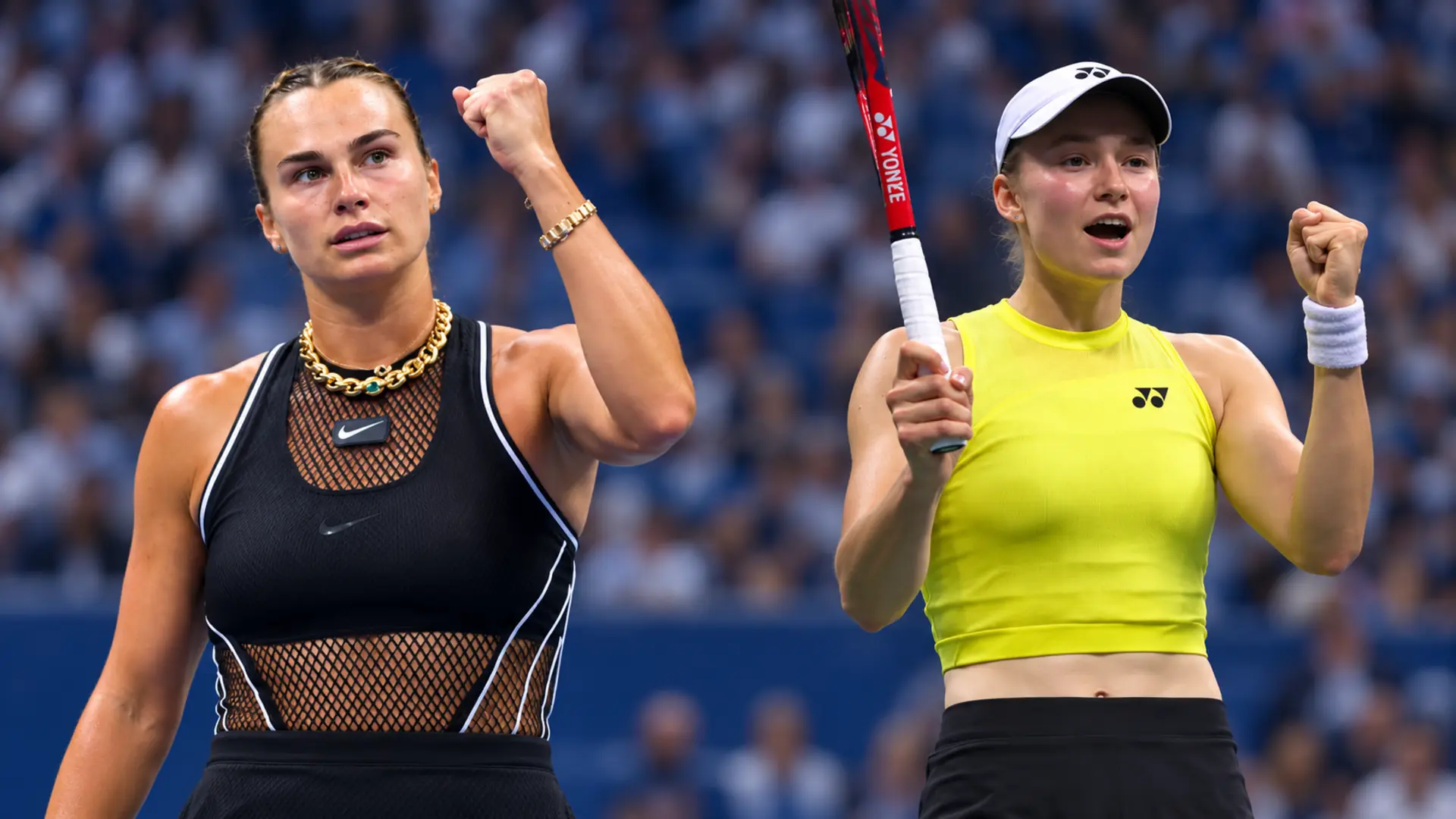
The 2026 US Open women’s final brings together two of the tour’s biggest hard-court forces, but they arrive with very different stories attached to them.
For Aryna Sabalenka, this is a chance to keep her New York dynasty going. She has now reached her fourth consecutive US Open final and remains one win away from a third straight title at Flushing Meadows. For Elena Rybakina, the occasion is new in this setting: this will be her first US Open final, and it comes just as she has risen to the top of the live rankings.
Rybakina’s run has already changed the hierarchy of women’s tennis before the final is even played.
She enters the championship match as the live World No. 1 with 9,201 points, having moved ahead of Sabalenka during the US Open. Sabalenka, the tournament’s No. 1 seed, is now second in the live rankings on 7,875 points.
And Saturday’s result will widen or narrow that gap considerably.
If Rybakina wins the title, she will add another 700 points and leave New York on 9,901, strengthening her new position at the top.
If Sabalenka wins, she will rise to 8,575 points. Rybakina would remain on 9,201, meaning Sabalenka could complete a third consecutive US Open title and still leave New York as World No. 2.
That creates one of the final’s more curious contrasts.
The seeding says Sabalenka is No. 1. The live ranking says Rybakina is No. 1.
By the end of the night, only the trophy will settle who was No. 1 where it counted most.
And for Rybakina, there is another historical angle. Born in Moscow and representing Kazakhstan, she now has the chance to become the first Moscow-born woman to win the US Open singles title.
Sabalenka Brings the New York Pedigree
There is no woman left in the draw with more recent US Open certainty than Sabalenka.
She has made this final in 2023, 2024, 2025 and now 2026, winning the title in each of the last two years. Her route to this year’s championship match has again shown both her authority and her resilience. She moved through Camila Osorio, Polina Iatcenko, Kamilla Rakhimova and Taylor Townsend in straight sets, then survived a major examination against Linda Noskova before defeating Jessica Pegula in the semifinals.
That semifinal mattered. Sabalenka no longer had the ranking prize available to her after Rybakina’s run, but she still played like a woman intent on defending her territory in New York. The serve was heavy, the first strike tennis clear, and once she raised the level against Pegula, there was no way back.
Rybakina Arrives With the Bigger Momentum Swing
If Sabalenka owns the recent US Open history, Rybakina may arrive with the sharper sense of momentum.
Her run has included wins over Thea Frodin, Jessica Bouzas Maneiro, Yuliia Starodubtseva, Naomi Osaka, Qinwen Zheng and Coco Gauff. The names became bigger, and so did the stakes, but the most important thing is that she kept finding answers.
The win over Zheng secured the live No. 1 ranking. The semifinal win over Gauff, achieved in front of a fiercely pro-American Arthur Ashe crowd, showed something equally important: composure under pressure. Rybakina held her nerve, adjusted tactically during the match, and earned her place in a first US Open final the hard way.
So while Sabalenka enters with more New York experience, Rybakina enters having already taken the tournament’s biggest ranking prize and having beaten the new World No. 1 challenger’s direct rival on the biggest court.
Recent Meetings Suggest Another Heavyweight Fight
This matchup has increasingly become one of the defining rivalries at the top of the women’s game.
Their recent meetings alone show how little separates them:
| Head-to-Head | Aryna Sabalenka | Elena Rybakina |
|---|---|---|
| Overall Wins | 10 | 7 |
| Total Matches | 17 | |
| First Meeting | September 2019 — Wuhan | |
| Most Recent Meeting | March 2026 — Miami | |
| Date | Tournament / Round | Surface | Winner | Loser | Score | Duration |
|---|---|---|---|---|---|---|
| Sep. 2019 | Wuhan — QF | Hard | Aryna Sabalenka | Elena Rybakina | 6–3, 1–6, 6–1 | 1h 41m |
| Jan. 2021 | Abu Dhabi — QF | Hard | Aryna Sabalenka | Elena Rybakina | 6–4, 4–6, 6–3 | 1h 58m |
| Jun. 2021 | Wimbledon — R16 | Grass | Aryna Sabalenka | Elena Rybakina | 6–3, 4–6, 6–3 | 1h 49m |
| Jan. 2023 | Australian Open — Final | Hard | Aryna Sabalenka | Elena Rybakina | 4–6, 6–3, 6–4 | 2h 28m |
| Mar. 2023 | Indian Wells — Final | Hard | Elena Rybakina | Aryna Sabalenka | 7–6(11), 6–4 | 2h 03m |
| Oct. 2023 | Beijing — QF | Hard | Elena Rybakina | Aryna Sabalenka | 7–5, 6–2 | 1h 34m |
| Oct. 2023 | Cancun Finals — RR | Hard | Aryna Sabalenka | Elena Rybakina | 6–2, 3–6, 6–3 | 2h 27m |
| Jan. 2024 | Brisbane — Final | Hard | Elena Rybakina | Aryna Sabalenka | 6–0, 6–3 | 1h 13m |
| Apr. 2024 | Madrid — SF | Clay | Aryna Sabalenka | Elena Rybakina | 1–6, 7–5, 7–6(5) | 2h 17m |
| Nov. 2024 | Riyadh Finals — RR | Hard | Elena Rybakina | Aryna Sabalenka | 6–4, 3–6, 6–1 | 1h 41m |
| Jun. 2025 | Berlin — QF | Grass | Aryna Sabalenka | Elena Rybakina | 7–6(6), 3–6, 7–6(6) | 2h 42m |
| Aug. 2025 | Cincinnati — QF | Hard | Elena Rybakina | Aryna Sabalenka | 6–1, 6–4 | 1h 15m |
| Oct. 2025 | Wuhan — QF | Hard | Aryna Sabalenka | Elena Rybakina | 6–3, 6–3 | 1h 25m |
| Nov. 2025 | Riyadh Finals — Final | Hard | Elena Rybakina | Aryna Sabalenka | 6–3, 7–6(0) | 1h 48m |
| Jan. 2026 | Australian Open — Final | Hard | Elena Rybakina | Aryna Sabalenka | 6–4, 4–6, 6–4 | 2h 18m |
| Mar. 2026 | Indian Wells — Final | Hard | Aryna Sabalenka | Elena Rybakina | 3–6, 6–3, 7–6(6) | 2h 31m |
| Mar. 2026 | Miami — SF | Hard | Aryna Sabalenka | Elena Rybakina | 6–4, 6–3 | 1h 19m |
That is the key context for Saturday night: these are not unfamiliar opponents trying to solve each other from scratch.
They know the patterns, the pace and the danger points. Both can dominate with serve and first-strike tennis, and both know they are unlikely to get many looks on return.
Grand Slam Finals Record
Sabalenka has the deeper body of major-final work, but Rybakina won the most recent one in Melbourne.
Elena Rybakina — Grand Slam finals record
- 2022 Wimbledon — W vs. Ons Jabeur, 3-6, 6-2, 6-2
- 2023 Australian Open — L vs. Aryna Sabalenka, 4-6, 6-3, 6-4
- 2026 Australian Open — W vs. Aryna Sabalenka, 6-4, 4-6, 6-4
Aryna Sabalenka — Grand Slam finals record
- 2023 Australian Open — W vs. Elena Rybakina, 4-6, 6-3, 6-4
- 2023 US Open — L vs. Coco Gauff, 2-6, 6-3, 6-2
- 2024 Australian Open — W vs. Qinwen Zheng, 6-3, 6-2
- 2024 US Open — W vs. Jessica Pegula, 7-5, 7-5
- 2025 Australian Open — L vs. Madison Keys, 6-3, 2-6, 7-5
- 2025 Roland Garros — L vs. Coco Gauff, 6-7(5), 6-2, 6-4
- 2025 US Open — W vs. Amanda Anisimova, 6-3, 7-6(3)
- 2026 Australian Open — L vs. Elena Rybakina, 6-4, 4-6, 6-4
That leaves Sabalenka at 4–4 in major finals and Rybakina at 2–1.
Where the Final Could Be Decided
Sabalenka will want to turn the final into a first-strike contest as quickly as possible.
When the serve lands and she gets a clean look at the next ball, she can take huge chunks of time away from Rybakina. The backhand, particularly through the middle and crosscourt, is likely to be one of the shots she uses to pin Rybakina before opening the court.
Rybakina poses almost the opposite problem.
Her game can look deceptively simple when it is working: big serve, compact swing, early contact, repeat. She does not need many spectacular points to take control of a set because she can make the court feel very small for the opponent. If Sabalenka leaves a return short or gives her a neutral ball in the middle of the court, Rybakina is usually quick to turn it into an attacking position.
The more interesting battle may come when the first serve misses. Sabalenka can still attack behind the second delivery, but she also lives closer to the edge when the pressure rises. Rybakina tends to give away less, although she too can become vulnerable if the second serve sits up. Sabalenka exploited this in Indian Wells and Miami.
That is where this final may tighten.
Who can keep the other from getting the first clean strike when the easy serve is no longer available.
A Final With Two Different Kinds of Prize
Sabalenka is chasing history in New York.
A win would give her a third straight US Open title and confirm her grip on this tournament even if the ranking has shifted away from her. Players talk about majors differently, and Sabalenka already knows how much the US Open has become part of her tennis identity.
Rybakina, on the other hand, is playing for something more novel. She is already the live No. 1, but now she can add a first US Open title to that status and turn a brilliant fortnight into a defining career moment.
Rybakina has won Wimbledon.
She has won the Australian Open.
Winning in New York would bring a different kind of weight.
Who Will Own the Crowd?
This final feels properly balanced.
Sabalenka has the stronger US Open history, the greater familiarity with this stage in New York, and the chance to turn four straight finals into a third consecutive title.
Rybakina arrives as the newly established live World No. 1, with a major opportunity to crown that rise by winning her first US Open final.
There may not be many long rallies. There may not be many breaks. But there should be pressure, pace and very little margin for hesitation.
And if Rybakina finishes the job, the history will be immediate: a first US Open title, confirmation of her place at the top of the rankings, and the chance to become the first Moscow-born woman to win in New York.
Sabalenka will have the crowd on her side. The question is: will it be enough?