
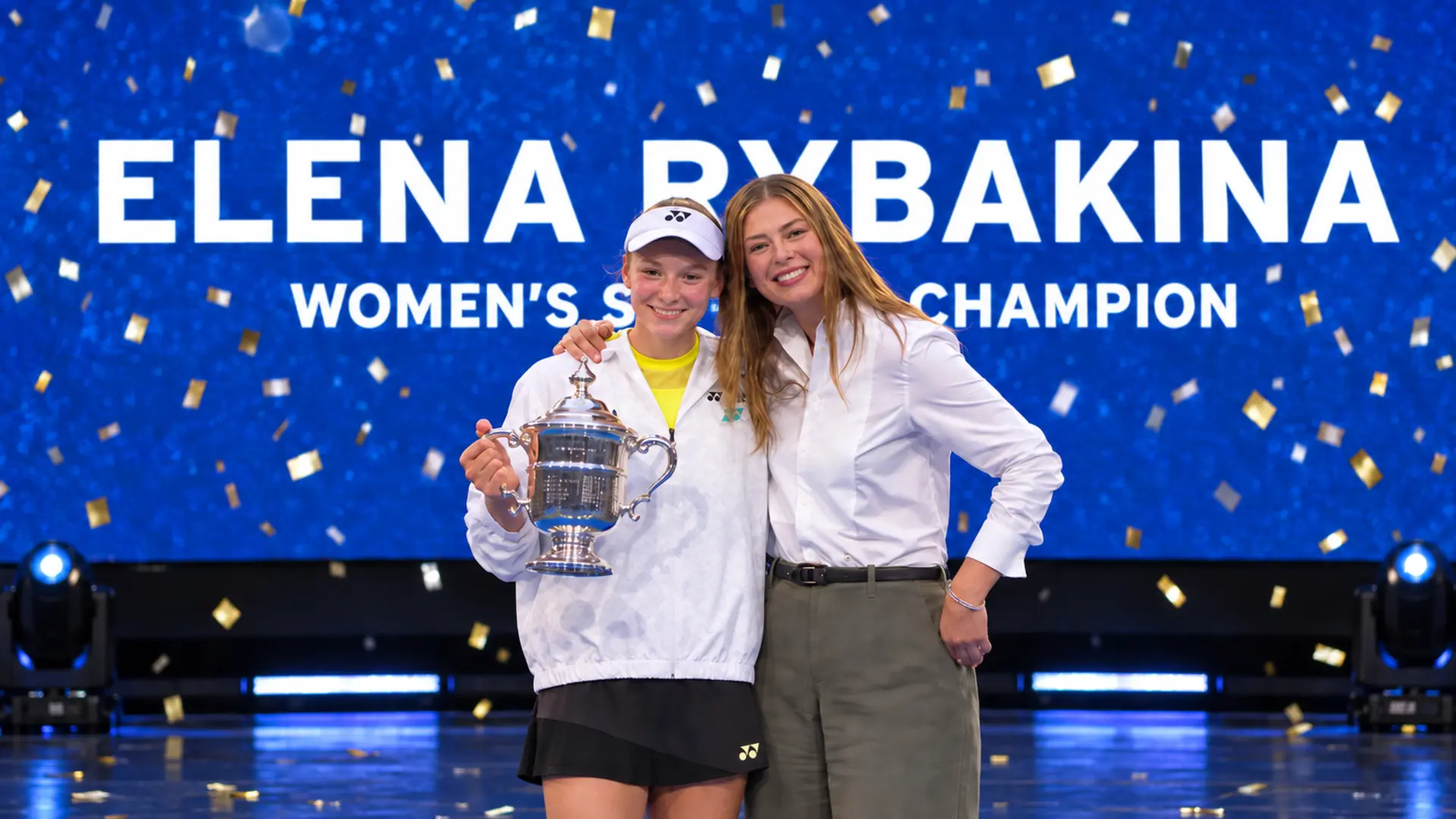
Elena Rybakina vs. Aryna Sabalenka — US Open 2026 Women’s Singles Final Match Report
It took only a handful of points inside Arthur Ashe Stadium to understand what kind of final this was going to be.
The crowd was far more evenly divided than it had been for Coco Gauff’s semifinal. The tennis was not divided at all: both women came out swinging.
Elena Rybakina landed the first punches, ripping two brilliant backhand winners and immediately establishing the wing that would hold firm throughout the match. Aryna Sabalenka survived the opening pressure, but from the beginning she looked the more agitated of the two.
Rybakina looked almost unnervingly calm.
Two hours and 21 minutes later, after an extraordinary final full of power, tactical shifts and sustained aggression, the new live World No. 1 had beaten the woman she was replacing at the top.
6-4, 5-7, 6-2.
A third Grand Slam title for Rybakina.
And, at last, a US Open trophy.

Rybakina Takes Control Before Sabalenka Can Settle
Sabalenka escaped her opening service game by the skin of her teeth.
Rybakina then answered with a love hold.
The contrast was immediate. Sabalenka looked tense; Rybakina looked composed. The Kazakh created three break points in Sabalenka’s next service game, only for the Belarusian to fight them all off.
The reprieve did not last.
On Sabalenka’s third service game, Rybakina again forced her way to break points. This time the pressure produced a double fault.
Sabalenka responded the loss of serve setback by smashing a ball into the stands and receiving a code violation.
Rybakina simply went back to work.
She consolidated the break for 4-2 and continued to dominate the baseline exchanges. Remarkably, it took roughly 25 minutes before she committed her first unforced error.
Her backhand was particularly clean, but there was very little weakness off either wing.
Sabalenka kept struggling and fighting, yet Rybakina never gave the break back.
6-4.
First set Rybakina.
Set 1 at a Glance
- Rybakina won 68% of her second-serve points (15 of 22), well ahead of Sabalenka’s 36% (5 of 14).
- Rybakina won her service games at a perfect 5 of 5, while Sabalenka managed 4 of 5.
- Rybakina closed the set 36 to 29 on total points, despite Sabalenka winning more pressure points, 60% to 40%.
Full Set 1 Stats
| Sabalenka | Statistic | Rybakina |
|---|---|---|
| Set 1 Duration: 0h45m | ||
| 0.67 | Dominance Ratio | 1.50 |
| 12 | Winners | 10 |
| 15 | Unforced Errors | 5 |
| 253 | Serve Rating | 285 |
| 3 | Aces | 3 |
| 2 | Double Faults | 1 |
| 60% (21/35) | 1st Serve % | 27% (8/30) |
| 76% (16/21) | 1st Serve Points Won | 88% (7/8) |
| 36% (5/14) | 2nd Serve Points Won | 68% (15/22) |
| 80% (4/5) | Break Points Saved | – (0/0) |
| 45 | Return Rating | 128 |
| 13% (1/8) | 1st Return Points Won | 24% (5/21) |
| 32% (7/22) | 2nd Return Points Won | 64% (9/14) |
| – (0/0) | Break Points Won | 1/5 |
| 29 | Total Points Won | 36 |
Sabalenka Begins to Find Her Level
The second set threatened to start in exactly the same way.
Sabalenka moved to 30-0 in her opening service game, only to find herself facing another two break points.
Two strong serves got her out.
Gradually, the match began to change.
Between 2-1 and 3-2, Sabalenka started striking with greater freedom. In that fifth game she produced two outstanding winners in succession, and for the first time there was a clear sense that the momentum might be shifting.
Rybakina’s response?
A hold to love.
Sabalenka finally began matching that authority on serve, producing her first love hold and then repeating the feat to move 5-4 ahead.
Now the pressure switched sides.
Sabalenka attacked Rybakina’s serve with an excellent return and created two set points.
Rybakina saved both.
Barely.
Sabalenka was suddenly the one required to hold under pressure again. She did, producing an ace at deuce before finishing the game with a huge smash for 6-5.
The level had risen dramatically.
One Drop Shot Sends Arthur Ashe Into Ecstasy
Then Sabalenka produced one of the shots of the final.
Mid-rally, seemingly from nowhere, she recognised the space in front of Rybakina and shaped a beautifully disguised drop shot.
It gave her another opportunity to take the set on Rybakina’s serve.
This time she did not let it escape.
7-5 Sabalenka.
Arthur Ashe erupted.
The quality was immense. The intensity even greater.
This no longer felt like one player imposing herself on the other.
It was a battle entirely worthy of a Grand Slam final.
Set 2 at a Glance
- Sabalenka didn’t commit a single double fault (0), while Rybakina had 2.
- Sabalenka won her service games at a perfect 6 of 6, while Rybakina fell to 5 of 6.
- Sabalenka closed the set 42 to 35 on total points, despite Rybakina hitting 4 aces to Sabalenka’s 1.
Full Set 2 Stats
| Sabalenka | Statistic | Rybakina |
|---|---|---|
| Set 2 Duration: 0h57m | ||
| 1.31 | Dominance Ratio | 0.77 |
| 12 | Winners | 11 |
| 8 | Unforced Errors | 13 |
| 305 | Serve Rating | 264 |
| 1 | Aces | 4 |
| 0 | Double Faults | 2 |
| 64% (25/39) | 1st Serve % | 61% (23/38) |
| 76% (19/25) | 1st Serve Points Won | 78% (18/23) |
| 64% (9/14) | 2nd Serve Points Won | 40% (6/15) |
| 100% (2/2) | Break Points Saved | 67% (2/3) |
| 132 | Return Rating | 60 |
| 22% (5/23) | 1st Return Points Won | 24% (6/25) |
| 60% (9/15) | 2nd Return Points Won | 36% (5/14) |
| 1/3 | Break Points Won | 0/2 |
| 42 | Total Points Won | 35 |
Rybakina Resets and Starts Firing Again
Rybakina disappeared briefly into the locker room after the second set, just as Sabalenka had done after losing the first.
Sabalenka again had to serve first in the decider.
She held impressively despite an onslaught of Rybakina forehands and backhands, but her service games remained much harder work than the score initially suggested.
Rybakina levelled at 1-1.
Then the match exploded again.
With complete commitment, the usually understated Moscow-born Kazakh began dictating from both wings.
The timing was fully back.
The backhand remained rock-solid.
The forehand began doing greater damage.
And the shoulder looked completely loose on serve.
Rybakina broke and then held, moving rapidly into command.
She missed an opportunity to stretch the advantage further from 1-3 to 1-4, but Sabalenka was increasingly feeling the pressure.
By 2-4, there was nowhere left to hide.
Rybakina broke again.
The double break was hers.
The championship was almost hers too.
An Ace Through the Middle Ends It
Rybakina served for the US Open.
The first match point disappeared.
The second did not.
She went straight through the middle.
Ace.
Sabalenka could only stand and drop her racket, breaking it after the handshake.
The match was over.
Rybakina had won her third Grand Slam title with a shot that had not even been the foundation of her performance.
And the numbers underline just how strong that performance was.
Set 3 at a Glance
- Rybakina won 100% of her first-serve points (10 of 10) and 84% of her service points overall (16 of 19).
- Rybakina won her return games 2 of 4
- Rybakina closed the set decisively, 32 to 19 on total points, hitting 5 aces to Sabalenka’s 2.
Full Set 3 Stats
| Sabalenka | Statistic | Rybakina |
|---|---|---|
| Set 3 Duration: 0h41m | ||
| 0.32 | Dominance Ratio | 3.17 |
| 8 | Winners | 15 |
| 12 | Unforced Errors | 6 |
| 201 | Serve Rating | 323 |
| 2 | Aces | 5 |
| 1 | Double Faults | 2 |
| 50% (16/32) | 1st Serve % | 53% (10/19) |
| 50% (8/16) | 1st Serve Points Won | 100% (10/10) |
| 50% (8/16) | 2nd Serve Points Won | 67% (6/9) |
| 60% (3/5) | Break Points Saved | – (0/0) |
| 33 | Return Rating | 190 |
| 0% (0/10) | 1st Return Points Won | 50% (8/16) |
| 33% (3/9) | 2nd Return Points Won | 50% (8/16) |
| – (0/0) | Break Points Won | 2/5 |
| 19 | Total Points Won | 32 |
Rybakina Wins the Serving Battle Against Sabalenka
Sabalenka is hardly accustomed to being outserved.
Here, she was.
Rybakina struck 12 aces to Sabalenka’s six and won an extraordinary 85 percent of points behind her first serve.
Sabalenka won 69 percent behind hers.
Rybakina’s average first serve came in at 112 mph (181 km/h), compared with Sabalenka’s 107 mph (173 km/h). Even on second serve, Rybakina averaged 93 mph (149 km/h) against Sabalenka’s 90 mph (145 km/h).
The first-serve percentage itself was actually lower — 47 percent for Rybakina compared with Sabalenka’s 58 — but when the first delivery landed, it was devastating.
Rybakina lost only six first-serve points all match.
She was also broken only once in 15 service games.
Against Sabalenka, in a Grand Slam final, that is some statement.
Rybakina Outhits Sabalenka Too
This was not simply a serving performance.
Rybakina finished with 36 winners and 24 unforced errors.
Sabalenka produced 32 winners but committed 35 unforced errors.
The contrast is substantial.
Rybakina’s backhand accounted for 13 winners, compared with Sabalenka’s 10, while Sabalenka produced more damage from the forehand side, 14 winners to eight.
But Rybakina gave far less away from that wing.
She committed only seven forehand unforced errors.
Sabalenka made 17.
That difference mattered enormously in a match where both women were trying to dictate.
Rybakina was not simply hitting hard.
She was hitting hard with considerably greater control.
The Numbers Confirm Who Controlled the Final
Rybakina finished with a 1.35 dominance ratio.
Sabalenka’s was 0.74.
The total points told a similar story:
Rybakina 103. Sabalenka 90.
She won 71 percent of her service points, compared with Sabalenka’s 61 percent, and also took 39 percent of return points.
At net, Rybakina was excellent too, winning 10 of 13 points.
Even the physical numbers tell part of the story.
Rybakina covered 1,521 metres, more than Sabalenka’s 1,413, yet still looked composed deep into the deciding set.
This was not a smash-and-grab final.
Across three sets, Rybakina was the stronger player.
From an Achilles Concern to the US Open Trophy
That makes the broader arc of her tournament even more remarkable.
Rybakina arrived in New York with questions surrounding an Achilles problem.
She leaves with the trophy.
And look at the route she eventually had to take.
Qinwen Zheng.
The deeper the tournament went, the more formidable the opposition became.
Rybakina kept winning.
She had already secured the live World No. 1 ranking before the final. Now she had beaten the reigning No. 1 for the title as well.
There could hardly have been a more emphatic way to complete the change at the top.
Sharapova Welcomes the New Champion
As preparations began for the trophy ceremony, Maria Sharapova spoke at length with Rybakina.
It was a striking scene.
A Russian former US Open champion standing alongside a Moscow-born player who had just conquered New York herself.
For Rybakina, the historical significance was matched by the scale of the performance.
This was not a title won because Sabalenka disappeared.
Sabalenka battled hard enough to drag the final into a third set and produced stretches of magnificent tennis herself.
Rybakina simply had more.
The Best Player Won
It could have ended in two sets.
Instead, Sabalenka forced a third and helped turn the final into one of the showpieces of the tournament.
But once Rybakina rediscovered her timing in the decider, she began taking the match away again.
She served better, she made fewer errors, and she struck more winners.
She moved Sabalenka around the court and absorbed the Belarusian’s power without losing control of her own game.
By the end, even the Arthur Ashe crowd that had initially leaned toward Sabalenka had been won over.
The woman who entered the US Open with an Achilles concern had worked her way through big names and emerged with the trophy.
A remarkable fortnight.
A third Grand Slam title.
And perhaps the clearest evidence yet that, at the age and stage of her career when many players settle into what they are, Elena Rybakina is seemingly still getting better.