
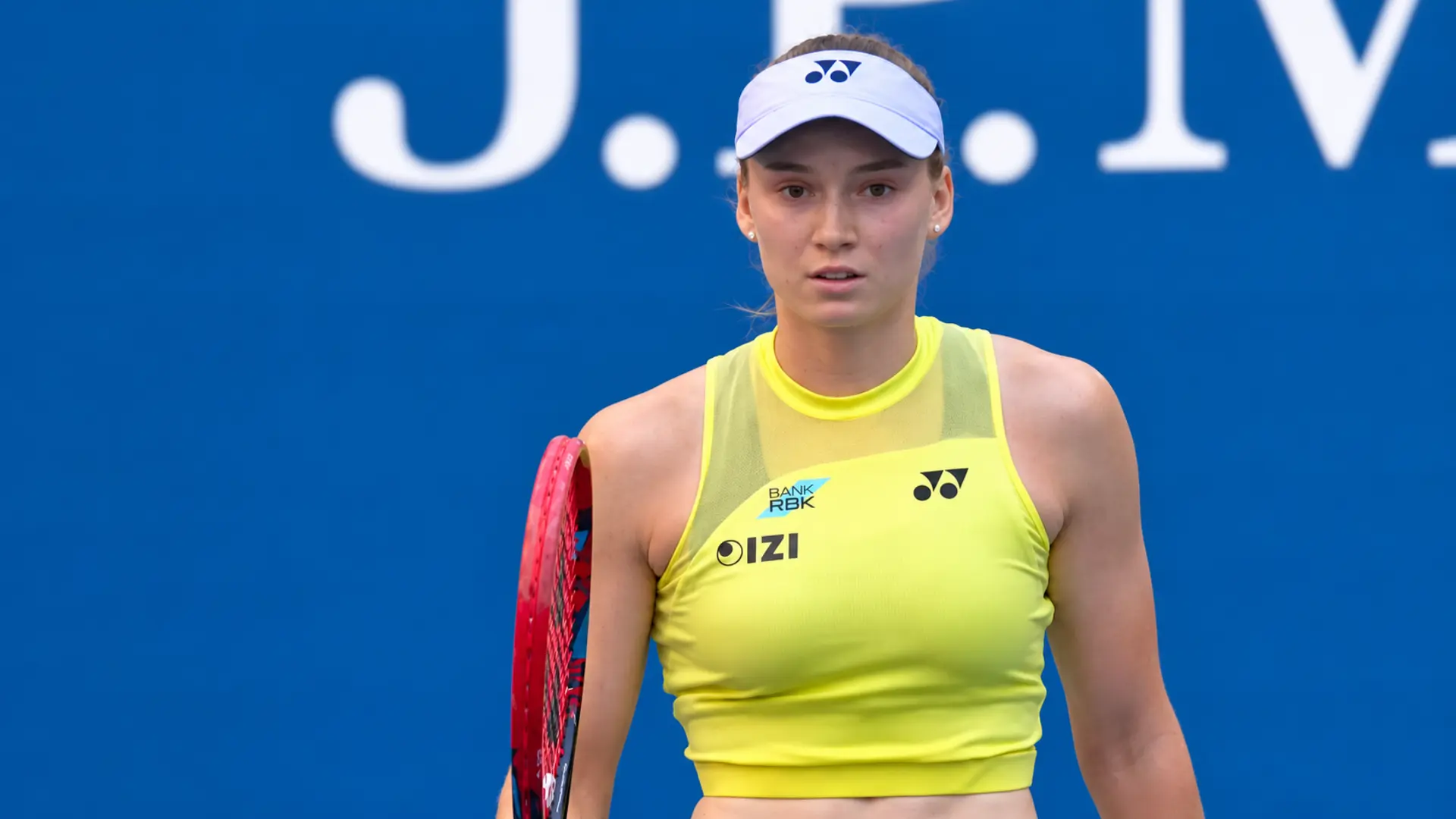
Naomi Osaka vs. Elena Rybakina — US Open 2026 Fourth-Round Match Report
Naomi Osaka was present for this one.
For long stretches, that was about as much influence as Elena Rybakina allowed her.
Rybakina produced one of her most complete performances of the tournament to win 6-1, 6-4, serving superbly, striking her backhand with its usual authority and, crucially, finding a forehand that was fully switched on from the beginning.
When all three pieces worked together, Osaka had nowhere to go.
The Moscow-born Kazakh is now into the US Open quarterfinals and, according to the ranking scenario entering this match, stands one victory away from becoming the new world No. 1.
Four opponents have tried to stop her in New York.
None has managed it.
Next comes Qinwen Zheng.
Rybakina Takes the First Set Away Almost Immediately
The opening two games went with serve.
That was as balanced as the set became.
Rybakina held for 2-1 and then broke Osaka for 3-1.
A hold pushed the lead to 4-1.
Then came another break.
5-1.
Rybakina served it out.
6-1.
From 1-1, she had won five consecutive games.
There was very little Osaka could do with the combination coming from the other side. Rybakina was getting enough first serves in, but the greater problem was what happened when they landed.
The points were frequently over before Osaka could establish herself.
Set 1 at a Glance
- Rybakina won 80% of pressure points (4 of 5) against Osaka’s 20% (1 of 5), the biggest gap on the page.
- Rybakina saved her lone break point and converted 2 of 3 herself, while Osaka went 0 for 1 on her own chance.
- Rybakina closed the set comfortably, 25 to 14 on total points, without a single double fault against Osaka’s 3.
Full Set 1 Stats
| Osaka | Statistic | Rybakina |
|---|---|---|
| Set 1 Duration: 0h22m | ||
| 0.56 | Dominance Ratio | 1.79 |
| 3 | Winners | 10 |
| 6 | Unforced Errors | 5 |
| 168 | Serve Rating | 283 |
| 1 | Aces | 2 |
| 3 | Double Faults | 0 |
| 57% (8/14) | 1st Serve % | 68% (17/25) |
| 63% (5/8) | 1st Serve Points Won | 88% (15/17) |
| 17% (1/6) | 2nd Serve Points Won | 25% (2/8) |
| 33% (1/3) | Break Points Saved | 100% (1/1) |
| 87 | Return Rating | 255 |
| 12% (2/17) | 1st Return Points Won | 38% (3/8) |
| 75% (6/8) | 2nd Return Points Won | 83% (5/6) |
| 0/1 | Break Points Won | 2/3 |
| 14 | Total Points Won | 25 |
Osaka Stays With Her Until 3-3
The second set at least gave Osaka some room to breathe.
She held for 1-0.
Rybakina answered.
That pattern continued through 3-3, with Osaka doing a much better job of protecting her own serve and preventing the match from running away as quickly as the first set had.
Then Rybakina struck.
She broke for 4-3.
This time there was no immediate answer.
Rybakina held for 5-3.
Osaka held for 5-4, forcing Rybakina to serve for the match.
There was no drama.
Rybakina closed it out to love, just as efficiently as she had handled almost every service game throughout the evening.
6-4.
That final hold summed up the match perfectly. Osaka could occasionally stay with her from the baseline, but on Rybakina’s serve she was given virtually nothing to work with.
Set 2 at a Glance
- Rybakina hit 5 aces to Osaka’s 1, and won 77% of her service points (20 of 26) against Osaka’s 58% (21 of 36).
- Osaka actually won 8 of 9 pressure points, yet Rybakina still took the set — a case where the raw numbers didn’t decide the outcome.
- Rybakina closed it out 35 to 27 on total points, with 19 winners to Osaka’s 6.
Full Set 2 Stats
| Osaka | Statistic | Rybakina |
|---|---|---|
| Set 2 Duration: 0h45m | ||
| 0.55 | Dominance Ratio | 1.81 |
| 6 | Winners | 19 |
| 9 | Unforced Errors | 12 |
| 252 | Serve Rating | 311 |
| 1 | Aces | 5 |
| 2 | Double Faults | 1 |
| 69% (25/36) | 1st Serve % | 54% (14/26) |
| 68% (17/25) | 1st Serve Points Won | 86% (12/14) |
| 36% (4/11) | 2nd Serve Points Won | 67% (8/12) |
| 80% (4/5) | Break Points Saved | – (0/0) |
| 47 | Return Rating | 136 |
| 14% (2/14) | 1st Return Points Won | 32% (8/25) |
| 33% (4/12) | 2nd Return Points Won | 64% (7/11) |
| – (0/0) | Break Points Won | 1/5 |
| 27 | Total Points Won | 35 |
The Serve Gives Osaka Almost Nothing
Rybakina’s serving statistics were exceptional.
She landed 61 percent of first serves and won 87 percent of those points — 27 of 31.
She hit seven aces against one double fault.
Most strikingly, she did not lose serve once.
Osaka generated only one break point in the entire match.
Rybakina saved it.
Her average first serve travelled at 111 mph (179 km/h), compared with Osaka’s 104 mph (168 km/h).
That difference in speed mattered, but placement and the first shot after the serve mattered just as much.
Osaka was allowed almost no neutral return games from which to build pressure.
And Then There Was the Forehand
The Rybakina backhand was as dependable as expected.
The forehand made the performance something else.
She repeatedly found clean acceleration from that wing, taking time away from Osaka and preventing the Japanese player from settling into the kind of baseline rhythm she needed.
The winner count says plenty.
Rybakina 29. Osaka 9.
The gap was enormous.
Rybakina committed 17 unforced errors, only two more than Osaka’s 15, despite producing more than three times as many winners.
That is the trade-off every attacking player wants.
She was taking the risks.
She was also receiving almost all the reward.
Her dominance ratio finished at 1.68, compared with Osaka’s 0.60.
This was not a match decided by a handful of important points.
Rybakina dominated it.
Osaka Cannot Get Into the Return Games
Perhaps the most unforgiving number for Osaka was her return performance against Rybakina’s first serve.
She won only four of 31 points — 13 percent.
That essentially removed one entire route into the match.
Even when Rybakina missed the first delivery, Osaka could not apply enough sustained pressure to compensate.
She won half of the points against the second serve, but there simply were not enough openings.
At the other end, Rybakina attacked Osaka’s second delivery mercilessly.
She won 71 percent of those return points.
Osaka committed five double faults and won only 29 percent behind her second serve.
Against Rybakina in this form, that was never going to survive.
Four Down, Zheng Next
Rybakina has now removed four opponents from her path at this US Open.
None has found the answer.
Osaka certainly did not.
Now comes a very different challenge in Qinwen Zheng, who has produced her own extraordinary run through New York.
The quarterfinal also carries an enormous prize for Rybakina.
One more victory would, on the ranking scenario supplied for this tournament, take her to world No. 1.
That makes Zheng the final obstacle between Rybakina and the top ranking.
And Zheng is hardly arriving quietly.
She has already shown repeatedly in New York that seemingly lost matches are not necessarily lost at all.
Rybakina, though, will enter the quarterfinal with a simpler calculation.
If the serve remains this sharp, the backhand this solid and the forehand this destructive, Zheng may have to produce something exceptional.
Now only Zheng stands between Rybakina and the No. 1 ranking.
One more win, and Elena Rybakina reaches the top of women’s tennis.