
Iga Swiatek vs. Qinwen Zheng — US Open 2026 Fourth-Round Match Report
Qinwen Zheng has now done it twice at this US Open.
Against Madison Keys, she came back from 0-5 in the deciding set.
Against Iga Swiatek, she did it again from 0-5 in the opening set.
This time there was no third set required.
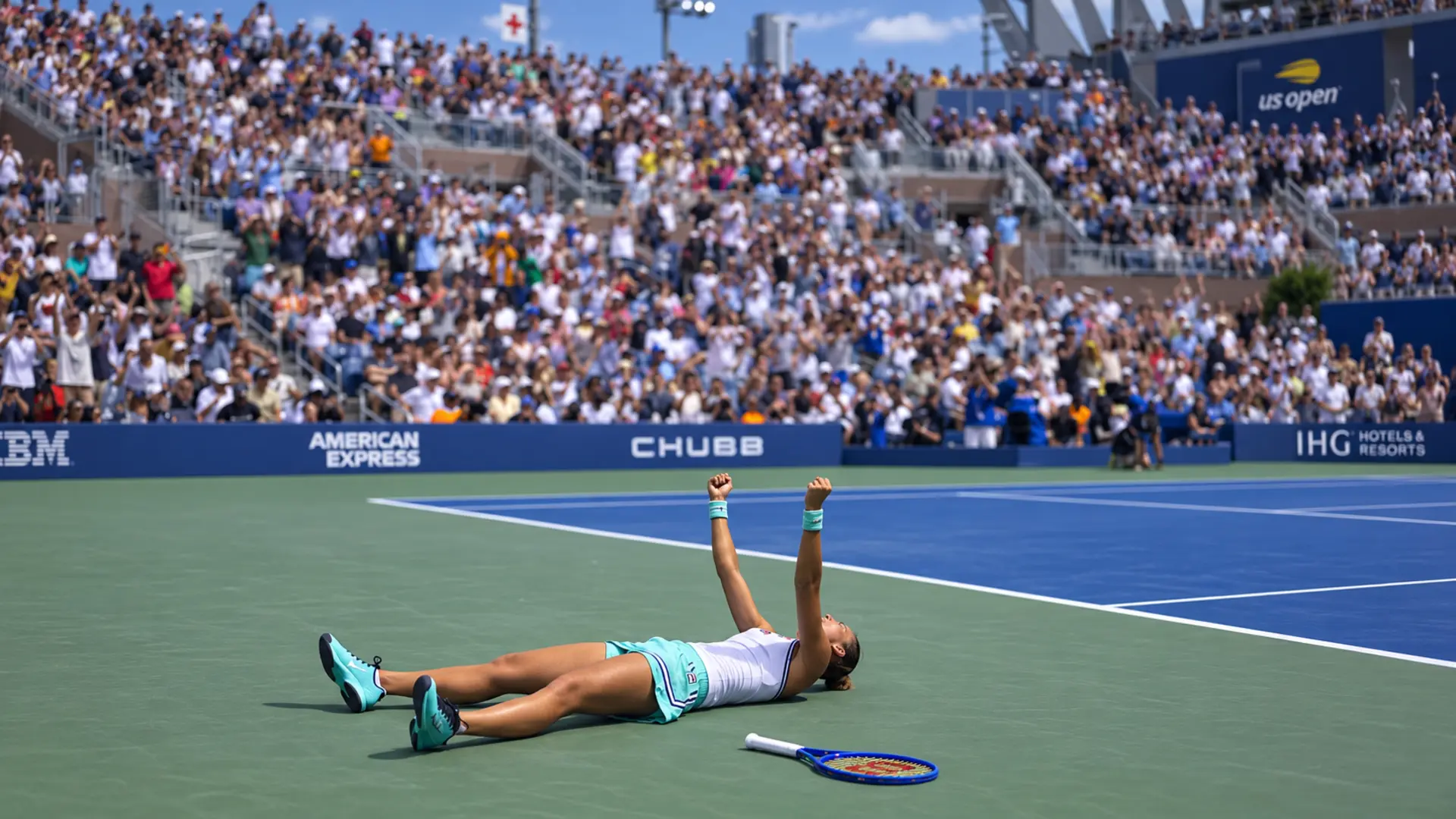
Zheng transformed what looked like an impending first-set demolition into a 7-5, 6-3 victory, reaching the US Open quarterfinals with her seventh win in seven matches at this tournament.
For Swiatek, the ending was much darker. The player who had recently won Montreal gradually lost command of both her serve and herself.
For Zheng, the message is becoming difficult to miss.
Queen Zheng is back.
Swiatek Races to 5-0 and Then Stops
For five games, this looked nothing like a comeback story.
Swiatek held to open the match, broke for 2-0, held for 3-0 and broke again for 4-0.
Another hold made it 5-0.
Zheng had barely established herself in the contest.
Then she held for 5-1.
That was all she needed to begin changing its direction.
At 5-1, Zheng broke Swiatek after a long game in which the Pole had opportunities to stop the momentum before it could properly develop.
5-2.
Zheng held for 5-3.
Swiatek then served for the set again.
Zheng broke again.
5-4.
By then the five-game advantage had stopped looking secure and started looking like baggage.
Zheng held for 5-5.
Then came a third consecutive break of the Swiatek serve.
6-5.
Zheng served it out.
7-5.
Seven consecutive games.
For the second time in this tournament, she had turned 0-5 into set victory.
Set 1 at a Glance
- Zheng won 60% of pressure points (12 of 20) to Swiatek’s 40% (8 of 20), the biggest gap on the page.
- Zheng won 81% of her first-serve points (13 of 16), well above Swiatek’s 59% (20 of 34) despite serving far fewer first-serve attempts.
- Zheng edged the total points race 41 to 37, backed by fewer unforced errors, 10 to Swiatek’s 14.
Full Set 1 Stats
| Swiatek | Statistic | Zheng |
|---|---|---|
| Set 1 Duration: 0h59m | ||
| 0.82 | Dominance Ratio | 1.22 |
| 7 | Winners | 9 |
| 14 | Unforced Errors | 10 |
| 223 | Serve Rating | 242 |
| 0 | Aces | 1 |
| 2 | Double Faults | 1 |
| 74% (34/46) | 1st Serve % | 50% (16/32) |
| 59% (20/34) | 1st Serve Points Won | 81% (13/16) |
| 42% (5/12) | 2nd Serve Points Won | 44% (7/16) |
| 57% (4/7) | Break Points Saved | 60% (3/5) |
| 148 | Return Rating | 192 |
| 19% (3/16) | 1st Return Points Won | 41% (14/34) |
| 56% (9/16) | 2nd Return Points Won | 58% (7/12) |
| 2/5 | Break Points Won | 3/7 |
| 37 | Total Points Won | 41 |
Zheng Does Not Need Another Miracle in the Second
The second set initially settled into something more conventional.
Swiatek held for 1-0.
Zheng answered.
The same pattern continued through 3-3.
This time Zheng did not wait until the scoreboard became desperate.
She broke Swiatek for 4-3.
Then she held for 5-3.
The pressure had shifted completely.
Swiatek was now serving to stay in the match, and what followed showed how far her control had slipped.
Zheng raced to 0-40, creating three consecutive match points.
Swiatek saved all three and reached deuce.
For a moment, that looked like resistance.
It wasn’t enough.
Zheng found another match point and converted.
6-3.
Set 2 at a Glance
- Zheng won her service games at a perfect 4 of 4, while Swiatek’s serve was broken twice, dropping to 3 of 5.
- Zheng won 88% of her first-serve points (7 of 8) and saved both break points she faced.
- Zheng closed out the set 34 to 26 on total points, despite Swiatek not committing a single double fault (0) to Zheng’s 1.
Full Set 2 Stats
| Swiatek | Statistic | Zheng |
|---|---|---|
| Set 2 Duration: 0h54m | ||
| 0.65 | Dominance Ratio | 1.53 |
| 10 | Winners | 11 |
| 14 | Unforced Errors | 7 |
| 231 | Serve Rating | 281 |
| 1 | Aces | 2 |
| 0 | Double Faults | 1 |
| 65% (22/34) | 1st Serve % | 31% (8/26) |
| 55% (12/22) | 1st Serve Points Won | 88% (7/8) |
| 50% (6/12) | 2nd Serve Points Won | 61% (11/18) |
| 67% (4/6) | Break Points Saved | 100% (2/2) |
| 52 | Return Rating | 168 |
| 13% (1/8) | 1st Return Points Won | 45% (10/22) |
| 39% (7/18) | 2nd Return Points Won | 50% (6/12) |
| 0/2 | Break Points Won | 2/6 |
| 26 | Total Points Won | 34 |
Swiatek Loses 14 of the Final 20 Points
The closing numbers reveal how sharply the match moved away from Swiatek.
Across the final 20 points, Zheng won 14.
More damagingly for Swiatek, 14 of those 20 points were played on her serve.
She won only five of those 14 service points.
That is where the mental and technical problems began to overlap.
Swiatek’s frustration became increasingly visible as the second set progressed, but the serve offered no safe place from which to reset.
Zheng kept getting into return games.
Swiatek kept being asked another question.
Eventually, there were too many. Once the rallies developed, backhands began sailing long and forehands drifting wide.
The overall return numbers support the same picture. Zheng won 43 percent of Swiatek’s first-serve points and 54 percent behind the second serve.
Swiatek, by contrast, won only 17 percent of points returning Zheng’s first serve.
Zheng Wins Despite Landing Only 41 Percent of First Serves
One of the more remarkable statistics is that Zheng did all this while landing only 41 percent of her first serves.
Normally that would invite trouble against a returner of Swiatek’s quality.
Instead, when Zheng did land the first serve, it was devastating.
She won 20 of 24 first-serve points — 83 percent.
Her average first-serve speed was also substantially higher, 109 mph (176 km/h) to Swiatek’s 96 mph (154 km/h).
That gave Zheng a completely different type of protection.
Even when the first serve was not appearing often enough, Swiatek was unable to punish it consistently.
The winner-error balance told another part of the story.
Zheng finished with 20 winners and 17 unforced errors.
Swiatek had 17 winners and 28 unforced errors.
In a match that began with Swiatek completely in command, that reversal was severe.
Montreal Suddenly Feels Further Away for Swiatek
Swiatek had arrived in New York after winning the Canadian Open.
This performance did not look like a continuation of that momentum.
At its worst, particularly late in the second set, it looked uncomfortably like a return to some of the uncertainty she had seemed to move beyond.
But there is also reason not to turn one defeat into a verdict.
Swiatek is still only 25.
A demanding run can empty the engine, and this may ultimately prove to have been no more complicated than an off-day at the wrong tournament.
What cannot be ignored is that she is now down to world No. 9, and the manner in which this match escaped will sting.
Losing from 5-0 up is one thing.
Never really recovering after it is another.
Hence the tears in the corridor after the match.
Tennis clearly means everything to Iga Swiatek, and the weight of Poland’s expectations is something she plainly feels. Perhaps the challenge now is learning not to let that burden become quite so heavy.
Seven Matches, Seven Wins for Zheng
Zheng’s story is moving in the opposite direction.
Her US Open began in qualifying.
Seven matches later, she is in the quarterfinals.
She has now survived two extraordinary 0-5 deficits and, rather than merely hanging around the tournament, increasingly looks capable of shaping it.
Next will be either Naomi Osaka or Elena Rybakina.
Those are two very different propositions.
An Osaka matchup would carry enormous attention in China and bring its own weight of expectation.
Against Rybakina, Zheng might feel she could swing rather more freely in a matchup with less of that surrounding pressure.
Either way, she is there.
Seven played.
Seven won.
After the difficulties that preceded this tournament, the qualifier label is beginning to look badly outdated.
Qinwen Zheng arrived in New York trying to rebuild. She is leaving each round looking more like the Olympic champion again.