
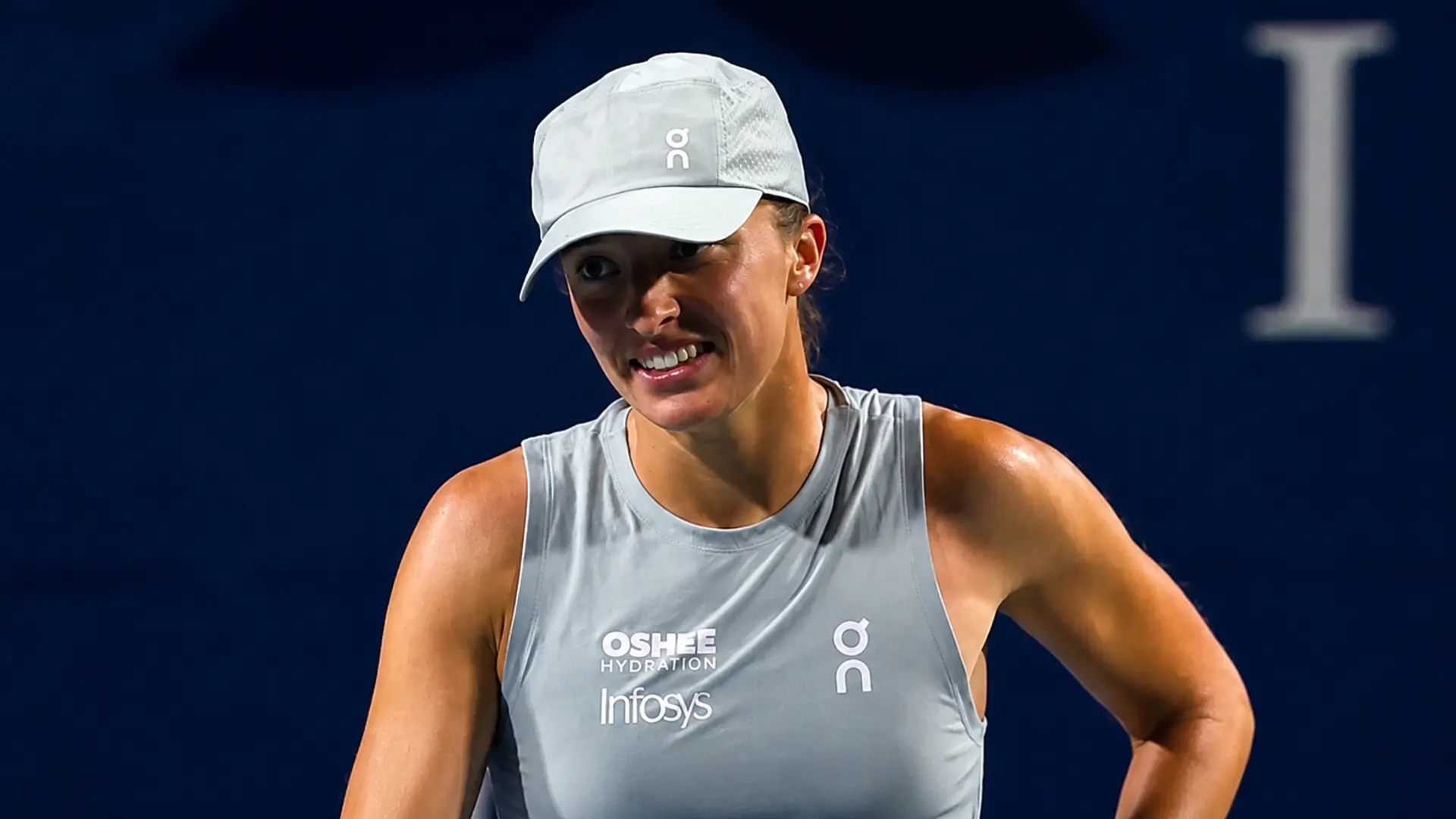
Iga Swiatek’s collapse from 5-0 up against Zheng Qinwen at the 2026 US Open left Boris Becker with a bigger concern than the result itself.
Swiatek had raced through the opening 23 minutes of their fourth-round match and appeared in complete control. Zheng then won seven consecutive games to steal the first set before completing a 7-5, 6-3 victory. It was one of the biggest turnarounds of the tournament.
On the Becker Petkovic podcast, Becker and Andrea Petkovic used that collapse to examine a deeper question: has Swiatek moved too far away from the tennis identity that originally made her dominant?
Becker: Is This Still Swiatek’s Tennis?
Becker was struck by how suddenly the match changed.
Swiatek had led 5-0 against a player who had come through qualifying and already spent enormous amounts of time on court. Then, in Becker’s words, there was a “total collapse.”
He questioned whether the changes Swiatek has been working on — more topspin, more margin over the net and longer rallies — really fit the player she is.
“Is that really the DNA of Iga Swiatek? Can she change her game that much, or is the change simply too big?”
For Becker, the danger appears in the biggest moments.
A player can work on a new pattern in practice, but under pressure the old instincts and the new instructions can collide.
“In critical moments, when doubts come in, you don’t quite know: do you remember last year, or play the way the coach wants?”
That uncertainty, Becker suggested, may explain some of what happened against Zheng.

‘You’re Changing Her Characteristics as a Tennis Player’
Becker went further. He said he is generally skeptical when coaches try to fundamentally alter an established champion.
“I always find it difficult with great champions like Iga Swiatek to want to change something fundamental.”
His concern was not about adding one tactical variation. It was about changing the defining characteristics of a player who has already won six Grand Slam titles.
“You’re changing her characteristics as a tennis player. I basically think that’s impossible.”
Becker then reached for Rafael Nadal as the obvious comparison.
He joked that telling Nadal to flatten out his forehand or stop finishing the stroke with his trademark wrap above the head would have been absurd.
“If I’d told Rafa to hit the forehand flatter and stop with the helicopter around his head, he would have laughed at you.”
The joke carried a serious point.
Great players are not simply collections of technically efficient strokes. Their habits, patterns and instincts are part of why they became great in the first place.
Becker Thinks Swiatek Is Still Searching
Becker believes Swiatek has not yet found a settled answer.
He described her as trying to rediscover the player she was a couple of seasons ago while simultaneously incorporating newer ideas.
“I think she’s still searching a little for the player from two years ago — the player who was winning.”
He also argued that, by Swiatek’s own standards, the Grand Slam return has become comparatively modest.
His conclusion was not that the changes have failed completely. Rather, he expects the process to remain uncomfortable.
“I see a long autumn ahead of her. I don’t think she’s finished searching for how she wants to define herself as a player.”
That became the central theme of the discussion: not whether Swiatek is still elite, but whether she currently knows exactly which version of Swiatek she wants to be.
Petkovic Explains Swiatek’s Two Tennis Identities
Petkovic agreed with Becker’s broader point but gave a more detailed explanation of how Swiatek reached this stage.
In her view, Swiatek has essentially played two different brands of tennis during her career.
The original version was built around heavy forehand spin, an aggressive backhand, elite movement and extraordinary returning.
“When she came on tour, she played the forehand with a lot of spin, attacked with the backhand and moved better than most.”
Petkovic described that version as Swiatek’s genuine tennis DNA.
She served with kick, entered rallies patiently and neutralized almost everything on return.
“Every serve she could get a racket on came back. She neutralized it, then attacked the second serve.”
That style had made Swiatek extraordinarily difficult to overwhelm.
But then the landscape of women’s tennis changed.
Sabalenka and Rybakina Forced a Rethink
Petkovic pointed specifically to Aryna Sabalenka and Elena Rybakina.
At the time, those two were increasingly dictating matches through power, first-strike tennis and superior serving. From a coaching perspective, Petkovic said, the conclusion was understandable: if those are the women setting the standard, Swiatek has to become more aggressive too.
“You look at Sabalenka and Rybakina and say: these are the best players in the world right now, and this is how they play.”
That led to work on Swiatek’s serve and a more forceful baseline style.
Petkovic jokingly described the result as Swiatek becoming more of a pure ball-striker — someone constantly trying to hit through opponents.
The problem, in her view, was consistency.
“She won Wimbledon, but in terms of consistency she wasn’t the Iga Swiatek she had been before.”
Winning Wimbledon showed that the more aggressive version could work spectacularly.
But it did not necessarily settle the question of what style Swiatek should trust week after week.
Petkovic: The Pendulum Swung Too Far
Petkovic said the more recent attempt has been to move Swiatek back toward the earlier version — more spin, more margin and more rally tolerance.
She understands the logic.
But she thinks the adjustment may have created a new problem.
“Maybe the pendulum swung too far in the other direction.”
Instead of being overly aggressive, Swiatek can now appear uncertain about when to attack and when to hold back.
That balance is where Petkovic believes the real work lies.
“Maybe she became a little too passive, or didn’t quite know: when do I go for it, and when do I hold?”
The problem is therefore not simply forehand technique or the amount of topspin on the ball.
It is decision-making.
The New Game Has Not Yet Reached the Subconscious
Petkovic believes Swiatek can execute the newer style when she is playing freely.
She pointed to strong summer performances as evidence that the tennis itself is there.
The issue becomes more visible at a Grand Slam, where the pressure rises and decisions have to become automatic.
That, Petkovic said, is what the Zheng match exposed.
“At a Grand Slam, the pressure multiplies. You can see the new style hasn’t completely reached the subconscious yet.”
She stressed that progress is being made.
“It’s slowly getting there, but it still isn’t completely in the subconscious.”
For Petkovic, Swiatek eventually needs to reach the point where she no longer consciously debates what kind of shot the situation requires.
The decision has to happen naturally.
Petkovic Is Waiting for the Balance Between Attack and Defense
Petkovic compared that instinctive decision-making with what she had seen from Alexander Zverev during the same US Open.
Her admiration was for the way he recognized when to absorb, when to play with margin and when to increase the pressure.
That is what she is still waiting to see consistently from Swiatek.
“That’s what I’m still waiting for with Iga — for the balance between attack and defense to become completely natural.”
That may be the most important line from the entire discussion.
Becker sees a champion searching for her identity.
Petkovic sees something slightly more specific: a champion who already possesses both versions of the game, but has not yet made the transition between them instinctive.
Against Zheng, that uncertainty became visible in dramatic fashion.
The question Becker and Petkovic raised is therefore larger than one defeat.
Swiatek does not need to become Sabalenka or Rybakina.
She may first need to decide exactly how much of the original Swiatek she wants back.