
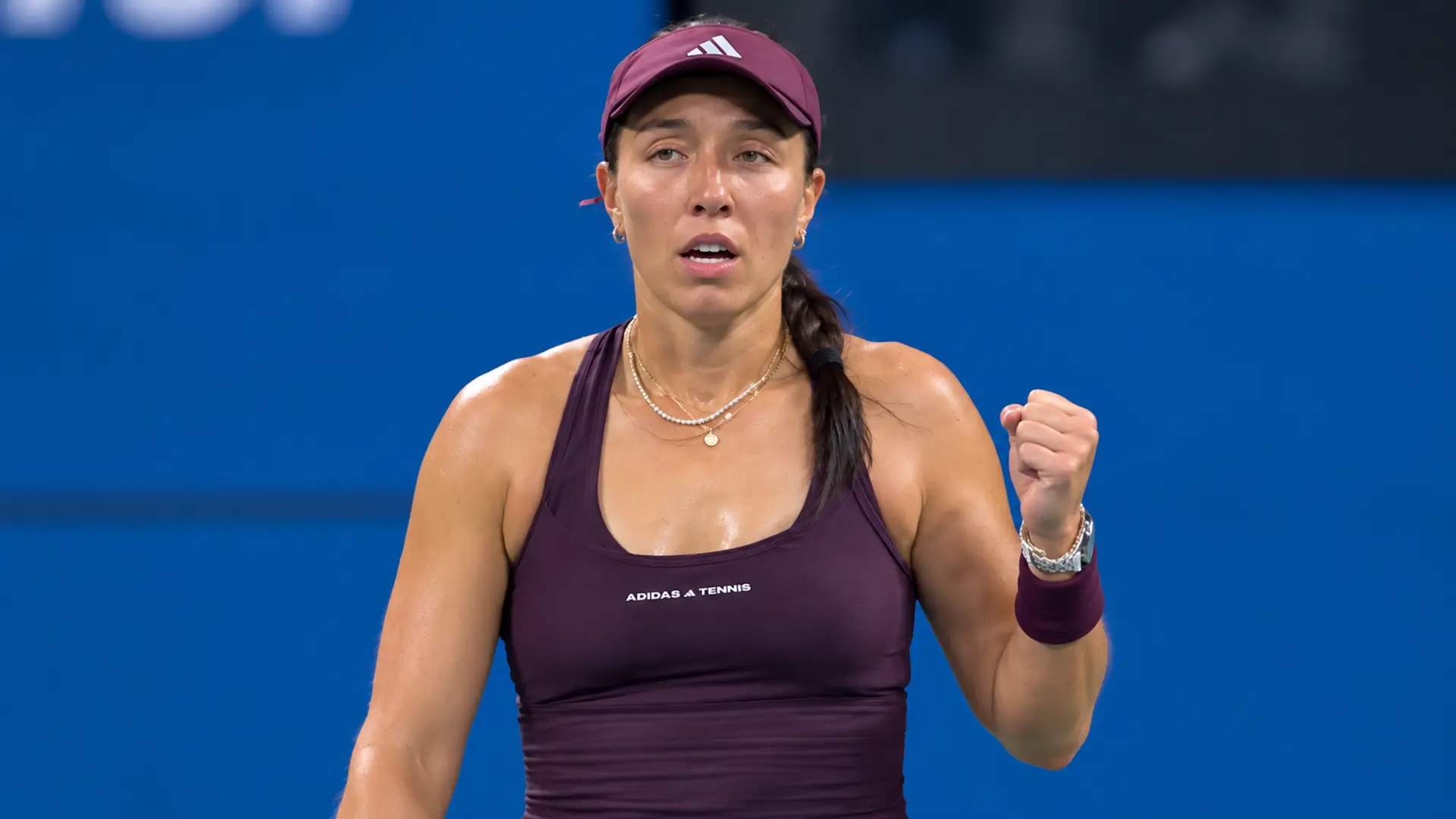
Jessica Pegula vs. Sorana Cirstea — US Open 2026 Fourth-Round Match Report
Jessica Pegula has reached the US Open quarterfinals without spending much unnecessary time getting there.
Sorana Cirstea made this one considerably less tidy than the score suggests, particularly once both women began attacking each other’s service games, but Pegula kept finding the better response.
The American won 6-3, 6-4, ending another remarkable New York run from the 36-year-old Romanian and setting up an all-American quarterfinal against Emma Navarro.
Pegula’s route has been efficient. Before facing Cirstea, she had spent only four hours and 30 minutes on court across three matches: 1:23 against Elena-Gabriela Ruse, 56 minutes against Sofia Kenin and 2:11 against Leylah Fernandez.
The fourth round added another straight-set victory rather than another long night.
Pegula Turns Cirstea’s Serve Into the First-Set Problem
Pegula immediately went after the Cirstea serve.
She broke in the opening game, held for 2-0 and then broke again for 3-0.
The start was even more one-sided than the score suggested: Cirstea did not win her first point of the match until the 14th point played.
Only then did the Romanian begin to find a foothold.
She broke Pegula for 3-1 and held for 3-2, suddenly turning what had looked like a runaway opening into a competitive set.
Pegula steadied herself with a hold for 4-2 and then struck again, breaking for 5-2.
Again Cirstea resisted.
She broke Pegula as the American served for the set, reducing the deficit to 5-3.
But there was no second escape.
Pegula broke once more to take it 6-3.
Five of the nine games had gone against serve.
The score looked comfortable.
The baseline battle was intense.
The route there was not.
Set 1 at a Glance
- Pegula won 67% of pressure points (12 of 18) to Cirstea’s 33% (6 of 18), a decisive gap.
- Pegula converted 4 of 6 break points against Cirstea’s serve, well ahead of Cirstea’s 2 of 5 the other way.
- Pegula took the total points battle comfortably, 37 to 25, backed by 3 aces to Cirstea’s 0.
Full Set 1 Stats
| Pegula | Statistic | Cirstea |
|---|---|---|
| Set 1 Duration: 0h38m | ||
| 1.39 | Dominance Ratio | 0.72 |
| 8 | Winners | 7 |
| 10 | Unforced Errors | 13 |
| 209 | Serve Rating | 136 |
| 3 | Aces | 0 |
| 3 | Double Faults | 2 |
| 54% (15/28) | 1st Serve % | 44% (15/34) |
| 67% (10/15) | 1st Serve Points Won | 53% (8/15) |
| 38% (5/13) | 2nd Serve Points Won | 21% (4/19) |
| 60% (3/5) | Break Points Saved | 33% (2/6) |
| 273 | Return Rating | 185 |
| 47% (7/15) | 1st Return Points Won | 33% (5/15) |
| 79% (15/19) | 2nd Return Points Won | 62% (8/13) |
| 4/6 | Break Points Won | 2/5 |
| 37 | Total Points Won | 25 |
Cirstea Threatens a Second-Set Turnaround
The opening three games of the second set stayed with serve.
Pegula then made the first move, breaking for 3-1 and holding for 4-1.
That should have provided breathing room.
Instead, the match became unstable again.
Cirstea held for 4-2 and then broke Pegula to move within a game at 4-3.
From there, neither woman could protect serve.
Pegula broke for 5-3.
Cirstea broke back for 5-4.
Then, with the Romanian serving to stay in the match, Pegula broke for the third consecutive game.
6-4.
It was an appropriately scrappy ending to a match in which return games repeatedly carried more authority than service games.
Set 2 at a Glance
- Pegula won 55% of her first-serve return points (11 of 20) against Cirstea’s serve, well ahead of Cirstea’s 31% (4 of 13) the other way.
- Both players faced heavy break-point pressure. Cirstea saved 7 of 10, Pegula 4 of 6, but neither converted well on offense (Pegula 3 of 10, Cirstea 2 of 6).
- Pegula edged the total points race 37 to 32, despite the two being nearly even on pressure points (52% to 48%).
Full Set 2 Stats
| Pegula | Statistic | Cirstea |
|---|---|---|
| Set 2 Duration: 0h48m | ||
| 1.16 | Dominance Ratio | 0.86 |
| 11 | Winners | 8 |
| 13 | Unforced Errors | 12 |
| 213 | Serve Rating | 192 |
| 2 | Aces | 1 |
| 2 | Double Faults | 0 |
| 39% (13/33) | 1st Serve % | 56% (20/36) |
| 69% (9/13) | 1st Serve Points Won | 45% (9/20) |
| 45% (9/20) | 2nd Serve Points Won | 50% (8/16) |
| 67% (4/6) | Break Points Saved | 70% (7/10) |
| 195 | Return Rating | 159 |
| 55% (11/20) | 1st Return Points Won | 31% (4/13) |
| 50% (8/16) | 2nd Return Points Won | 55% (11/20) |
| 3/10 | Break Points Won | 2/6 |
| 37 | Total Points Won | 32 |
Pegula’s Return Does the Heavy Lifting
Pegula’s serving numbers were hardly pristine.
She landed only 46 percent of first serves, committed five double faults and held five of nine service games.
But Cirstea was under even more pressure.
She held only three of ten service games.
Pegula converted seven of 16 break points and won 59 percent of her return points overall.
The most damaging number for Cirstea was the second serve.
Pegula won 66 percent of points against it.
Even Cirstea’s first serve offered limited protection: she won only 49 percent of those points.
That made it extremely difficult to build any sustained scoreboard pressure.
Pegula did not need her cleanest serving performance because her return kept giving her another way into the match.
Not Brilliant, but Efficient
The overall statistics fit the nature of the contest.
Pegula hit 19 winners and 23 unforced errors.
Cirstea finished with 15 winners and 25 errors.
Neither produced the kind of numbers associated with a flawless performance.
Pegula simply controlled more of the important exchanges.
Her dominance ratio finished at 1.28, compared with Cirstea’s 0.78, and she won 74 of the 131 points.
That 17-point advantage is considerably clearer than some of the individual games felt.
Whenever the match threatened to become complicated, Pegula generally found a way to prevent it from staying complicated for long.
A Buffalo-Born New Yorker Keeps Moving
There is a little extra symmetry to Pegula doing this in New York.
She was born in Buffalo, and local station WKBW has long described her as a Western New York native. Her parents, Terry and Kim Pegula, own the Buffalo Bills and Buffalo Sabres.
Her tennis story did not remain in Buffalo, however. Pegula has explained that she first took up the sport partly because her older sister played, before moving to Hilton Head, South Carolina, after a coach recognised her ability at a young age.
The US Open is also listed by the WTA as her favourite tournament.
That makes another deep run here feel particularly natural, even if Pegula has made the journey look more economical than dramatic so far.
Cirstea’s Late-Career Rise Still Deserves Attention
Cirstea leaves New York after another tournament that underlined how unusual her career trajectory has become.
At 36, she arrived in career-best ranking territory rather than simply extending an already long career.
Pegula stopped her here, but Cirstea again showed why her current level cannot be reduced to longevity.
Her return game repeatedly created problems, and she broke Pegula four times.
What she could not do was protect her own serve long enough to turn those moments into control.
Against Pegula, that was the difference.
Emma Navarro Is Next
Pegula’s reward is Emma Navarro.
That gives the US Open an all-American quarterfinal and guarantees one American woman a place in the semifinals from this section of the draw.
Pegula arrives there without having overloaded her legs.
Three of her four victories have come in straight sets, and even the Fernandez comeback in the third round lasted only 2:11.
Cirstea made her work in patches.
She never made her stay.
That may prove useful as the tournament gets considerably harder from here.