
Coco Gauff vs. Iva Jovic — US Open 2026 Fourth-Round Match Report
American tennis had reasons to feel good on both sides of the net.
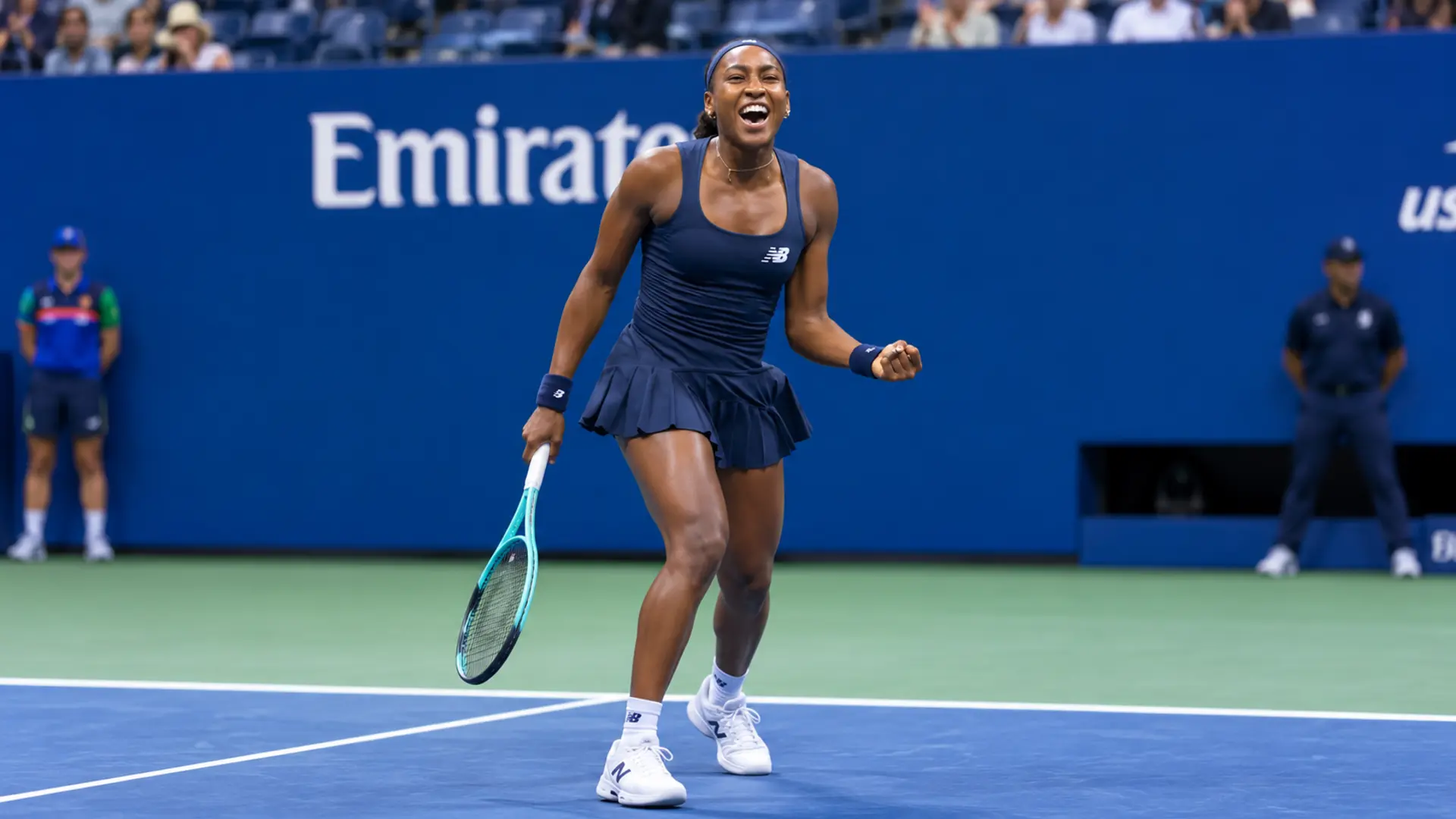
Coco Gauff produced one of her most complete performances of this US Open to beat Iva Jovic 6-1, 6-4 and reach the quarterfinals. The score, particularly in the opening set, was considerably harsher on Jovic than the tennis itself.
The 18-year-old did not look out of place.
Not remotely.
She stayed with Gauff in increasingly demanding exchanges, pushed her hard in the second set and, at 4-all, briefly had an opening that could have changed its direction.
Then came several errors Jovic would not normally have expected from herself.
Against Gauff playing this well, that small dip was enough.
Gauff’s First Set Is Better Than the Scoreline Suggests
The 6-1 opening set makes this look like a rout.
It was not quite that.
Jovic gave a good account of herself in the rallies and showed why there is so much excitement surrounding another young American coming through.
The problem was Gauff.
Her movement was exceptional, the forehand was secure, the backhand held firm and the serve repeatedly gave her the first advantage in points.
Nothing looked particularly vulnerable.
Jovic could construct good rallies and still find herself required to hit another quality ball.
Then another.
That is what Gauff does to opponents when every part of her game is functioning.
The scoreboard moved quickly even when the tennis itself was competitive.
Set 1 at a Glance
- Gauff won her return games at a perfect 3 of 3, while Jovic managed just 1 of 4.
- Gauff won 71% of her first-serve return points (12 of 17), a dominant number against Jovic’s serve.
- Gauff closed the set decisively, 29 to 15 on total points, winning 67% of return points overall.
Full Set 1 Stats
| Jovic | Statistic | Gauff |
|---|---|---|
| Set 1 Duration: 0h34m | ||
| 0.52 | Dominance Ratio | 1.92 |
| 2 | Winners | 10 |
| 12 | Unforced Errors | 8 |
| 159 | Serve Rating | 270 |
| 0 | Aces | 1 |
| 1 | Double Faults | 1 |
| 81% (17/21) | 1st Serve % | 65% (15/23) |
| 29% (5/17) | 1st Serve Points Won | 67% (10/15) |
| 50% (2/4) | 2nd Serve Points Won | 63% (5/8) |
| 40% (2/5) | Break Points Saved | 0% (0/1) |
| 196 | Return Rating | 281 |
| 33% (5/15) | 1st Return Points Won | 71% (12/17) |
| 38% (3/8) | 2nd Return Points Won | 50% (2/4) |
| 1/1 | Break Points Won | 3/5 |
| 15 | Total Points Won | 29 |
Jovic Makes the Second Set a Genuine Contest
Jovic’s level became even more apparent in the second set.
She refused to let the first-set score dictate what came next and matched Gauff through to 4-4.
By then, the intensity had risen even further.
This was no longer a young player merely producing respectable tennis against one of the tournament favourites. Jovic was actively looking for a way into the match.
And at 4-all, she found one.
On Gauff’s serve, Jovic created opportunities in the return game.
For perhaps the first time, there were also signs that the physical intensity of the contest was beginning to register with Gauff.
Her level had been extraordinarily high throughout, but during those final two or three games there were hints of fatigue.
The door opened slightly.
Jovic did not walk through it. She all of a sudden produced unforced errors on return.
A Few Errors at 4-All Change Everything
This was the decisive passage.
Jovic had chances, albeit not in the score, in the return game at 4-4, but several unexpected unforced errors arrived at exactly the wrong time.
They visibly bothered her.
The frustration did not disappear when the game ended.
It followed her to the service line.
At 4-5, Jovic produced her weakest service game of the set and lost it to love.
That was the opening Gauff had been waiting for.
There would be no second opportunity.
Gauff served out the match.
6-4.
The margins had been tight for much of the set, but the final two games showed the difference between competing at this level and finishing at it.
Jovic had opportunities but failed to take them.
Gauff survived it and then immediately punished the lapse that followed.
Set 2 at a Glance
- Gauff won 63% of her service points (17 of 27), well ahead of Jovic’s 50% (19 of 38).
- Jovic actually won more pressure points, 8 of 12 to Gauff’s 4, yet still dropped the set.
- Gauff closed it out 36 to 29 on total points, committing far fewer unforced errors, 7 to Jovic’s 18.
Full Set 2 Stats
| Jovic | Statistic | Gauff |
|---|---|---|
| Set 2 Duration: 0h59m | ||
| 0.74 | Dominance Ratio | 1.35 |
| 7 | Winners | 8 |
| 18 | Unforced Errors | 7 |
| 214 | Serve Rating | 263 |
| 0 | Aces | 1 |
| 0 | Double Faults | 1 |
| 55% (21/38) | 1st Serve % | 59% (16/27) |
| 52% (11/21) | 1st Serve Points Won | 69% (11/16) |
| 47% (8/17) | 2nd Serve Points Won | 55% (6/11) |
| 67% (4/6) | Break Points Saved | 0% (0/1) |
| 196 | Return Rating | 174 |
| 31% (5/16) | 1st Return Points Won | 48% (10/21) |
| 45% (5/11) | 2nd Return Points Won | 53% (9/17) |
| 1/1 | Break Points Won | 2/6 |
| 29 | Total Points Won | 36 |
Gauff’s Complete Game Leaves Very Few Weak Points
The full-match numbers underline the quality of Gauff’s performance.
She hit 18 winners to 15 unforced errors, while Jovic finished with nine winners and 30 errors.
The dominance ratio was emphatic:
Gauff 1.55. Jovic 0.64.
Gauff won 68 percent of her first-serve points and 58 percent behind the second serve.
Jovic, by contrast, managed only 42 percent behind her first delivery.
That became particularly damaging because Gauff returned it so aggressively, winning 58 percent of Jovic’s first-serve points.
There was no obvious area in which Gauff could be attacked repeatedly.
Her serve held.
Codo’s return pressed.
And her movement closed spaces.
At net she won 16 of 22 points.
This was not a victory built around one dominant shot.
It was a victory built around almost every part of the game working together.
Jovic’s 30 Errors Need Context
Thirty unforced errors will look severe beside Gauff’s 15.
They were important.
But they should not obscure the level Jovic showed.
Many came after Gauff had already forced another ball, another change of direction or another attempt to create something from a neutral position.
Jovic was not simply spraying errors from the first ball.
She was often being asked to play at an uncomfortable level of precision for longer than she could sustain.
At 18, against a Gauff playing this cleanly, there is little shame in that.
The more revealing part was how close she came to making the second set genuinely dangerous.
The American Picture Keeps Getting Better
Pegula remains in the draw.
Amanda Anisimova is still there.
Gauff is now into the quarterfinals.
And then there is Jovic.
That is a considerable spread of American talent across different stages of careers.
Jovic leaves before the quarterfinals, but she also leaves with evidence that she can already compete inside the kind of rallies and pressure situations she will increasingly encounter at this level.
There is work to do.
That much was obvious in the closing games.
But the foundation is equally obvious.
The future of American women’s tennis looks very bright.
All Four Top Seeds Are Still Standing
Gauff’s victory also preserves something remarkable in the draw.
All four top seeds have reached the US Open quarterfinals.
At this stage of a Grand Slam, that level of order is unusual enough.
If all four were now to win their quarterfinals as well, the semifinals would belong entirely to the tournament’s leading quartet.
That would be extraordinary.
Gauff has done her part to keep the possibility alive.
Jovic made her work considerably harder than 6-1, 6-4 suggests.
But when the decisive moments arrived, Gauff looked every bit like the established champion facing a player who may one day occupy similar stages much more regularly.
Today belonged to Gauff.
Jovic’s part of the story may only just be beginning.