
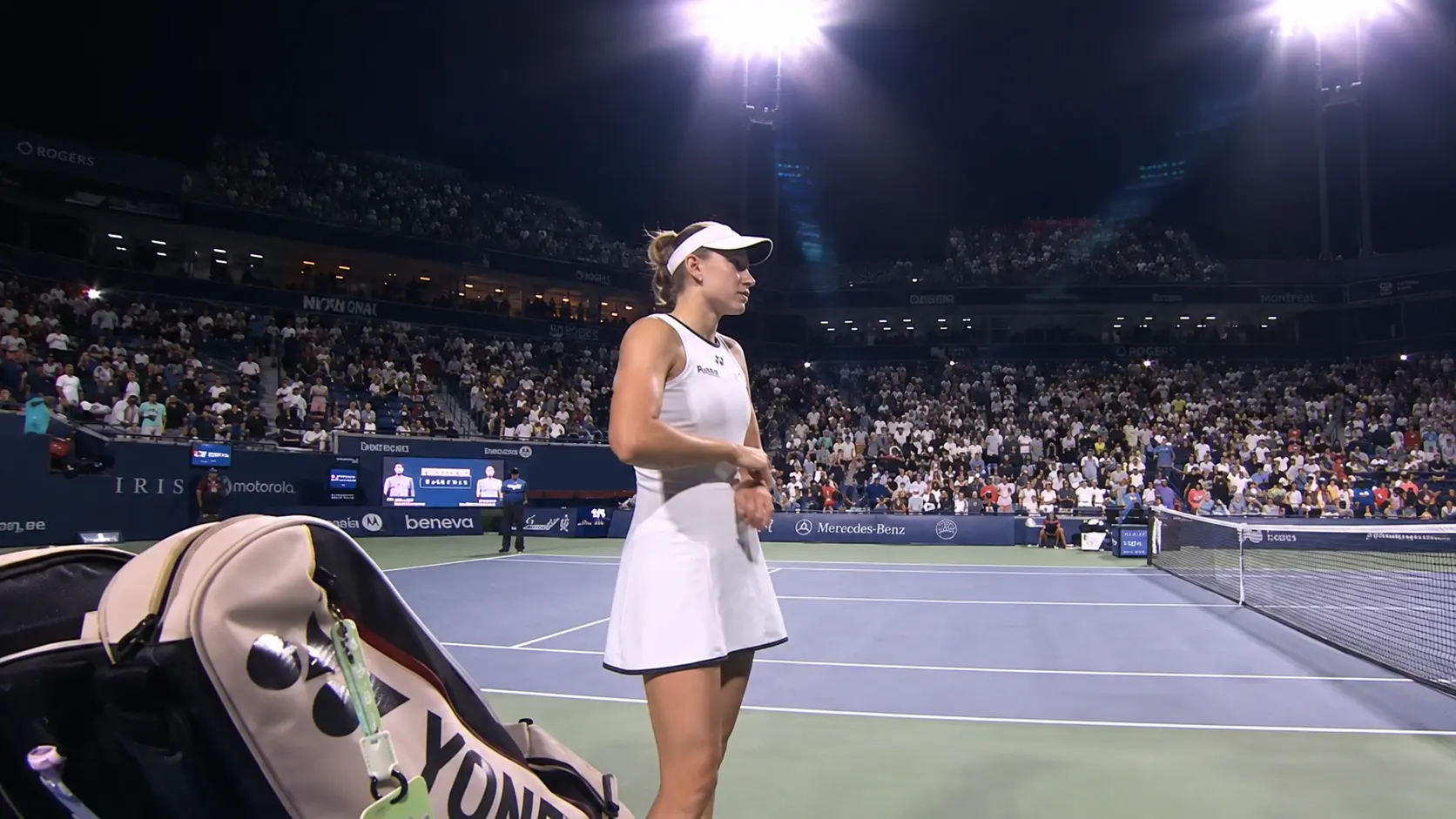
Rybakina vs Osaka in Toronto match report: Elena Rybakina trailed by a set and then fell 4-2 behind in the second. Her serve was misfiring, the errors were piling up, and Naomi Osaka appeared to have the match exactly where she wanted it.
Rybakina won anyway.
The Kazakh fought back to beat Osaka 4-6, 7-6(5), 6-4 in a bruising battle that tested just about every part of both players’ games.
There was very little tidy about it. Rybakina struck 47 winners but committed 73 unforced errors. She fired 15 aces, yet double-faulted at some of the worst possible moments. Osaka looked in control, lost control, regained it and then watched Rybakina drag the contest somewhere neither player could comfortably dominate.
By the end, Rybakina had shown a side of herself that continues to be overshadowed by the easy power and booming serve.
She can scrap.
And when a match starts going badly, she can be extraordinarily difficult to finish off.
One Early Break Is Enough for Osaka
The opening set was decided almost immediately.
Osaka broke Rybakina in the first game and, remarkably given what would follow later, that proved to be the only break of the set.
From there, both players held serve.
Rybakina therefore spent almost the entire set chasing the damage done in those opening minutes, while Osaka protected her advantage without ever allowing the Kazakh to draw level.
At 4-5 down, Rybakina finally began to put serious pressure on Osaka’s serve.
She moved to 0-15 and then 15-30, threatening to recover the break at the last possible moment. Osaka steadied herself, however, and a kick serve into Rybakina’s forehand helped her reach set point.
Rybakina got Osaka’s first serve back and an intense baseline exchange followed. Osaka changed direction first, sending the ball towards Rybakina’s backhand.
The Kazakh did not fully commit.
Osaka did.
She attacked immediately, drilling a fierce backhand into the open court and taking the opening set 6-4.
One break in the opening game had been enough.
Osaka vs Rybakina – Set 1 Key Stats
| Statistic | Osaka | Rybakina |
|---|---|---|
| Dominance Ratio | 1.04 | 0.96 |
| Winners | 6 | 12 |
| Unforced Errors | 18 | 25 |
| Serve Rating | 286 | 261 |
| Aces | 2 | 3 |
| Double Faults | 1 | 2 |
| 1st Serve % | 59% (22/37) | 53% (16/30) |
| 1st Serve Points Won | 73% (16/22) | 63% (10/16) |
| 2nd Serve Points Won | 53% (8/15) | 64% (9/14) |
| Break Points Saved | 100% (3/3) | 0% (0/1) |
| Service Games | 100% (5/5) | 80% (4/5) |
| Ace % | 5.4% | 10% |
| Double Fault % | 2.7% | 6.7% |
| Return Rating | 194 | 74 |
| 1st Return Points Won | 38% (6/16) | 27% (6/22) |
| 2nd Return Points Won | 36% (5/14) | 47% (7/15) |
| Break Points Won | 100% (1/1) | 0% (0/3) |
| Return Games | 20% (1/5) | 0% (0/5) |
| Pressure Points | 78% (7/9) | 22% (2/9) |
| Service Points | 65% (24/37) | 63% (19/30) |
| Return Points | 37% (11/30) | 35% (13/37) |
| Total Points | 52% (35/67) | 48% (32/67) |
| Set 1 Duration | 0h43m | |
Double Fault, Ace, Double Fault: Rybakina’s Second-Set Chaos
At 1-all in the second set came a service game that summed up Rybakina’s afternoon.
She opened with a double fault.
Then came an ace so good that Osaka applauded it.
Then another double fault.
It was Rybakina at her most unpredictable: devastating one point, vulnerable the next.
Osaka took advantage and broke, but this time Rybakina responded immediately. A brilliant and badly needed backhand volley at the net helped her break straight back.
Still, the serve refused to settle.
Another double fault followed in the next service game, and when Rybakina committed her 34th unforced error of the match, Osaka broke again.
The Japanese player roared.
At 4-2, there was a sense that she knew exactly how close she was.
The match looked hers.
Rybakina had other ideas.
From 4-2 Down, Rybakina Suddenly Finds Another Gear
There was no obvious warning that the match was about to turn.
Rybakina simply began hitting more freely.
She opened her shoulders, found greater depth and started driving through the court in a way she had struggled to do for much of the afternoon.
First came 3-4.
Then 4-4.
Then a hold for 5-4.
Was Osaka suddenly collapsing?
Not really.
That would be too simple an explanation.
Rybakina had found another level almost from nowhere.
Her thinking briefly became muddled again when she moved to within two points of taking the set on Osaka’s serve. Osaka, sensing the danger, was again the first player willing to take control of a rally, while a second serve that clipped the line caught Rybakina by surprise.
Osaka held for 5-all.
Rybakina’s next service game was hardly comfortable either. Osaka fought her way back to deuce, but Rybakina found an ace when she needed one and followed it with another strong serve to move ahead 6-5.
Osaka remained composed.
A tiebreak would decide whether she walked off with a straight-sets victory or whether the afternoon would become considerably more complicated.
Rybakina Takes the Tiebreak When the Match Is on the Line
Rybakina started quickly, moving 2-0 ahead.
Osaka pulled one point back before levelling at 2-2, with Rybakina briefly looking heavy-legged. Then came another response.
Rybakina moved forward well to take a 3-2 lead, only for another Osaka second serve to catch the line and surprise her for 3-all.
Osaka then sent a backhand long through the middle of the court, handing Rybakina a 4-3 advantage.
Back came Osaka again: 4-4.
Rybakina applied heavy forehand pressure on the next point, doing just enough to unsettle Osaka and move ahead 5-4.
She then went looking for a forehand winner down the line but could not finish the point, allowing Osaka to level at 5-all.
Now the set had been reduced to two points.
Rybakina took the first with a winning rally.
At 6-5, she finished the job at the net, punching away a fierce winning volley to take the tiebreak 7-5.
Osaka vs Rybakina – Set 2 Key Stats
| Statistic | Osaka | Rybakina |
|---|---|---|
| Dominance Ratio | 0.96 | 1.04 |
| Winners | 8 | 17 |
| Unforced Errors | 16 | 26 |
| Serve Rating | 243 | 235 |
| Aces | 1 | 4 |
| Double Faults | 2 | 4 |
| 1st Serve % | 64% (25/39) | 63% (27/43) |
| 1st Serve Points Won | 56% (14/25) | 74% (20/27) |
| 2nd Serve Points Won | 57% (8/14) | 31% (5/16) |
| Break Points Saved | 0% (0/2) | 0% (0/2) |
| Service Games | 67% (4/6) | 67% (4/6) |
| Ace % | 2.6% | 9.3% |
| Double Fault % | 5.1% | 9.3% |
| Return Rating | 228 | 220 |
| 1st Return Points Won | 26% (7/27) | 44% (11/25) |
| 2nd Return Points Won | 69% (11/16) | 43% (6/14) |
| Break Points Won | 100% (2/2) | 100% (2/2) |
| Return Games | 33% (2/6) | 33% (2/6) |
| Pressure Points | 40% (2/5) | 60% (3/5) |
| Service Points | 56% (22/39) | 58% (25/43) |
| Return Points | 42% (18/43) | 44% (17/39) |
| Total Points | 49% (40/82) | 51% (42/82) |
| Set 2 Duration | 1h00m | |
For much of the second set, Osaka had seemed to have the match on her racquet.
Yet when the decisive points arrived, Rybakina was still there.
A deciding set was the last thing anyone would have expected when Osaka led 6-4, 4-2.
Now it was unavoidable.
A Deciding Set That Starts to Feel Like a Grand Slam Battle
The third set offered a useful glimpse of where both women stood with Cincinnati and the US Open approaching.
Osaka served first and carried the confidence of the opening two sets with her.
She edged ahead 1-0, then 2-1.
At 2-all, the match passed the two-hour mark.
If either player was beginning to feel the physical strain more visibly, it appeared to be Osaka. A double fault dragged one of her service games to deuce, although there was little evidence of fatigue once the rallies began.
She held for 3-2.
Then came one of the most important games of the match.
Rybakina landed two strong serves, both of which Osaka managed to return. An unforced error from the Kazakh opened the door further, and Osaka began accumulating opportunities.
One break point came and went. Then another.
Eventually, a fourth arrived.
Rybakina was forced into a longer rally, but Osaka could not finish it from the backhand side.
By the skin of her teeth, the Kazakh survived.
A running forehand winner helped her escape the game and level at 3-all. It felt significant. Osaka had been given repeated chances to re-establish control. She had not taken them.
Osaka Cracks First as the Pressure Builds
The next game developed into another exhausting battle.
This time Osaka was the player who blinked. After being dragged to deuce, she conceded break point and then committed the unforced error that handed Rybakina the break.
The frustration was immediate.
Osaka dropped her racquet and kicked it across the court.
Rybakina watched on, almost bewildered by the reaction.
The Kazakh now had the chance to move 5-3 ahead, but there was nothing remotely comfortable about the situation.
Nerves had taken over the arena. Both women were giving everything. This was no longer a particularly clean tennis match, nor did it need to be. The quality fluctuated. The errors came in clusters. Momentum seemed temporary. But the fight was unmistakable. It had started to feel more like a Grand Slam battle than a routine tour match.
Rybakina, normally associated with some of the cleanest ball-striking in the women’s game, was surviving through sheer persistence.
Even a dreadful attempted volley-smash, which handed Osaka deuce, could not derail her. Rybakina recovered and held.
5-3.
Rybakina Has to Win It the Hard Way One More Time
An extraordinary rally put Rybakina 0-15 ahead on Osaka’s next service game. Then came a double fault. Then an ace. Soon it was 30-all.
The tension was beginning to affect both players. Osaka started rushing. Rybakina briefly did the same. Osaka nevertheless found the composure to hold for 5-4.
That left Rybakina with the task every player wants until the moment it actually arrives: Serve for the match.
Could she do it after everything her serve had put her through?
Two aces and a forehand winner provided a fairly emphatic answer.
Match point one. Osaka saved the first and clenched her fist. Rybakina barely reacted.
On the next opportunity, she went back to the shot that had been both friend and enemy all afternoon.
Second serve.
Ace.
Match over.
Osaka vs Rybakina – Set 3 Key Stats
| Statistic | Osaka | Rybakina |
|---|---|---|
| Dominance Ratio | 0.85 | 1.18 |
| Winners | 5 | 18 |
| Unforced Errors | 19 | 22 |
| Serve Rating | 258 | 291 |
| Aces | 0 | 8 |
| Double Faults | 3 | 0 |
| 1st Serve % | 64% (21/33) | 50% (18/36) |
| 1st Serve Points Won | 67% (14/21) | 83% (15/18) |
| 2nd Serve Points Won | 50% (6/12) | 50% (9/18) |
| Break Points Saved | 0% (0/1) | 100% (4/4) |
| Service Games | 80% (4/5) | 100% (5/5) |
| Ace % | 0% | 22.2% |
| Double Fault % | 9.1% | 0% |
| Return Rating | 67 | 203 |
| 1st Return Points Won | 17% (3/18) | 33% (7/21) |
| 2nd Return Points Won | 50% (9/18) | 50% (6/12) |
| Break Points Won | 0% (0/4) | 100% (1/1) |
| Return Games | 0% (0/5) | 20% (1/5) |
| Pressure Points | 18% (2/11) | 82% (9/11) |
| Service Points | 61% (20/33) | 67% (24/36) |
| Return Points | 33% (12/36) | 39% (13/33) |
| Total Points | 46% (32/69) | 54% (37/69) |
| Set 3 Duration | 0h53m | |
It was an extraordinary way to finish a match in which her serve had repeatedly threatened to drag her down.
When she needed it most, it delivered.
The Statistics Reveal Just How Wild This Match Was
The numbers explain both the quality and the chaos.
Rybakina produced 47 winners, more than double Osaka’s 19.
She struck 15 aces to Osaka’s three.
But there was an enormous cost attached to all that aggression.
Rybakina also committed 73 unforced errors, compared with Osaka’s 53.
This was never a match about controlled percentages. Both players were trying to impose themselves, and both frequently crossed the line between aggression and impatience.
One statistic captures just how evenly balanced the contest was: Rybakina held serve in 14 of her 17 service games, while Osaka held in 13 of 16. Both players broke serve three times.
The difference was not that one woman consistently dominated the other. It was when those points were won.
Rybakina edged the pressure points 54 percent to 46.
In a match decided by moments rather than sustained superiority, that mattered more than almost anything else.
Osaka Runs Into a Side of Rybakina Too Often Overlooked
Rybakina’s serve will always dominate the discussion around her game. It is too big and too obvious not to. Her clean ball-striking attracts almost as much attention.
What gets discussed far less is her ability to stay alive in matches that have become ugly.
This was one of them. She was not playing her best tennis. She was making errors at an alarming rate. Her serve abandoned her for stretches. She trailed by a set and 4-2 against a player who looked increasingly convinced the match was hers. And still Rybakina remained dangerous. That is not simply a product of a big serve.
Her return game continues to be underrated, particularly on evenings when she needs something other than serving dominance to stay in a contest. She makes opponents play one more ball, gets herself into return games that appear to be drifting away and can turn defensive positions into sudden attacking opportunities.
More importantly, she does not seem to require a match to feel comfortable before believing she can win it.
That may be the most overlooked part of her game.
Three Tennis Podcast analysts had picked Osaka even to reach the final, and the selection was perfectly understandable given the level she had shown.
But forecasts built around form can miss something harder to quantify.
Rybakina has developed a habit of remaining switched on from losing positions. She does not always look animated. She does not always advertise the fight. That does not mean it isn’t there.
Against Osaka, it was the defining feature of the match.
Gauff Awaits, but Both Players Leave Toronto With Something
Rybakina now moves into a semifinal against Coco Gauff, who advanced after receiving a walkover from Belinda Bencic.
She will know that 73 unforced errors are unlikely to be survivable every day.
The serve will need to be steadier. The concentration will need to be cleaner. There will be moments from this match she will want to forget quickly. But there are others worth remembering.
Four break points against her at 2-3 in the decider, she survived.
Serving for the match after nearly three hours of tension, she finished with a second-serve ace.
Osaka leaves Toronto disappointed but hardly diminished. Her level has continued to rise, and she competed superbly for long stretches. She absorbed Rybakina’s pace, got an extraordinary number of big serves back into play and showed that her own aggressive baseline game can again trouble the very best.
She had her opportunities.
Rybakina simply refused to let them become the ending. That is the part of the Kazakh’s game people tend not to notice. They see the serve. They see the effortless winners.
Against Osaka, the more revealing quality was the grit required when neither of those things was working quite as planned.
And that may matter more heading towards the US Open than any clean straight-sets victory could have shown.