
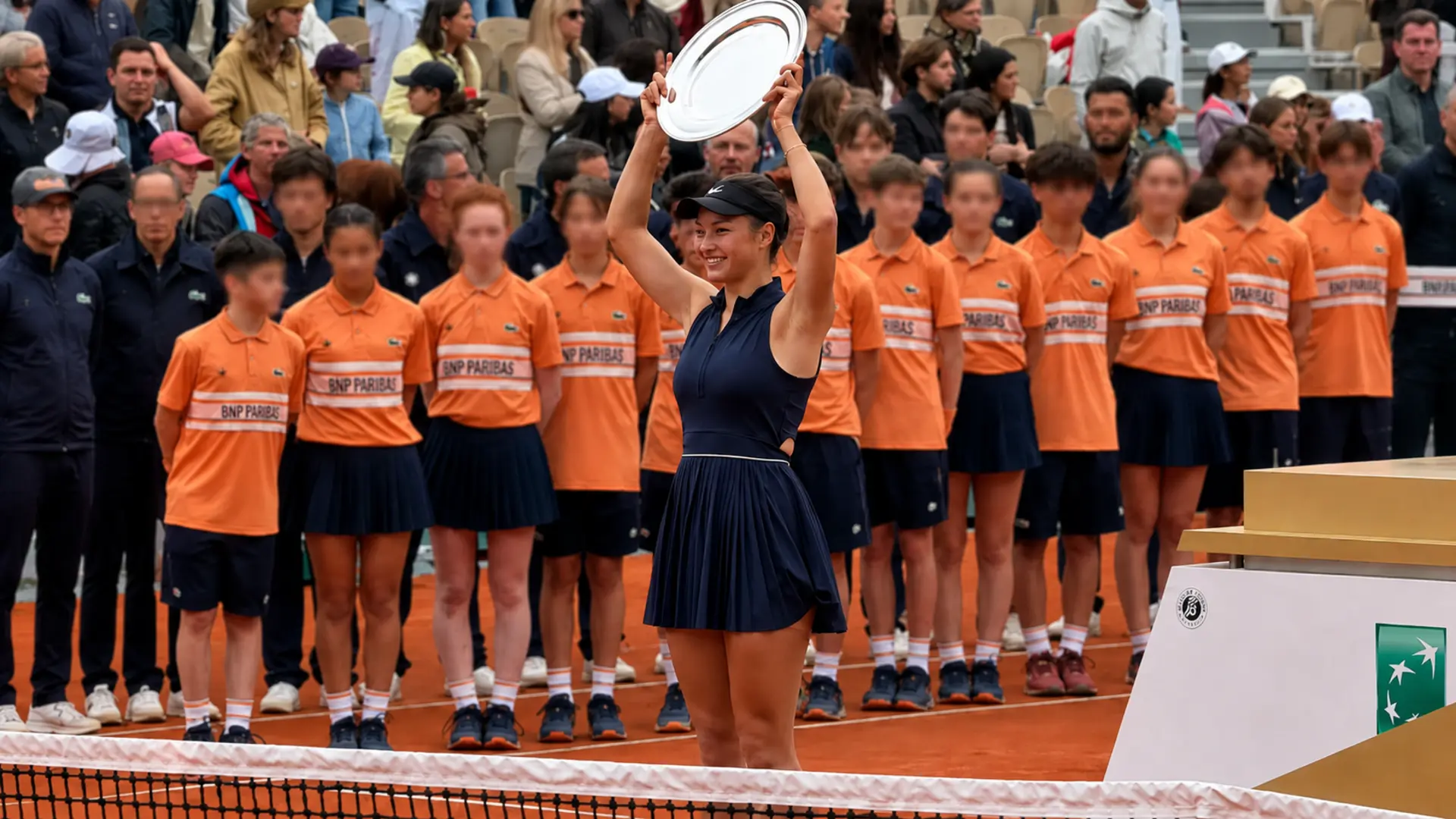
Alisa Oktiabreva was born in Russia, but almost her entire life in tennis has been shaped somewhere else.
The 17-year-old Roland Garros girls’ singles champion has obtained Czech citizenship and now represents the Czech Republic. On paper, her nationality change may look like another entry in the growing list of Russian-born players switching countries. Her circumstances, however, are very different from most of the recent examples.
A Change That Formalizes a Life Already Lived in Prague
Oktiabreva moved to the Czech Republic when she was just two years old. She began training and competing for TK Sparta Praha at the age of four.
That background separates her case from many other nationality changes in professional tennis. Some players establish careers under one flag before relocating, obtaining citizenship elsewhere and eventually changing representation.
Oktiabreva effectively grew up inside the Czech tennis system.
TK Sparta Praha director Miroslav Malý explained to Czech media during Roland Garros that Oktiabreva had been part of the club since childhood and that obtaining Czech citizenship was therefore a natural development.
Her change of sporting nationality was initially reported by Czech outlet Sport.cz on June 5, while Oktiabreva was still competing in the Roland Garros junior tournament. At the time, she was expected to begin representing the Czech Republic later that month.
That transition has since been completed.
Oktiabreva made her first appearance under the Czech flag at the WTA tournament in Prague in July, meaning the nationality change is no longer simply an administrative development. She is now officially competing as a Czech player.
The Roland Garros Title That Made the Change More Significant
The timing coincided with the biggest result of Oktiabreva career so far.
She won the Roland Garros girls’ singles title in June, three years after first making a major impression at the same tournament.
Back in 2023, at just 14 years old, she reached the junior semifinals in Paris. Her run ended against Alina Korneeva, who went on to win the title.
Oktiabreva returned three years later and completed the job herself.
Winning a junior Grand Slam immediately raised her profile and made her nationality change considerably more notable than it would have been when she was still an emerging junior prospect.
Her professional career remains at an earlier stage.
Oktiabreva has already climbed inside the world’s top 300 during 2026, but she is still making the transition from elite junior tennis to the senior circuit. That is often the most difficult step for even the most successful junior players.
The Roland Garros title therefore represents both a major achievement and the beginning of a much bigger challenge.
A Different Story From Many Recent Russian Nationality Changes
Oktiabreva’s switch also comes during a period in which a growing number of Russian-born tennis players have begun representing other countries.
Daria Kasatkina is the most prominent recent example. After publicly criticizing the Kremlin and Russia’s policies, she changed her sporting representation to Australia.
Varvara Gracheva became a French citizen and has represented France since 2023. Elina Avanesyan and Alina Charaeva now compete for Armenia, while Anastasia Potapova has switched to Austria.
Kamilla Rakhimova, Polina Kudermetova and Maria Timofeeva have moved to represent Uzbekistan, while Oksana Selekhmeteva now plays under the Spanish flag.
The circumstances behind those decisions are not identical, and it would be misleading to treat every nationality change as politically motivated.
Oktiabreva’s case is particularly distinct.
She did not relocate to the Czech Republic after establishing herself as a professional player. She moved there as a toddler and developed almost entirely within Czech tennis.
Her new flag therefore reflects the country where she learned the sport, trained for more than a decade and built the career that eventually produced a Roland Garros junior championship.
Czech Tennis Adds Another Major Junior Champion
The Czech Republic already possesses one of the deepest pools of women’s tennis talent in the world.
Oktiabreva now joins that system officially as one of its most promising young players.
Winning a junior Grand Slam does not guarantee success on the professional tour, and plenty of accomplished junior champions have struggled to make the same impact at senior level.
At 17, Oktiabreva still has considerable development ahead of her.
What she already possesses is a major junior title, experience competing on the professional circuit and more than a decade inside one of Europe’s strongest tennis structures.
Her nationality may have changed on tournament entry lists, but the Czech connection itself is nothing new.
For Oktiabreva , representing the Czech Republic is the formal recognition of the tennis identity she has spent almost her entire life building.
Source: Marek Burkert, “Od čtyř let sparťanka. Finalistka pařížské juniorky bude reprezentovat Česko,” Sport.cz, June 5, 2026.