
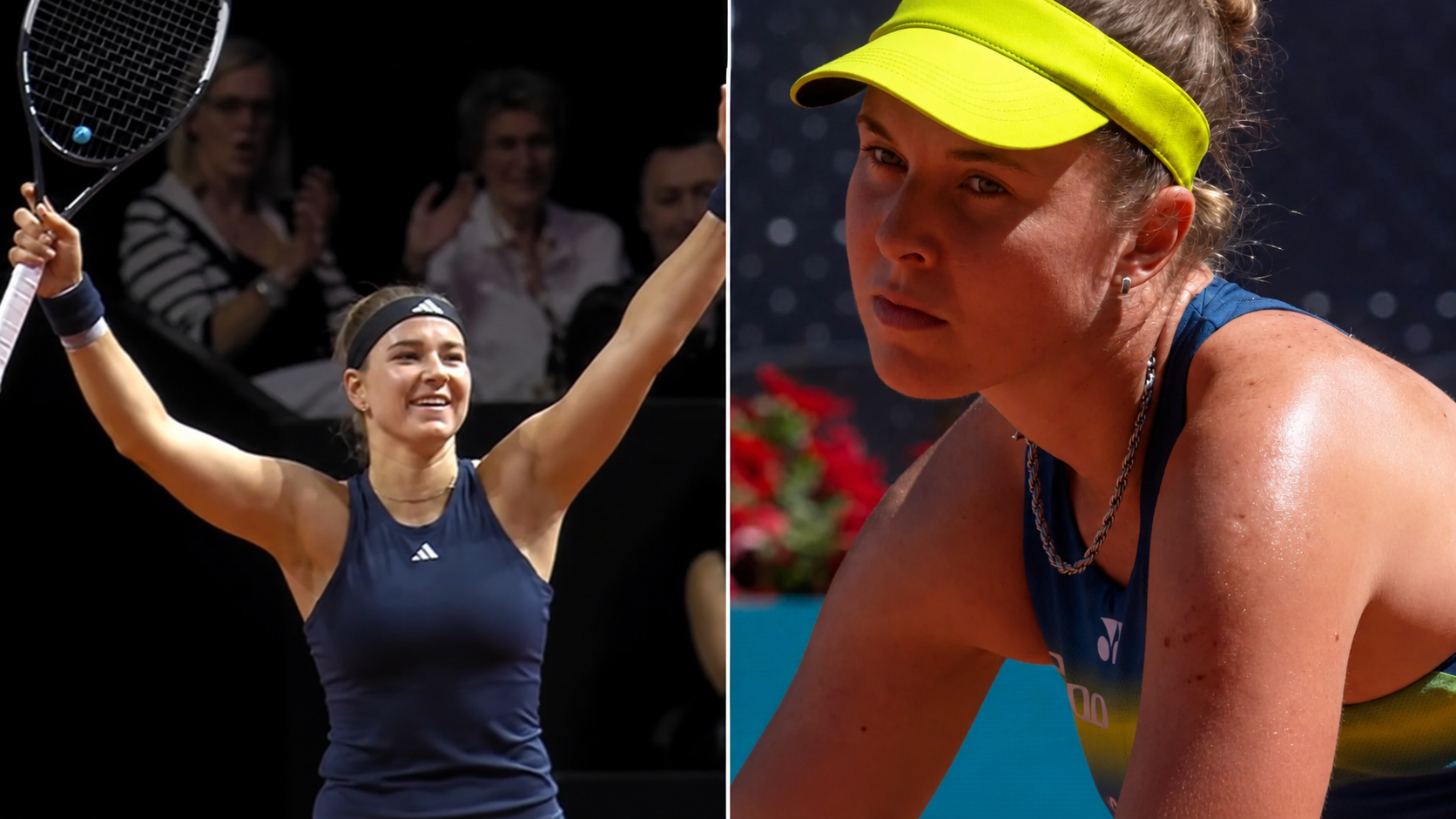
The Wimbledon final was already emotional before either Czech player touched the microphone.
Linda Noskova had just survived the strangest, wildest and most human match of her life, beating Karolina Muchova 6-2, 5-7, 6-3 to win her first Grand Slam title. She had been dominant, then frozen, then somehow brave enough to put herself back together after losing five championship points and five games in a row.
Muchova had done almost everything a runner-up could do to make the final unforgettable. She had looked beaten at 2-6, 2-5. She had saved five championship points. She had dragged Noskova into a third set. Then, once the younger Czech found her nerve again, Muchova had to stand on Centre Court with the silver plate and speak through tears.
It was not only a trophy ceremony.
It was a release.
Two countrywomen had turned an all-Czech Wimbledon final into a match full of tension, class, grief, pride and national feeling. By the end, Muchova was joking through heartbreak, Noskova was looking to the sky for her late mother, and Centre Court was pulled into the kind of ceremony that makes tennis feel much larger than the score.
Muchova Breaks the Tension With a Joke, Then Pays Tribute
Muchova tried to hold herself together first.
The 29-year-old had just lost her second Grand Slam final, after also finishing runner-up at Roland Garros in 2023. She had entered Wimbledon in magnificent form, unbeaten in her previous 10 matches after winning Bad Homburg, and she had saved a match point against Coco Gauff in a dramatic semi-final.
This time, the escape did not quite reach the trophy.
“Really tough to find any words, but I’ll start with Linda, my ‘ex-friend’. I’m kidding obviously, kind of,” Muchova said, managing to make Centre Court laugh through the tension.
Then the praise came.
“You are so young, this is your first final at a Grand Slam, the way you handled it and the way you played is really unbelievable. Beyond this you are an especially very kind person and human being, so congratulations to you and your team. You deserve it.”
That was the grace of Muchova’s speech. She was devastated, but not small. She could have spoken only about pain. Instead, she gave Noskova the full weight of the moment.
And Noskova had earned it.
Noskova Had to Win the Final Twice
For more than a set and a half, Noskova looked almost frighteningly clear.
She served with the authority of a player much older than 21, backed it up with heavy forehands, and kept Muchova away from the delicate, layered tennis that had carried her through the draw. The first set went 6-2. Then Noskova surged to 5-2 in the second.
At that stage, the final looked ready to end early.
Instead, it cracked open.
Noskova created five championship points across the next three games and lost them all. Muchova broke back after a brutal game full of danger, then completed one of the most improbable set comebacks a Wimbledon final could offer. Five games in a row went to Muchova. The second set was hers, 7-5.
Noskova put her fingers in her ears, covered her head with a towel and left the court at the end of the set.
The trophy had been one point away.
Then it had vanished.
Noskova Comes Back With a Champion’s Mind
What made Noskova’s title so impressive was not only the level she produced early.
It was the way she returned after the collapse.
Muchova had the momentum. She had the experience. She had the crowd fully alive after one of the great Grand Slam final escapes. Noskova had to begin the third set with the weight of five lost championship points still sitting on her shoulders.
Then she saved break points.
Then she broke.
Then she moved to 3-0.
That was the real championship passage. Not the first-set dominance, not even the final point. The title was forged in those first games of the third set, when Noskova had every reason to panic and chose to swing again.
She later admitted how hard the final stage had been.
“All these matches have been so tough physically and mentally tough, today especially and it’s never easy to get the last point,” Noskova said.
No one on Centre Court needed convincing. They had just watched her need six championship points to finish a final she had once seemed to own.
“Karo — You Really Made Me Work for It”
Noskova’s first words to Muchova carried the warmth of a shared Czech moment.
“Karo – you really made me work for it,” Noskova said. “We’re friends, I’m so glad I could play you in my first Grand Slam final, with you I think we made history today. I believe all the Czech fans at home are proud of us, no matter the result, it’s a good day. I want to congratulate your team, a good two weeks for you and a great season so congrats as well.”
That line — “we made history today” — was not ceremony fluff.
Czech women’s tennis has a deep Wimbledon history, from Petra Kvitova to Marketa Vondrousova to Barbora Krejcikova. Now Noskova has joined that line, while Muchova has added another major final to a season that already includes titles in Qatar and Bad Homburg.
There was also something beautifully awkward and tender about the setting: two friends, two Czech players, one winner, one heartbroken runner-up, both knowing the final had become bigger than a national celebration.
It had become a classic.
Muchova Thanks Wimbledon, Then Breaks When She Turns to Her Box
Muchova tried to move through the usual parts of the runner-up speech.
She thanked the tournament and the people who make it possible.
“I would like to thank everyone who is making this special tournament possible,” she said. “The attention is always on us players, but there are so many people who run this special event, so thank you for making it so smooth. I would like to thank every one of you guys [the crowd] for the past two weeks, you have been coming to every one of my matches, supporting everyone. This is an unbelievable tournament, a special one, the best one in the world and I am just really glad to be standing here.”
Then she looked toward her corner.
That was when the speech changed.
“Even though I am pretty disappointed now. But, when I look to my corner… I’m sorry, it is emotional. When I look to the corner, I have all my friends and family who cancel plans to come and watch me and it means a lot. My team who has been with me these past weeks, pushing me and keeping me positive, thank you guys very much.”
The tears were understandable. Muchova had not been outclassed in spirit. She had fought her way back from the edge, saved five championship points, and still had to watch Noskova reset and take the title.
That is a particularly cruel kind of defeat.
Noskova Thanks Her Team, Then Her Late Mother
Noskova’s speech moved through joy, gratitude and grief.
She thanked her team first, then her father and family, giving the ceremony a wonderfully human touch.
“I want to thank my team, I want to thank my dad for coming here, for my family flying here – I know you don’t like flying so I appreciate it. I would like to thank my friends, supporters, agents, my whole team. I would like to thank my coach, for being with me, which is not easy all the time. We have been together for six years and I’m so grateful for you. I would not be here without you.”
Then came the moment that broke the ceremony open.
Noskova’s mother died in 2024 after a battle with cancer. She was not in the player box. She was not there to see her daughter lift Wimbledon. But Noskova made sure she was part of the moment.
“There’s one more person that I want to thank, which is my mum. I would definitely not be standing here without you so thank you,” Noskova said, looking up to the sky and blowing a kiss.
That was the line the final had been carrying without anyone quite knowing it.
Noskova had already survived the tennis storm. Now the emotional one arrived.
Muchova Promises This Is Not the End
For Muchova, the defeat was brutal, but her message did not end in surrender.
“I will be fighting more, I want the trophy and I hope I can reach the final again and can come back and win,” she said.
That line should not be missed.
Muchova is now up to sixth in the world after a brilliant campaign that includes Qatar, Bad Homburg and a Wimbledon final. Her game remains one of the most complete in women’s tennis. She has the touch, movement, disguise and improvisation to trouble anyone on any surface.
This loss will hurt because it was close enough to feel stolen from both directions.
At 2-5 in the second, it looked gone.
At the start of the third, after saving five championship points and winning five games in a row, it looked possible again.
Then Noskova tore it away.
Muchova will carry that for a while. But she also leaves Wimbledon in a strong position for the WTA Finals and with proof that her best tennis can still carry her to the biggest stages.
Noskova Will Never Forget the Tears, Sweat and Blood
Noskova’s closing words captured the two-week journey.
“I have enjoyed these two weeks so much. All the sad tears, happy tears, sweat, blood and it’s all worth it. I will never forget these two weeks. I want to thank all the fans. You guys made this final like nothing I’ve experience before so I can’t wait to come back.”
It was an imperfect line, and that made it better.
This was not a polished corporate speech. It was a 21-year-old new Grand Slam champion trying to describe the biggest emotional event of her life after nearly letting it slip through her fingers.
A Final That Deserved Its Tears
There was no dry, neat way to end this Wimbledon final.
Noskova had gone from dominance to tension to collapse to recovery. Muchova had gone from outclassed to inspired to devastated. The crowd had watched a match that looked over twice before finally becoming one of the great modern Wimbledon finals.
Muchova was the runner-up, but not a background figure.
Her comeback made the final. Her speech gave it grace. Her pain gave the ceremony weight.
Noskova was the champion, but not in a simple way.
She had to lose five championship points, lose five games in a row, leave the court, come back, rebuild her mind and swing through the third set like someone refusing to let the worst moment of her career happen on the best day of her life.
Then she thanked her father.
Then her coach.
Then her mother.
And then Wimbledon had its new champion.
Linda Noskova, 21 years old, Grand Slam champion, and now forever part of Czech tennis history.