
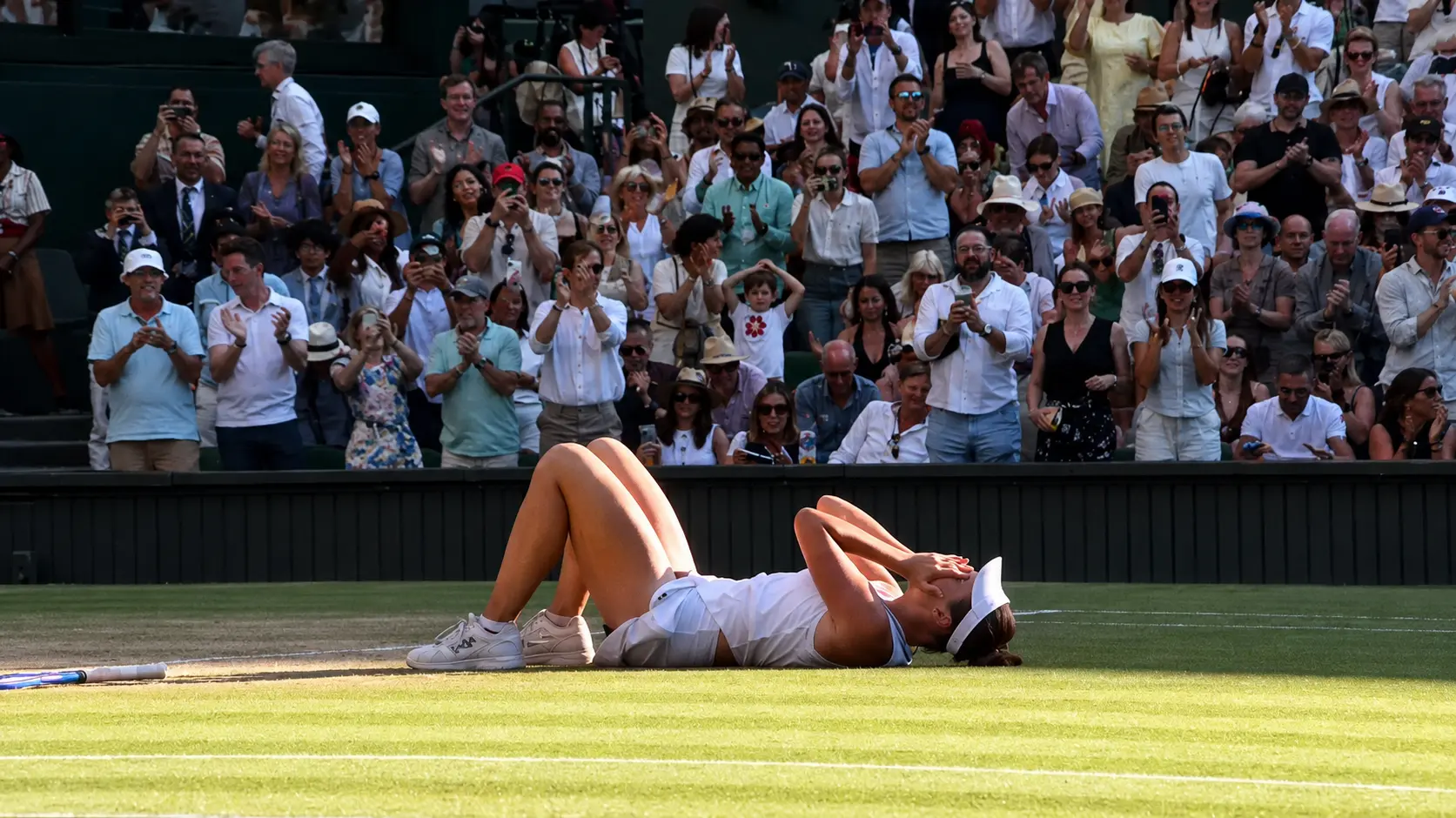
This Wimbledon final had every chance to become a strange little anti-climax.
Two Czech players, one famous old lawn, one Grand Slam trophy, and for more than an hour Linda Noskova looked ready to make the whole thing brutally simple.
She was 21 years old, playing the biggest match of her life, and still she was taking Karolina Muchova apart with a serve-heavy, forehand-led performance that felt almost rude in its clarity.
Noskova led 6-2, 5-2. She had five match points. The Royal Box was getting ready for the polite applause, the cameras were all set, and the final looked finished.
Then Wimbledon got its drama.
Noskova tightened. Muchova grabbed the last scrap of hope and turned it into a set. Five match points disappeared. Five games in a row disappeared with them. Suddenly the younger Czech player had gone from champion-in-waiting to the woman who had to live with the thought of throwing away a Wimbledon final.
And then she did something even more impressive than her opening burst.
She came back.
Noskova beat Muchova 6-2, 5-7, 6-3 to become the Wimbledon 2026 ladies’ singles champion, surviving a final that went from dominance to panic to pure forehand authority.
By the end, there were tears in the player boxes, tears in the stands, tears on court, and the unmistakable feeling that everyone watching had seen something rare.
An all-Czech final may have looked like a treat reserved for the deepest lovers of women’s tennis.
It became one for everybody.
Noskova Starts Like a Player in a Hurry
The first set belonged almost completely to Noskova.
Muchova has more variety, more soft hands, and the more layered grass-court game. She can slice, float, stab, angle, change rhythm and make opponents look as if they are solving a puzzle while running uphill.
Noskova did not allow the puzzle to form.
She served with huge authority, attacked early, and used her forehand to keep Muchova from settling into the kind of creative exchanges that had carried her past Barbora Krejcikova, Naomi Osaka and Coco Gauff on the way to the final.
The scoreline told the story quickly enough: 6-2.
Muchova vs Noskova – Set 1 Key Stats
| Statistic | Muchova | Noskova |
|---|---|---|
| Dominance Ratio | 0.49 | 2.03 |
| Winners | 7 | 8 |
| Unforced Errors | 10 | 7 |
| Serve Rating | 231 | 314 |
| Aces | 3 | 3 |
| Double Faults | 0 | 2 |
| 1st Serve % | 81% (21/26) | 64% (14/22) |
| 1st Serve Points Won | 57% (12/21) | 93% (13/14) |
| 2nd Serve Points Won | 40% (2/5) | 56% (5/9) |
| Break Points Saved | 71% (5/7) | – (0/0) |
| Service Games | 50% (2/4) | 100% (4/4) |
| Ace % | 11.5% | 13.6% |
| Double Fault % | 0% | 9.1% |
| Return Rating | 51 | 182 |
| 1st Return Points Won | 7% (1/14) | 43% (9/21) |
| 2nd Return Points Won | 44% (4/9) | 60% (3/5) |
| Break Points Won | – (0/0) | 29% (2/7) |
| Return Games | 0% (0/4) | 50% (2/4) |
| Pressure Points | 50% (5/10) | 50% (5/10) |
| Service Points | 54% (14/26) | 77% (17/22) |
| Return Points | 23% (5/22) | 46% (12/26) |
| Net Points | 40% (2/5) | 67% (2/3) |
| Total Points | 40% (19/48) | 60% (29/48) |
| Set Duration | 0h32m | |
Noskova’s serve had the feel of a weapon beyond her years. She was not only winning service games. She was winning them with the calm of a player who knew exactly where the next strike was coming from.
Muchova, eight years older and far more experienced in these kinds of emotional storms, looked rushed.
That was the shock.
Not that Noskova could win the final.
That she could make Muchova look so short of answers.
Five Match Points and a Final That Suddenly Turns
The second set looked like more of the same.
Noskova moved ahead 5-2, still serving with purpose, still striking the forehand with the kind of freedom that makes the grass look faster than it already is. At that stage, it was not hard to imagine a short final, a clean ceremony and a new champion crowned before the match had ever truly caught fire.
Then came the edge of the cliff.
Noskova had five match points.
Five chances to become Wimbledon champion.
Five chances to end it before Muchova could turn the afternoon into something far more dangerous.
She kept hitting aces and yet..
She lost them all.
Muchova did what champions, near-champions and stubborn survivors do. She did not need to believe she was in control. She only needed Noskova to start feeling the size of the moment. Once that happened, the match opened, and the crowd came to her side.
Noskova stopped swinging quite as freely. The serve that had looked so untouchable began to carry tension. Seemingly, the toss was gone. Muchova, who had seemed cornered, began to find the small openings: a deeper return, a cleverer angle, one more ball back into court.
The scoreline flipped in a way that felt almost impossible moments earlier.
From 2-5 down, Muchova won five straight games and took the second set 7-5.
Muchova vs Noskova – Set 2 Key Stats
| Statistic | Muchova | Noskova |
|---|---|---|
| Dominance Ratio | 1.07 | 0.94 |
| Winners | 16 | 21 |
| Unforced Errors | 11 | 22 |
| Serve Rating | 274 | 249 |
| Aces | 2 | 4 |
| Double Faults | 0 | 2 |
| 1st Serve % | 64% (30/47) | 67% (33/49) |
| 1st Serve Points Won | 70% (21/30) | 70% (23/33) |
| 2nd Serve Points Won | 55% (11/20) | 43% (9/21) |
| Break Points Saved | 80% (4/5) | 82% (9/11) |
| Service Games | 83% (5/6) | 67% (4/6) |
| Ace % | 4.3% | 8.2% |
| Double Fault % | 0% | 4.1% |
| Return Rating | 138 | 112 |
| 1st Return Points Won | 30% (10/33) | 30% (9/30) |
| 2nd Return Points Won | 57% (12/21) | 45% (9/20) |
| Break Points Won | 18% (2/11) | 20% (1/5) |
| Return Games | 33% (2/6) | 17% (1/6) |
| Pressure Points | 53% (17/32) | 47% (15/32) |
| Service Points | 62% (29/47) | 59% (29/49) |
| Return Points | 41% (20/49) | 38% (18/47) |
| Net Points | 50% (3/6) | 67% (8/12) |
| Total Points | 51% (49/96) | 49% (47/96) |
| Set Duration | 1h12 | |
The final was alive.
Noskova had to walk to the locker room with the knowledge that she had been one point from the title five times and was now back at the start of a deciding set.
Muchova’s Escape Was Brave, but Noskova’s Recovery Was Bigger
Muchova deserves enormous credit for forcing the third set.
She had already played one of the matches of the tournament in the semi-finals against Coco Gauff, saving match point in a 12-10 super tiebreak. She had already shown she could survive when the match was spinning. She had already proved she could win with craft, nerve and problem-solving.
In the final, she found that again.
For a while, it looked as if the experience gap might swallow Noskova. Muchova had dragged the match into the territory where she usually thrives: uncertainty, tension, angles, hands, rhythm changes, and all the small emotional traps that come with a Grand Slam final.
But Noskova did not vanish.
That is why this title feels so large.
Plenty of players can dominate when the ball feels clean and the scoreboard is simple. Fewer can blow five match points, lose five games in a row, and then come back in a third set with the same forehand that first put them in charge.
Noskova did exactly that.
She reset, stepped back into the baseline exchanges and began driving through Muchova again. The final set was not flawless. It could not be after what had happened. But it was brave, controlled and increasingly forceful.
At 6-3 in the third, the collapse had become a comeback.
Muchova vs Noskova – Set 3 Key Stats
| Statistic | Muchova | Noskova |
|---|---|---|
| Dominance Ratio | 0.84 | 1.19 |
| Winners | 12 | 15 |
| Unforced Errors | 6 | 7 |
| Serve Rating | 272 | 343 |
| Aces | 1 | 3 |
| Double Faults | 1 | 0 |
| 1st Serve % | 77% (17/22) | 92% (33/36) |
| 1st Serve Points Won | 65% (11/17) | 70% (23/33) |
| 2nd Serve Points Won | 55% (6/11) | 78% (7/9) |
| Break Points Saved | 0% (0/1) | 100% (4/4) |
| Service Games | 75% (3/4) | 100% (5/5) |
| Ace % | 4.5% | 8.3% |
| Double Fault % | 4.5% | 0% |
| Return Rating | 52 | 205 |
| 1st Return Points Won | 30% (10/33) | 35% (6/17) |
| 2nd Return Points Won | 22% (2/9) | 45% (5/11) |
| Break Points Won | 0% (0/4) | 100% (1/1) |
| Return Games | 0% (0/5) | 25% (1/4) |
| Pressure Points | 30% (3/10) | 70% (7/10) |
| Service Points | 64% (14/22) | 69% (25/36) |
| Return Points | 31% (11/36) | 36% (8/22) |
| Net Points | 88% (7/8) | 67% (6/9) |
| Total Points | 43% (25/58) | 57% (33/58) |
| Set Duration | 0h45m | |
The lost match points became part of the legend instead of the wound.
The Numbers Show How Noskova Took the Trophy
The full match stats show why Noskova deserved the title, even after the chaos of the second set.
She finished with a dominance ratio of 1.20, while Muchova ended at 0.83. Noskova hit 44 winners to Muchova’s 35, a huge attacking edge in a final filled with pressure.
The serve was the biggest separator.
Noskova hit 10 aces, compared with six for Muchova. She won 74 percent of her first-serve points, while Muchova won 64 percent. Noskova also held 13 of 15 service games, an 87 percent rate, despite the emotional earthquake of that second-set finish.
Muchova had to save five match points and still found a way to drag the final into a third set. That alone says plenty about her nerve.
But Noskova kept generating more force.
She won 109 of the 201 total points. Muchova won 92.
Noskova also won 61 percent of the pressure points, taking 17 of 28. That stat is striking because it includes the match-point drama. Even with five lost chances, Noskova still won more of the points that carried the most tension.
Her return numbers were stronger too. Noskova won 40 percent of return points, compared with 34 percent for Muchova. She converted four of 13 break points, while Muchova converted only two of 15.
Muchova covered more ground, 1,861 meters to Noskova’s 1,685.
Noskova made Muchova run.
That was the final in one sentence.
Muchova Could Not Quite Turn Craft Into the Crown
Muchova did so much right at Wimbledon.
She beat champions. She survived a classic against Gauff. She reached her first final at the All England Club and gave Czech tennis half of a dream championship match.
In the final, she nearly stole the whole story.
Her comeback from 2-5 down in the second set was extraordinary. She used every bit of her variety, and made Noskova feel the full burden of standing one point from a Grand Slam title.
For a player with her imagination, the match briefly looked ready for one last Muchova trick.
But the third set showed the limit.
She could not consistently hold off Noskova’s power. She could not turn enough of her 15 break points into real scoreboard damage. She could not make the final live permanently in her kind of tennis.
Muchova had the artistry.
Noskova had the bigger strikes when the match needed to be rebuilt.
Noskova’s Forehand Becomes the Final Word
By the end, this final belonged to Noskova’s forehand as much as her serve.
The serve created the platform. The forehand did the emotional repair.
After the second-set collapse, Noskova needed something simple to trust. The forehand gave her that. She used it to move Muchova, to finish rallies, to stop the match from becoming a delicate contest of touch and disguise.
That was the tactical heart of the final.
Muchova wanted texture.
Noskova wanted impact.
For long stretches, impact won. Even after the wobble, even after the missed match points, even after Muchova dragged the final into a place where nerves usually decide everything, Noskova found the cleaner, louder answer.
That is why this was not only a breakthrough.
It was a champion’s response.
A Czech Final Turns Into a Wimbledon Classic
There can be a fear when two countrywomen meet in a major final.
The match can become tight, awkward, overly familiar. The shared history can flatten the occasion. The crowd can take time to choose its emotional route into the contest.
This final avoided that fate in the most dramatic way possible.
Noskova’s early dominance gave it shock value. Muchova’s second-set escape gave it theatre. The third set gave it meaning. By the time Noskova finally crossed the line, the match had become something more than a Czech tennis celebration.
It became a Wimbledon final for the ages.
The tears afterward said as much. In the Royal Box, in the player boxes, in the stands and on the court, the emotion spilled out because the match had demanded it.
Everyone had been pulled through the same journey: the near-coronation, the collapse, the disbelief, the recovery, and finally the arrival of a new champion.
Linda Noskova Is the New Wimbledon Champion
Linda Noskova is the Wimbledon champion.
That sentence still feels almost too fresh to sit still.
She came into the final as the younger Czech, the rising force, the player with the bigger serve and the cleaner power. She left it as a Grand Slam champion who had already lived through the kind of scar that can define a career and somehow turned it into the greatest day of her tennis life.
She was dominant.
She was nervous.
She almost lost the plot.
Then she picked the plot back up, wrote the ending herself, and lifted the trophy.
She had the nerve to survive herself.
Linda Noskova is the new Wimbledon champion.
And women’s tennis has another young Grand Slam champion with a game big enough, and now a story wild enough, to suggest she could win Wimbledon three or four times.