
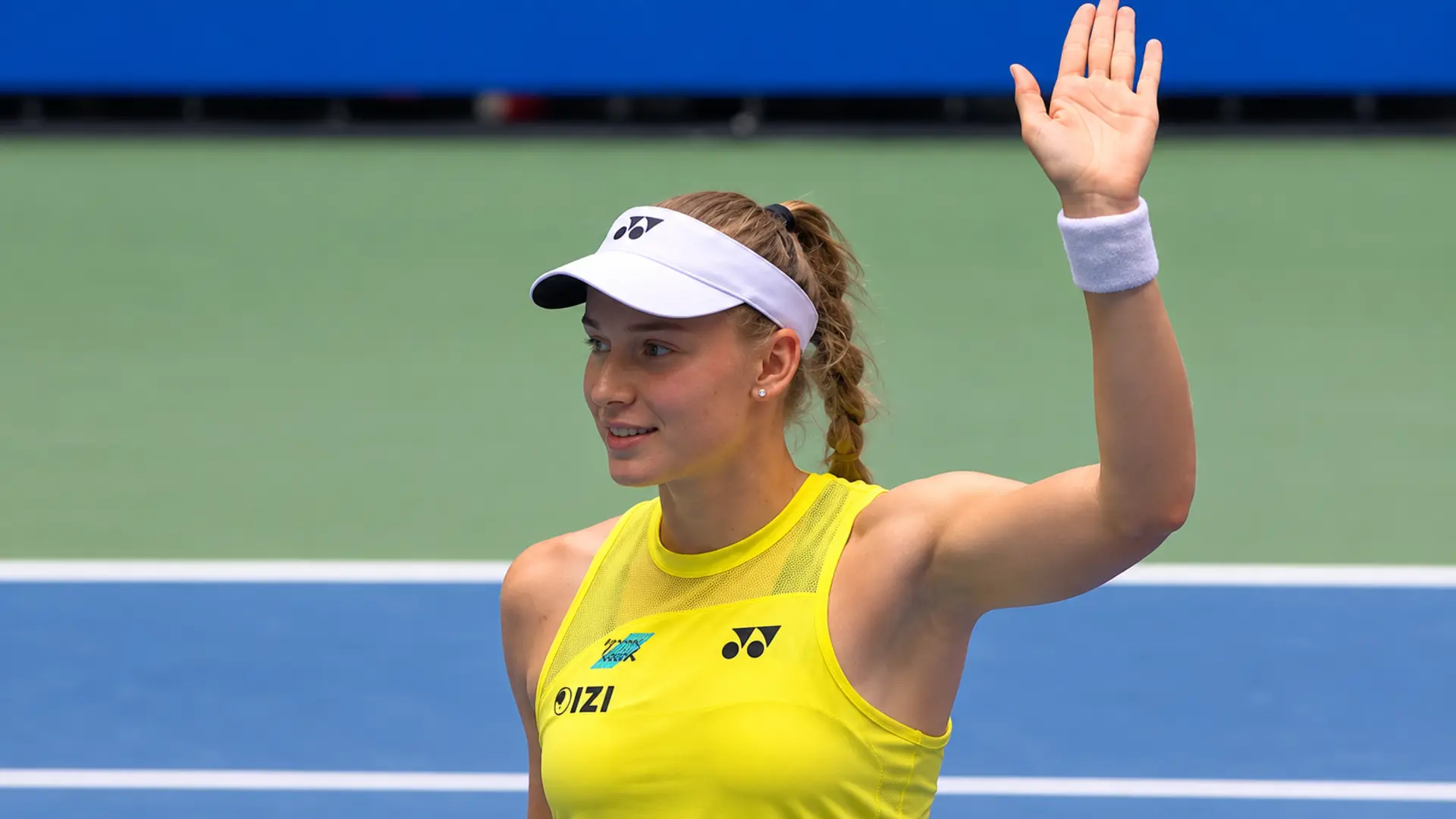
Elena Rybakina vs. Qinwen Zheng — US Open 2026 Quarterfinal Match Report.
Elena Rybakina spent much of her junior career sharing courts rather than receiving individual training. She did not begin working seriously one-on-one until around the age of 17.
On Wednesday in New York, that unconventional route reached the top of women’s tennis.
Rybakina recovered from a nervous opening set to defeat Qinwen Zheng 3-6, 6-1, 6-4, reaching her first US Open semifinal and securing enough ranking points to become the 30th WTA World No. 1 when the new rankings are published on Monday.
Aryna Sabalenka’s reign will end after 99 consecutive weeks at No. 1. Even if the Belarusian wins a third straight US Open title, she can no longer prevent Rybakina from taking over.
The final step looked anything but routine.
Rybakina became visibly frustrated during the first set and later acknowledged that she had allowed herself to become too negative. The tension was understandable. For all the familiar talk about players concentrating only on the next match and allowing rankings to take care of themselves, this was one of those rare occasions when the consequence was impossible to ignore.
Beat Zheng and the calculations disappeared.
Rybakina eventually did exactly that.
Zheng Makes Rybakina Wait
The opening six games gave little indication of what was coming.
Neither player faced a break point as Zheng moved ahead three times and Rybakina answered each time, bringing the set to 3-3.
Zheng then held for 4-3.
The eighth game became the first real struggle of the match. Rybakina was repeatedly forced back to deuce and saved several break opportunities before Zheng eventually converted.
For the first time, there was separation.
5-3 Zheng.
The qualifier made sure Rybakina received no immediate opportunity to recover. Zheng served out the set in the following game to take it 6-3.
Rybakina had not lost a set during her first four matches in New York.
Now she had lost one at precisely the moment when the No. 1 ranking was sitting one victory away.
Her reaction was unusually revealing. The negative body language increased, conversations with the two members of her team became more frequent and the calm rhythm of the previous rounds had disappeared.
The match had begun to feel like more than a quarterfinal.
Rybakina Clears Her Head and Takes Control
Whatever Rybakina carried with her at the end of the first set did not survive the changeover.
She held to begin the second, immediately broke Zheng and then produced a love hold for 3-0.
Zheng stopped the run by holding for 1-3, but the momentum did not shift with it.
Rybakina held again for 4-1 before applying pressure to the Zheng serve once more. A second break followed.
At 5-1, Rybakina was serving for the set.
This time there was no hesitation.
She closed it out for 6-1.
The transformation did not depend on a flood of spectacular winners. Rybakina became calmer, played with greater discipline behind her serve and stopped allowing every missed opportunity to linger into the next point.
The match was level.
One set now separated her from World No. 1.
One Break Point Saved, One Break Taken
The third set returned to the pattern of the beginning of the match.
Zheng held.
Rybakina held.
Neither gave the other much room as the score moved through 1-1, 2-2 and 3-3.
Zheng then held for 4-3.
The next game became the defining moment of Rybakina’s afternoon.
Serving at 3-4, she faced a break point. Had Qinwen Zheng taken it, she would have served for the match at 5-3.
Rybakina saved it.
She eventually held for 4-4, and the entire dynamic changed within minutes.
Zheng was now the player under pressure.
Rybakina attacked the following service game and converted the opportunity that had eluded both players for most of the deciding set.
Break. 5-4.
For the first time in the third set, Rybakina was ahead.
She was also one service game away from becoming World No. 1.
This time the nerves did not return.
Rybakina served out the match to Win-15.
3-6, 6-1, 6-4.
The race was over.
Rybakina’s Second Serve Made the Difference
The winner and unforced-error totals suggest a much closer match than the eventual dominance ratio.
Rybakina finished with 20 winners and 26 unforced errors. Zheng had 18 winners and 27 unforced errors.
The clearer advantage came from what happened after the first serve.
| Zheng | Statistic | Rybakina |
|---|---|---|
| Match Duration: 2h14m | ||
| 0.74 | Dominance Ratio | 1.36 |
| 18 | Winners | 20 |
| 27 | Unforced Errors | 26 |
| 255 | Serve Rating | 291 |
| 7 | Aces | 5 |
| 4 | Double Faults | 5 |
| 48% (45/94) | 1st Serve % | 55% (40/73) |
| 80% (36/45) | 1st Serve Points Won | 80% (32/40) |
| 47% (23/49) | 2nd Serve Points Won | 64% (21/33) |
| 77% (10/13) | Break Points Saved | 75% (3/4) |
| 89 | Return Rating | 119 |
| 20% (8/40) | 1st Return Points Won | 20% (9/45) |
| 36% (12/33) | 2nd Return Points Won | 53% (26/49) |
| 1/4 | Break Points Won | 3/13 |
| 79 | Total Points Won | 88 |
Both women won 80% of their first-serve points.
The second serve separated them.
Rybakina won 64% of her second-serve points, compared with Zheng’s 47%. On return, she won 53% of Zheng’s second-serve points, while Zheng managed only 36% against hers.
That difference helped Rybakina win 73% of all service points and hold in 12 of her 13 service games.
Zheng faced considerably more pressure. She saved 10 of 13 break points, but Rybakina generated enough opportunities to break three times.
The final one came at 4-4 in the deciding set.
Rybakina also finished with a 1.36 dominance ratio, compared with Zheng’s 0.74, and won the overall points count 88-79.
The Road to No. 1 Started With a Last-Minute Ticket to Riyadh
The ranking change did not begin at this US Open.
Its origins can be traced to the final weeks of 2025.
Rybakina only secured her place at the 2025 WTA Finals late in the qualification race.
Once she got there, she beat everyone.
She completed an undefeated five-match run in Riyadh and defeated Sabalenka in the final. The title was worth the maximum 1,500 ranking points and brought Rybakina $5.235 million, the largest prize-money payout recorded in women’s sport at the time.
The momentum carried into Melbourne.
Rybakina won the 2026 Australian Open, again defeating Sabalenka in the championship match.
Those two titles alone added 3,500 ranking points.
Still, the No. 1 ranking remained distant.
Sabalenka responded emphatically during the American spring, winning Indian Wells and Miami and temporarily stretching the gap again.
There was no simple straight line from Riyadh to No. 1.
What eventually transformed the race was the difference in what both players had to defend in New York.
Sabalenka entered the US Open with 2,000 points from her 2025 title due to come off her ranking.
Rybakina had only 240 points to defend after an early exit the previous year. Before the tournament, Sabalenka held 8,575 points and Rybakina 8,141. Once the 2025 US Open points began dropping away, the balance changed dramatically.
As we detailed in our previous US Open 2026 World No. 1 race, Rybakina eventually reached the point where she could settle everything herself.
A semifinal would guarantee it.
Not even another Sabalenka title could stop her.
Sabalenka’s 99-Week Reign Will End Monday
Sabalenka first returned to No. 1 on October 21, 2024.
She has stayed there ever since.
When Monday arrives, that uninterrupted run will end at 99 weeks, the sixth-longest continuous reign in WTA ranking history. Her overall total will stand at 107 weeks.
The significance of Rybakina replacing her goes beyond a simple exchange of positions.
Rybakina will become the 30th woman since the computerized WTA rankings began in 1975 to reach No. 1 and the first representing Kazakhstan.
The Kazakhstan Tennis Federation has gone even further, describing her as the first athlete representing the country, male or female, to reach No. 1 in a world singles ranking.
That makes Monday a landmark in Kazakh sport as well as women’s tennis.
No Individual Training Until 17
Rybakina’s route to the top also looks very different from the conventional development story of an elite tennis player.
She was born in Moscow and spent much of her childhood training in groups rather than receiving individual instruction.
Rybakina has previously described practicing with several players on the same court through her junior years and not beginning serious individual coaching until around the age of 17 or 18.
Even relatively late in her development, she was still sharing training time rather than operating with the kind of dedicated team now considered normal for a future Grand Slam champion.
That makes the headline of her rise especially striking.
No individual training until roughly 17.
World No. 1 at 27.
Her career changed course after she began representing Kazakhstan in 2018, when the Kazakhstan Tennis Federation offered the backing necessary to continue pursuing a professional career.
Eight years later, the player born and developed in Moscow will become the first player carrying the Kazakh flag to sit at the top of the WTA rankings.
The Reaction Said More Than the Celebration
Rybakina has never been one of the sport’s most demonstrative players.
Wednesday did not suddenly change that.
Yet there were signs throughout the match of how heavily the occasion was sitting on her. The frustration of the opening set was stronger than usual, and she later admitted that she had become too negative before resetting herself.
The reaction from her box told another part of the story.
Only two people were sitting there, but there was no mistaking the significance of the moment when Rybakina finally closed the match. Stefano Vukov, in particular, reacted like someone who understood the size of the milestone they had just reached.
For all the attempts players make to reduce rankings to a by-product of winning matches, No. 1 is different.
There is nowhere higher to go.
From Shared Courts to the Top of Women’s Tennis
Rybakina still has a US Open semifinal to play, and potentially two more matches before her tournament is finished.
But one part of this US Open is already settled.
Aryna Sabalenka can win the title again. She can complete the three-peat. Sabalenka can leave New York with another major trophy.
She cannot remain World No. 1.
Rybakina survived the nerves, recovered from a set down and won the match she needed to remove every remaining mathematical condition.
On Monday, the rankings will make it official.
A player who spent her entire junior development sharing courts and did not receive individual training until her late teens will now be sitting above everyone else.
Ask almost any player or coach and they will tell you how extraordinary that is. Group training at that level of development is almost unheard of for someone who eventually reaches World No. 1. Yet it remains one of the least-known parts of Rybakina’s story.
Elena Rybakina, World No. 1.