
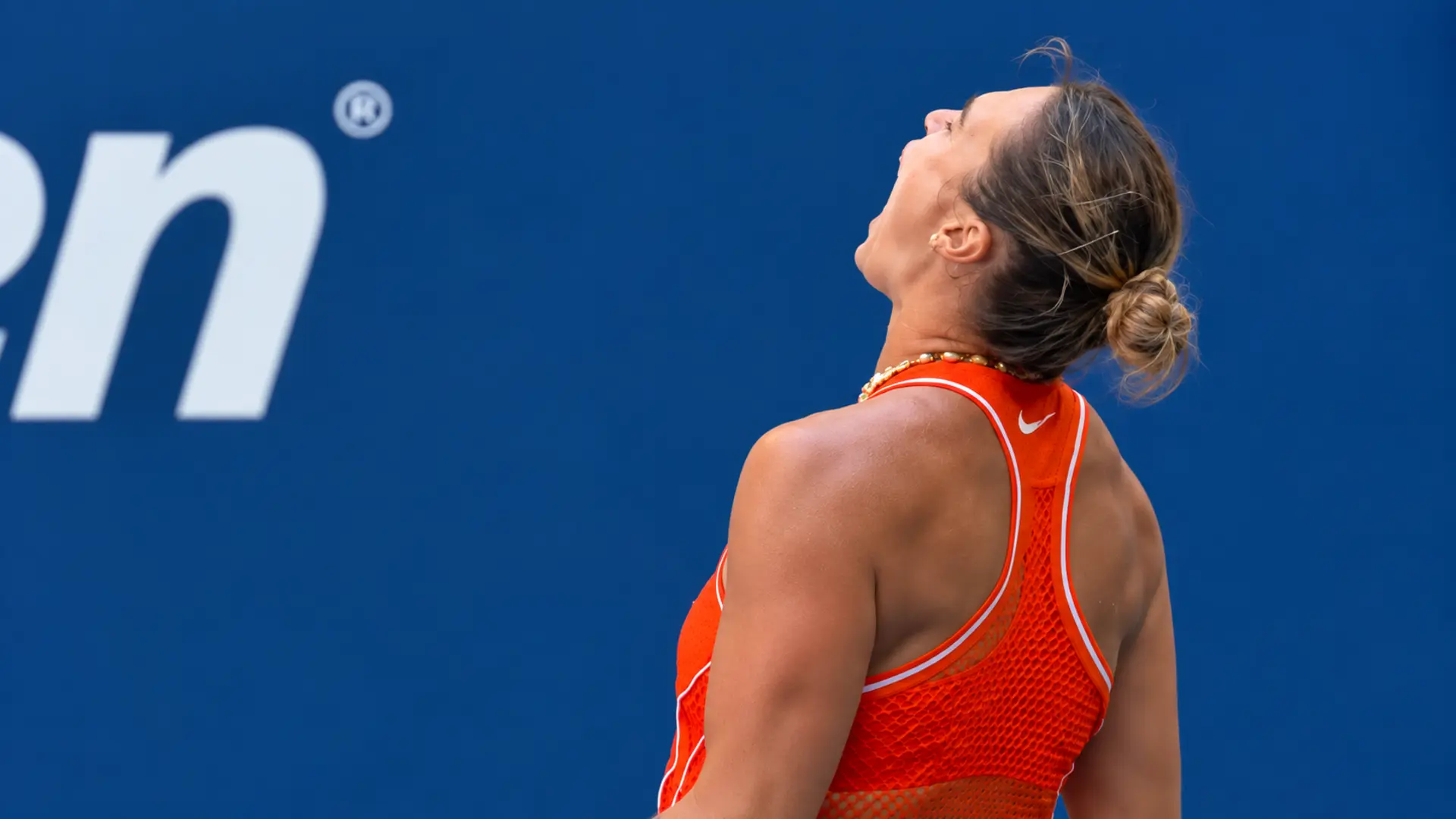
Aryna Sabalenka — US Open 2026 Quarterfinal Press Conference After Defeating Linda Noskova
For a few minutes in the third set, Aryna Sabalenka had already begun imagining the end.
Linda Noskova was serving better, striking freely and applying enough pressure to make the defending champion feel that her US Open title defence might finally have run its course.
Sabalenka said it plainly afterwards:
“I honestly thought that’s it.”
What happened next explains rather more about her than another collection of aces or winners ever could.
She caught herself thinking about defeat, discarded the thought and returned to something much smaller: the next point.
That reset eventually carried Sabalenka through a bruising three-set quarterfinal and into the semifinals, keeping alive both her title defence and the possibility of a third consecutive US Open crown.
Sabalenka Had to Stop Thinking About the Ending
Noskova had given Sabalenka good reason to worry.
The Czech was serving with increasing authority and had turned the deciding set into exactly the kind of contest in which one loose game could end a tournament.
Sabalenka recognised that shift.
“I just felt at some point in the third set, yeah, she was definitely serving better than me and putting so much pressure on me,” she said.
The significant part came next.
Rather than trying to persuade herself that everything was fine, Sabalenka acknowledged the thought and then removed it from the equation.
“I’m glad that I kind of threw that thought away and I was able to focus point by point and literally just try to build something bigger in that moment.”
That was the psychological pivot.
The situation had become too large.
Sabalenka made it small again.
One point.
Then another.
The Break at 3-4 Changed What Sabalenka Believed
Sabalenka identified the break back at 3-4 in the deciding set as the moment when survival began to look like something more.
She rejected the suggestion that she had simply been fortunate.
“I got — not lucky, but I’m happy with the way I broke her serve at 3-4,” Sabalenka said.
What pleased her was the quality of the tennis she produced under pressure.
“I think I really played great-intensity-level tennis, and that really gave me so much confidence that I still can get the win in this match.”
That distinction is important.
Sabalenka did not escape by retreating.
She escaped by becoming more assertive.
Earlier in the set, the aggression had sometimes carried the feeling of urgency. After the break back, it became much cleaner.
The shots were still big.
The panic around them had disappeared.
A Second-Serve Ace Is an Appropriate Ending
The match eventually reached a deciding tiebreak, and Noskova still refused to release her.
That made the final point particularly Sabalenka-like.
Second serve.
Ace.
Match.
“Obviously, a second-serve ace, couldn’t be happier,” she said. “That was a really tough, tight battle.”
It was more than a flashy way to finish.
It represented the attitude Sabalenka had decided to trust once she found herself in genuine danger.
She would not protect the result by shrinking her game.
“I’m just super happy that I really stayed aggressive throughout the whole match and I really trusted my shots.”
That trust was ultimately the difference between thinking the tournament was over and still having two matches available to win it.
“Three-Peat Sounds Great”
The stakes now become larger.
Sabalenka is two victories away from winning a third consecutive US Open title, something no woman has done since Serena Williams.
She is not pretending the idea has escaped her attention.
“Three-peat sounds great.”
But there is an important qualification.
Sabalenka has been in a similar position before and believes she learned from allowing the possibility of a historic achievement to occupy too much mental space at the Australian Open.
This time, she wants the ambition without the burden.
“I’m just super happy that I put myself in the position where I have a chance to go for three-peat, even though I’m still far away from that,” she said.
The lesson from Australia, she explained, was to “shut down all of the noise.”
Having the possibility somewhere in the back of her mind is acceptable.
Building every point around it is not.
The Body Passed a Test Too
Sabalenka’s satisfaction was not purely psychological.
A match of this intensity also gave her information about her body.
That mattered.
“Knowing that physically my body can handle these matches again, I’m super happy with that.”
A straightforward victory can tell a player that the tennis is working.
A match like this tests something else.
Can the body still produce at full intensity late in a third set?
Can the mind recover after briefly believing the match is gone?
Can aggression survive pressure rather than turn into panic?
Against Noskova, Sabalenka received affirmative answers to all three.
That is why she described the match as giving her a “boost of energy and motivation.”
Noskova May Have Given Sabalenka Exactly What She Needed
For Noskova, defeat was cruel.
She served superbly, pushed the defending champion into genuine doubt and came close enough for Sabalenka herself to contemplate the end.
But that is also what may make this victory particularly valuable for the world No. 1.
Sabalenka left the court knowing she had been close to losing and had still found a way back.
That kind of evidence can travel with a player.
The three-peat remains two victories away.
Sabalenka knows that.
But after briefly believing this US Open was finished, she now has something more useful than a comfortable win.
She has proof that even when the thought of defeat arrives, she does not have to obey it.