
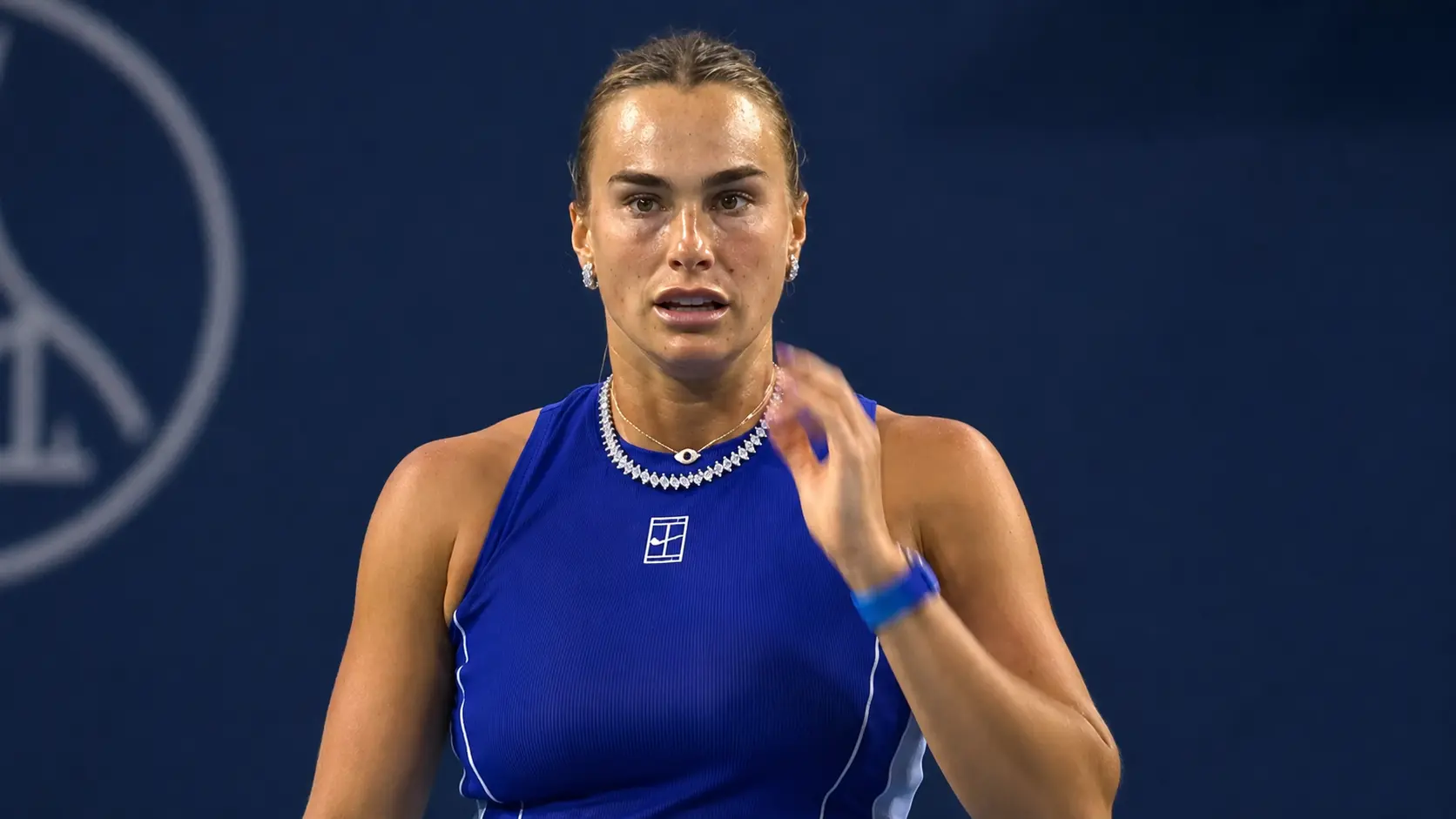
Aryna Sabalenka has spent the last two US Opens doing something nobody else in the women’s draw could stop.
Now she gets the chance to make it three.
The World No. 1 arrives in New York chasing a third consecutive US Open title, but with a curious contradiction attached to her name. Her last two tournaments ended earlier than expected. Ekaterina Alexandrova stopped her in Toronto. Sara Bejlek did the same in Cincinnati. Suddenly, the conversation around Sabalenka has shifted toward form, vulnerability and whether her dominance on hard courts is beginning to loosen.
The numbers tell a very different story.
RallyHer’s analysis of Sabalenka’s hard-court seasons found her 22-3 in 2026 through Cincinnati, an 88.0% winning rate that is the best at this stage of any season in the nine-year comparison. Her dominance ratio of 1.44 is almost identical to her career-best figures, while she is winning more second-serve points than in any previous season studied.
And now we have the draw.
It is not completely comfortable. Barbora Krejcikova could arrive as early as the third round, Diana Shnaider is the projected Round of 16 opponent and Linda Noskova sits on the quarterfinal line.
But compared with the minefields surrounding Elena Rybakina and Coco Gauff, Sabalenka has been given a route that the defending champion should look at and see possibility.
Sabalenka’s US Open Women’s Main Draw Bracket Section
This is the complete 16-player section containing Sabalenka:
Sabalenka A. (Wrl) (1) v Osorio C. (Col)
Zarazua R. (Mex) v Qualifier
Ito A. (Jpn) v Selekhmeteva O. (Wrl)
Rakhimova K. (Uzb) v Krejcikova B. (Cze) (27)
Chwalinska M. (Pol) (20) v Townsend T. (Usa)
Preston T. (Aus) (WC) v Parks A. (Usa)
Vandewinkel H. (Bel) v Pliskova K. (Cze)
Snigur D. (Ukr) v Shnaider D. (Wrl) (15)
The seedings project Sabalenka against Shnaider in the Round of 16, but the most obvious disruption to that route could come considerably earlier.
Krejcikova is positioned to meet Sabalenka in the third round.
That immediately makes the top seed’s first week more interesting than the seed numbers alone suggest.
Sabalenka’s Projected US Open Path by Seeding
- 1st Round: Camila Osorio
- 2nd Round: Renata Zarazua / Qualifier
- 3rd Round: Barbora Krejcikova
- Round of 16: Diana Shnaider
- Quarterfinal: Linda Noskova
- Semifinal: Jessica Pegula
- Final: Elena Rybakina
As always, this is the path created by the seedings, not a prediction that each player will reach the corresponding round.
And Sabalenka’s section is a good illustration of why that distinction is important.
Her biggest early danger may not be the highest seed immediately around her.
The First Two Rounds Give Sabalenka Room
Sabalenka opens against Camila Osorio.
The second round would bring either Renata Zarazua or a qualifier.
For a player coming off consecutive Round of 16 defeats, that is useful territory.
There is no guarantee of anything at a Grand Slam, but Sabalenka has avoided the kind of opening assignment that immediately turns the tournament into a test of survival.
That gives her two potential matches to settle into New York, recalibrate after Cincinnati and rediscover the rhythm that produced the extraordinary hard-court numbers she has accumulated this year.
Because underneath those two recent losses lies something that should not be forgotten.
Sabalenka has barely lost on hard courts in 2026.
Krejcikova Changes the Third Round Completely
The first place where the draw could become genuinely uncomfortable is the third round.
Barbora Krejcikova is the No. 27 seed in Sabalenka’s immediate eight-player section.
Krejcikova first has to negotiate her own path, beginning against Kamilla Rakhimova, but if the seedings hold, she and Sabalenka meet before the second week has even begun.
That is the match that prevents this from being described as a soft section.
For Sabalenka, the danger is also structural. A top seed normally expects the difficulty of a Grand Slam to rise progressively. Here, a significant test could appear in Round 3 before potentially easing back into a more conventional seeded matchup in the fourth round.
Get through it, though, and the shape of the tournament begins to look attractive.
Shnaider Is the Projected Round of 16 Test
Diana Shnaider, seeded No. 15, anchors the other half of Sabalenka’s section.
Her route is hardly guaranteed.
Maja Chwalinska is seeded No. 20, while Taylor Townsend, Alycia Parks and Karolina Pliskova all occupy the same part of the bracket.
That means the bottom half of Sabalenka’s section has plenty of capacity to break apart before the Round of 16.
If the seedings do hold, however, Sabalenka-Shnaider would decide a place in the quarterfinals.
It would also represent the point where the defending champion should expect the draw to stop offering any room for error.
Noskova Heads the Other Half of the Quarter
Sabalenka’s projected quarterfinal opponent is Linda Noskova, the No. 6 seed.
The adjacent 16-player section reads:
Kostyuk M. (Ukr) (11) v Qualifier
Stephens S. (Usa) (WC) v Tauson C. (Den)
Birrell K. (Aus) v Marcinko P. (Cro)
Kessler M. (Usa) v Alexandrova E. (Wrl) (18)
Li A. (Usa) (29) v Ruzic A. (Cro)
Gibson T. (Aus) v Vekic D. (Cro)
Qualifier v Tararudee L. (Tha)
Volynets K. (Usa) v Noskova L. (Cze) (6)
And that section may be more unpredictable than Sabalenka’s own.
Noskova is the highest seed, but Marta Kostyuk sits at No. 11 and Ekaterina Alexandrova at No. 18.
Alexandrova is particularly difficult to ignore.
She is the woman who ended Sabalenka’s Toronto campaign earlier this month.
A quarterfinal rematch is not the projected result by seeding, but the draw has at least left open the possibility that one of the two women responsible for Sabalenka’s recent dip could reappear in New York.
Bejlek cannot do so until much later. Alexandrova could.
The Sabalenka “Slump” Looks Different When You See the Numbers
This is what makes Sabalenka’s US Open particularly fascinating.
There are two versions of her current form.
The first is easy to see.
She lost in the Round of 16 in Toronto. Then she lost in the Round of 16 in Cincinnati. Across the two tournaments she went 4-2.
For the World No. 1 and two-time defending US Open champion, those are disappointing results.
But our examination of every Sabalenka hard-court season since 2018 showed why treating those two tournaments as evidence of a poor 2026 is much harder to justify.
Through Cincinnati:
- Sabalenka is 22-3 on hard courts
- Her 88.0% winning percentage is the highest in the nine-season comparison
It is a player having one of the strongest hard-court seasons of her career who has happened to lose twice in August.
The US Open now gets to tell us which part matters more.
One Statistic May Matter Most in New York
Sabalenka’s second serve once provided opponents with a way into matches.
That has changed dramatically.
In RallyHer’s comparison, she won only 41.4% of second-serve points in 2022 while double-faulting on 12.3% of service points.
Four years later, those numbers are almost unrecognizable.
Her second-serve success has climbed to 57.0%, while the double-fault rate has fallen to 3.3%.
For a player whose first-strike power already makes her exceptionally difficult to contain on a hard court, removing that old weakness changes the equation.
It also helps explain why two recent defeats should not automatically outweigh everything that came before them.
Sabalenka is trying to rediscover the results that her game was producing only a few weeks ago.
Pegula Could Be Waiting in the Semifinals
If Sabalenka survives her quarter, the projected semifinal is Jessica Pegula.
That would immediately bring recent US Open history into the conversation.
Pegula has the most open quarter of the top four seeds on paper, while Sabalenka has a route that sits somewhere between Pegula’s relatively favorable section and the considerably more difficult territory occupied by Rybakina and Gauff.
It means the top half has a clear projected destination:
Sabalenka vs. Pegula.
But the important difference is how they might get there.
Pegula’s danger is more spread out.
Sabalenka has one potentially awkward early collision with Krejcikova, followed by Shnaider and then a quarter containing Noskova, Kostyuk and Alexandrova.
Not easy.
Not brutal either.
For the defending champion, it is workable.
Three Straight US Opens Would Turn a Great Run Into Something Else
This is ultimately why Sabalenka’s bracket deserves more attention than any of the others.
Rybakina has the hardest draw.
Pegula may have the most favorable one.
Gauff has perhaps the greatest concentration of dangerous names around her.
But Sabalenka is playing for history.
She has already won the US Open twice in succession. Seven more victories would make it three.
The last two tournaments created doubt.
The previous 25 hard-court matches created the counterargument.