
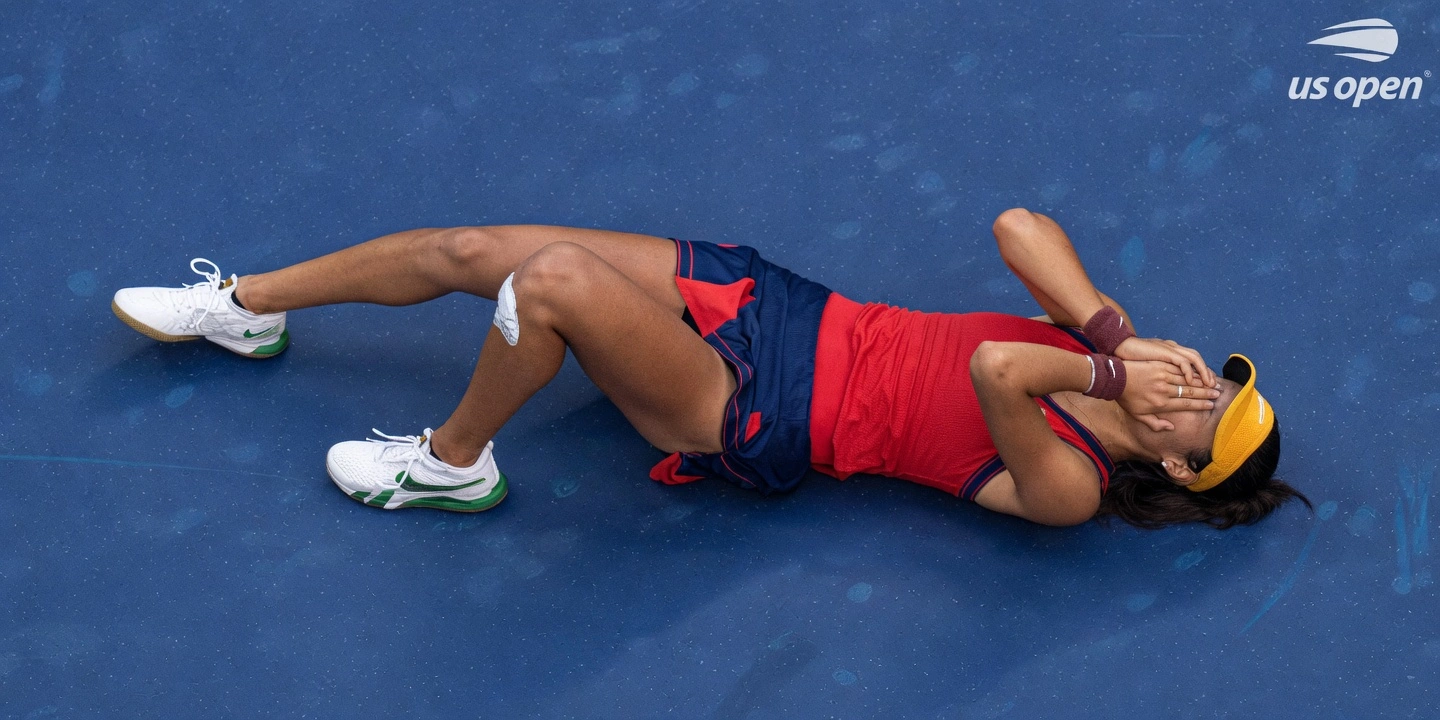
Emma Raducanu will not defend anything at Flushing Meadows this year, because there is nothing left of her season to defend it with.
The 23-year-old has confirmed she will miss the US Open after a stress fracture in her right leg, the same injury that already forced her out of Wimbledon and the Canadian Open. On paper that reads as one more setback in a run of them. Look at the calendar instead of the injury list, though, and a different problem shows up: since the start of January, Raducanu has actually competed in ten weeks of tennis. The season is twenty-two weeks old.
That is not a player having a difficult year. That is a player who has barely had a year at all.
A Season Told in Fragments
The results themselves are not the issue. When healthy, Raducanu has looked like exactly the player who won a Grand Slam at nineteen.
She reached the final in Cluj-Napoca as the top seed in February, needing three-set escapes to get there before running into a Sorana Cirstea who simply had her number, 6-0, 6-2.
She reached another final in June at Queen’s Club, her third career tour-level final, beating a run of increasingly dangerous opponents (Blinkova, Cirstea again in revenge, Rakhimova, Iva Jovic) before Donna Vekic edged her in a tight two-setter.
Those are not the results of a player in decline. They’re the results of a player who is good enough to make finals whenever she actually gets a sustained run of matches.
The problem is how rarely that’s happened.
January opened with a loss to Maria Sakkari at the United Cup, then a week in Hobart that ended in a straight-sets quarterfinal defeat to wildcard Taylah Preston. The Australian Open lasted exactly one round beyond the opener, a routine win followed by a tight three-set loss to Anastasia Potapova.
February brought that Cluj-Napoca final, then a retirement while trailing in Doha and a three-set loss in Dubai the week after.
March gave her one win at Indian Wells before a heavy 6-1, 6-1 defeat to Amanda Anisimova ended the tournament fast.
Then nothing. Ten and a half weeks of nothing.
The Gap Nobody’s Really Talking About
Between an early exit at Indian Wells in early March and a first-round loss in Strasbourg in mid-May, Raducanu did not play a single competitive match.
That stretch lines up with a post-viral illness that kept her away from the tour, on top of a foot injury that had already disrupted her preseason. By the time she returned, she looked like a player searching for rhythm rather than building on anything: a loss to Diane Parry in Strasbourg, then an even earlier exit at Roland Garros against Solana Sierra. Two tournaments, two first matches, two losses.
Then, for one week in June, everything clicked.
Queen’s Club Was the Proof of Concept. It Also Broke Her.
The grass swing was supposed to be the turnaround. For five matches, it was.
Raducanu won her way to the Queen’s Club final playing some of her best tennis since the 2021 US Open, only for the physical cost of that run to surface almost immediately afterward. The stress fracture that ended her Wimbledon hopes traces directly back to that week. It is the cruelest kind of irony available to an athlete: the best stretch of her season is also the one that ended it.
She has not played since.
What Ten Weeks of Tennis Costs a Ranking
The tennis calendar does not pause for injuries, and neither does the ranking system built to reward whoever keeps showing up.
Raducanu reached the third round at the Canadian Open, Cincinnati and the US Open last year, which means all three results are due to be defended this summer by a player who will contest none of the three events.
She currently sits near the top 50. By the time the US Open ends, she could be outside the top 90, with her place inside the top 100 genuinely at risk. None of that is about a decline in her tennis. It’s simple arithmetic: points earned in 2025 disappear whether or not you’re fit enough to go and re-earn them in 2026.
A Reunion That Never Got the Chance It Needed
Raducanu brought back Andrew Richardson, the coach who guided her to the 2021 US Open title, hoping 2026 would be the year that partnership got room to build something.
Instead, it has mostly been a partnership conducted around gaps in the schedule rather than inside it. Ten weeks of matches is not enough time for any coach to reshape a game, however good the working relationship is. The tennis Raducanu produced at Cluj-Napoca and Queen’s suggests the ability is still there, fully intact. What’s missing isn’t talent. It’s the uninterrupted stretch of weeks that talent needs to turn into results that hold.
Whether that stretch ever arrives is not a question this season can still answer. For now, Raducanu’s focus is recovery, not competition, and the tour moves on to Flushing Meadows without her for the first time since the tournament made her a Grand Slam champion.