
The first two rounds of a Grand Slam are supposed to thin the field.
At this US Open, they have barely touched the top of it.
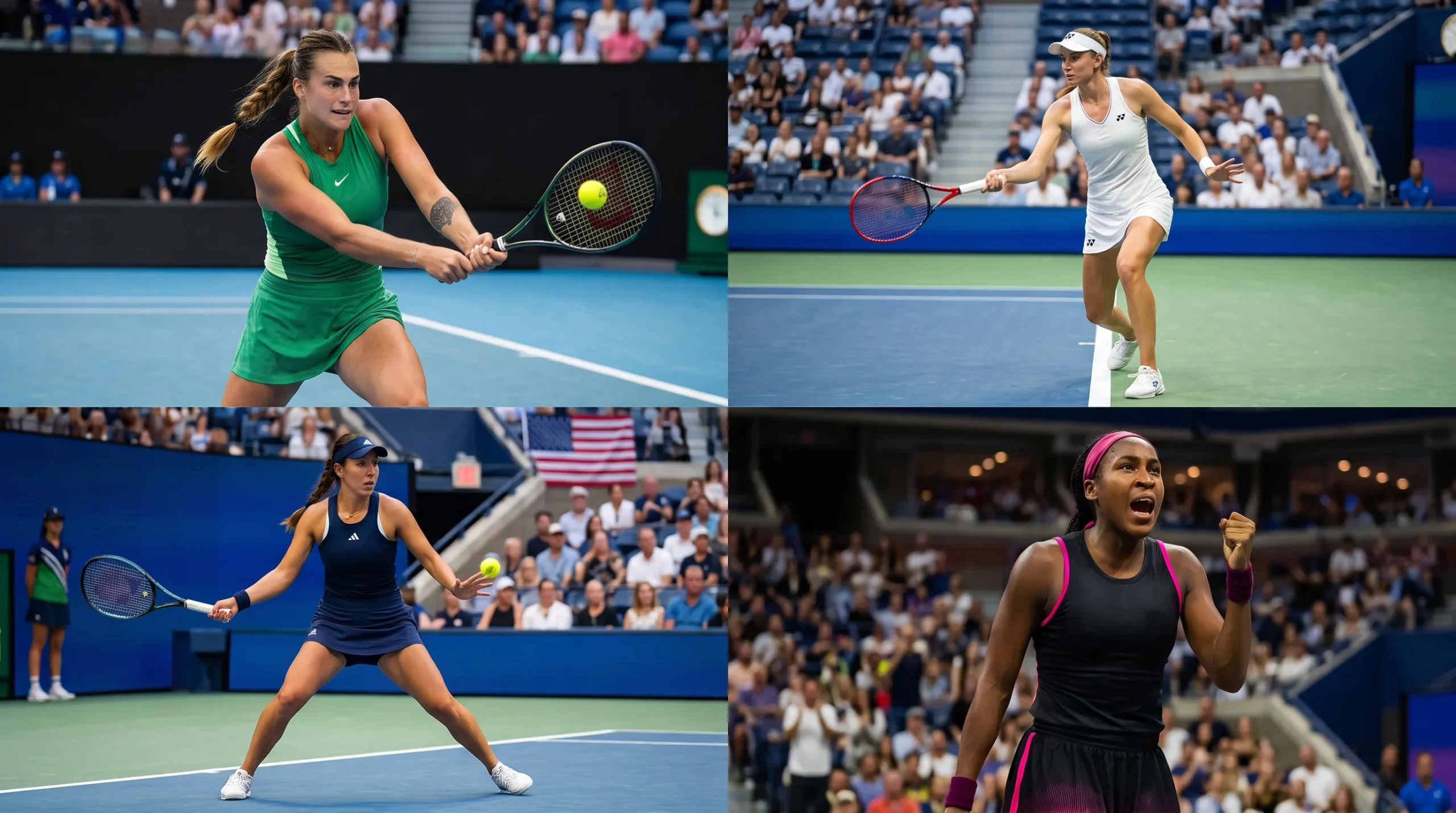
Aryna Sabalenka, Elena Rybakina, Jessica Pegula, Coco Gauff, Mirra Andreeva, Linda Noskova, Karolina Muchova and Iga Swiatek are all safely into the third round.
So are Elina Svitolina, Amanda Anisimova and Marta Kostyuk.
Look at the current Top 12 and there is essentially one empty chair: Belinda Bencic, beaten in the first round by Yulia Putintseva.
The contrast at the other end of the draw could hardly be greater. Sixteen women came through qualifying. After only two main-draw rounds, Qinwen Zheng is the only qualifier still standing.
Seeds everywhere.
Qualifiers almost nowhere.
For a US Open that arrived with so much depth in the women’s field, the remarkable early story has been just how little disorder there has been.
The Top Eight Have Not Lost Anyone
Start with the biggest names.
Every one of the tournament’s top eight seeds has reached Round 3:
- No. 1 Aryna Sabalenka beat Camila Osorio 6-2, 6-4 and then demolished qualifier Polina Iatcenko 6-1, 6-1.
- No. 2 Elena Rybakina opened against 17-year-old wildcard Thea Frodin, winning 6-3, 6-2, before beating Jessica Bouzas Maneiro 6-2, 6-4.
- No. 3 Jessica Pegula has been one of the most efficient of all. Elena-Gabriela Ruse took five games from her, Sofia Kenin only four: 6-3, 6-2 followed by 6-3, 6-1.
- No. 4 Coco Gauff beat Zeynep Sonmez 6-3, 6-4 and then survived a far more nervous evening against Paula Badosa, 6-4, 7-6(5).
- No. 5 Mirra Andreeva has conceded only four games in two matches, dismissing Janice Tjen 6-2, 6-2 and Eva Lys 6-0, 6-2.
- No. 6 Linda Noskova recovered from 2-5 down in her opening set against Katie Volynets before winning 7-5, 6-1, then took care of Lanlana Tararudee 6-4, 6-2.
- No. 7 Karolina Muchova has been even more ruthless. She beat Sinja Kraus 6-3, 6-0 and then allowed Katie Boulter just one game, 6-1, 6-0.
- And No. 8 Iga Swiatek has progressed 6-2, 6-3 against Wang Xiyu and 6-3, 6-2 against Nadia Podoroska.
Eight seeds.
Sixteen matches.
Sixteen straight-sets victories.
The draw has not managed to remove a single one of them.
From No. 9 to No. 12, Bencic Is the Lone Casualty
The pattern almost continues through the next four positions.
- No. 9 Elina Svitolina began with a 6-1, 6-2 victory over Solana Sierra and then survived the much tougher Maya Joint 6-2, 6-7(6), 6-4.
- No. 10 Amanda Anisimova beat Ashlyn Krueger 6-1, 6-3 before overcoming Lilli Tagger 6-3, 3-6, 6-1.
- No. 11 Marta Kostyuk has also survived without dropping a set. Storm Hunter went down 6-4, 6-1 before Kostyuk stopped former US Open champion Sloane Stephens 6-1, 7-5.
Then, finally, comes the exception.
Belinda Bencic.
The world No. 12 was beaten in her opening match by Yulia Putintseva 4-6, 7-5, 6-3.
That defeat looks increasingly unusual when placed alongside what everyone immediately above her has done.
Among the current Top 12 players shown in the rankings, 11 are still in the tournament.
Only Bencic is gone.
Six Seeds Out, 26 Still Standing
The wider seeded field has taken more damage, but not much.
By the end of Round 2, only six of the 32 seeds have been eliminated.
Bencic, seeded No. 12, was the highest-ranked casualty.
The others are:
- No. 20 Maja Chwalinska, beaten by Taylor Townsend in Round 1.
- No. 27 Barbora Krejcikova, eliminated by Kamilla Rakhimova 7-6(4), 6-2.
- No. 28 Sara Bejlek, beaten in three sets by Cristina Bucsa.
- No. 30 Jelena Ostapenko, who lost to Tatjana Maria after taking the opening set.
- And No. 32 Maria Sakkari, who survived qualifier Robin Montgomery in Round 1 but then lost 6-1, 6-7(4), 2-6 to Yuliia Starodubtseva.
That leaves 26 of the original 32 seeds in Round 3.
For a 128-player draw after two complete rounds, that is an extraordinary level of preservation at the top.
Round Three Already Has Second-Week Weight
The lack of early upsets has created an unusually strong last 32.
Several third-round matches would not look out of place much later in a Grand Slam: Pegula against Fernandez, Svitolina against Kalinskaya, Navarro against Muchova, Osaka against Mertens, and Jovic against Eala.
That is the consequence of so many seeds surviving together.
Instead of a third round full of unexpected names trying to extend surprise runs, the US Open has arrived at a stage where established players are already being forced into direct competition with one another.
The tournament is still technically outside the second week.
Parts of the draw no longer feel that way.
Andreeva and Muchova Have Been Particularly Ruthless
Not all passages into Round 3 have been equal.
Andreeva has dropped four games.
Muchova has dropped four games as well.
Sabalenka followed a fairly conventional first round with a 6-1, 6-1 second-round demolition.
Pegula has conceded only nine games in total and has yet to drop serve.
Rybakina has moved through two rounds while giving away just 11 games.
Swiatek has lost 10.
None of them has yet required a deciding set.
Gauff came closer to being dragged into one than most of the leading contenders, surviving Badosa in a second-set tiebreak.
Kostyuk also had to save a set point against Stephens at 4-5 in the second before escaping 7-5.
But even where the favourites have been tested, they have generally found the answer.
That is precisely what has been missing from so much of this opening week: the finishing blow from the underdog.
Qinwen Zheng Is the Last Qualifier in the Building
Now compare all of that stability with what happened to the qualifiers.
Sixteen women survived three matches just to get into the US Open main draw.
Only one has reached Round 3.
Qinwen Zheng.
And she did it the difficult way.
Her first-round opponent was another qualifier, 16-year-old Kristina Liutova. Zheng lost the opening set before recovering to win 4-6, 6-3, 6-1.
Then came Putintseva, fresh from eliminating Bencic.
Again Zheng needed three sets.
Again she survived.
6-4, 2-6, 6-1.
The Olympic champion now faces No. 22 seed Madison Keys, who has just survived five match points against Anna Bondar.
The other 15 qualifiers are gone.
Some disappeared immediately against seeds: Hunter to Kostyuk, Iatcenko to Sabalenka in Round 2 after surviving her opener, Knutson to Lys, Havlickova to Bondar, Montgomery to Sakkari.
Others won a main-draw match before running into the seeded wall.
Harriet Dart reached Round 2 but lost 6-2, 6-2 to Bouzkova.
Lucrezia Stefanini was stopped by Paolini.
Himeno Sakatsume pushed Bucsa through three tiebreak sets before losing.
Francesca Jones reached Round 2 before Jovic beat her 6-4, 6-4.
For all the momentum qualifying is supposed to provide, almost none of it has survived the first 128 matches of the main draw.
The Upsets Have Barely Reached the Top
There have been notable casualties.
Belinda Bencic went out in the first round. Barbora Krejcikova, Jelena Ostapenko, Sara Bejlek and Maria Sakkari have also disappeared.
But those defeats have mostly come below the tournament’s leading tier.
The remarkable part is how intact that top tier remains.
Sabalenka, Rybakina, Pegula, Gauff, Andreeva, Noskova, Muchova and Swiatek are all through. Svitolina, Anisimova and Kostyuk have joined them.
So the early rounds have produced upsets without producing a genuine shake-up at the top.
That distinction is what makes this US Open unusual so far.
Round Three Finally Forces the Issue
The first two rounds preserved the hierarchy to an unusual degree.
Round Three cannot.
Now the draw starts putting many of those surviving seeds directly across the net from one another: Pegula against Fernandez, Svitolina against Kalinskaya, Navarro against Muchova, Osaka against Mertens, Jovic against Eala.
That is where the early stability begins to break down.
Until now, the most striking feature of the tournament has been how faithfully the draw has followed the rankings. The Top 8 are intact, 11 of the current Top 12 remain and 26 seeds have reached the last 32.
At the opposite end, only Qinwen Zheng remains from the 16 qualifiers.
So the opening week has produced a curious imbalance: almost no erosion at the top, and almost complete elimination at the bottom.
From here, the US Open no longer needs an upset to change that picture.
The draw itself will do it.