
Paula Badosa vs. Coco Gauff — US Open 2026 Second-Round Match Report
Coco Gauff had two problems to deal with inside a lively Arthur Ashe Stadium.
One was Paula Badosa.
The other could be heard as soon as Gauff began speaking after the match.
The American sounded distinctly congested during her on-court interview, but avoiding a third set meant she could leave with a 6-4, 7-6(5) victory rather than find out how much more a cold and an increasingly dangerous Badosa might take out of her.
The relief was obvious.
Badosa had dragged Gauff through a second set in which neither player could hold onto control, and the Spaniard came within a few points of forcing a decider. The eventual tiebreak became less a display of pure quality than a test of nerve.
Gauff survived that too.
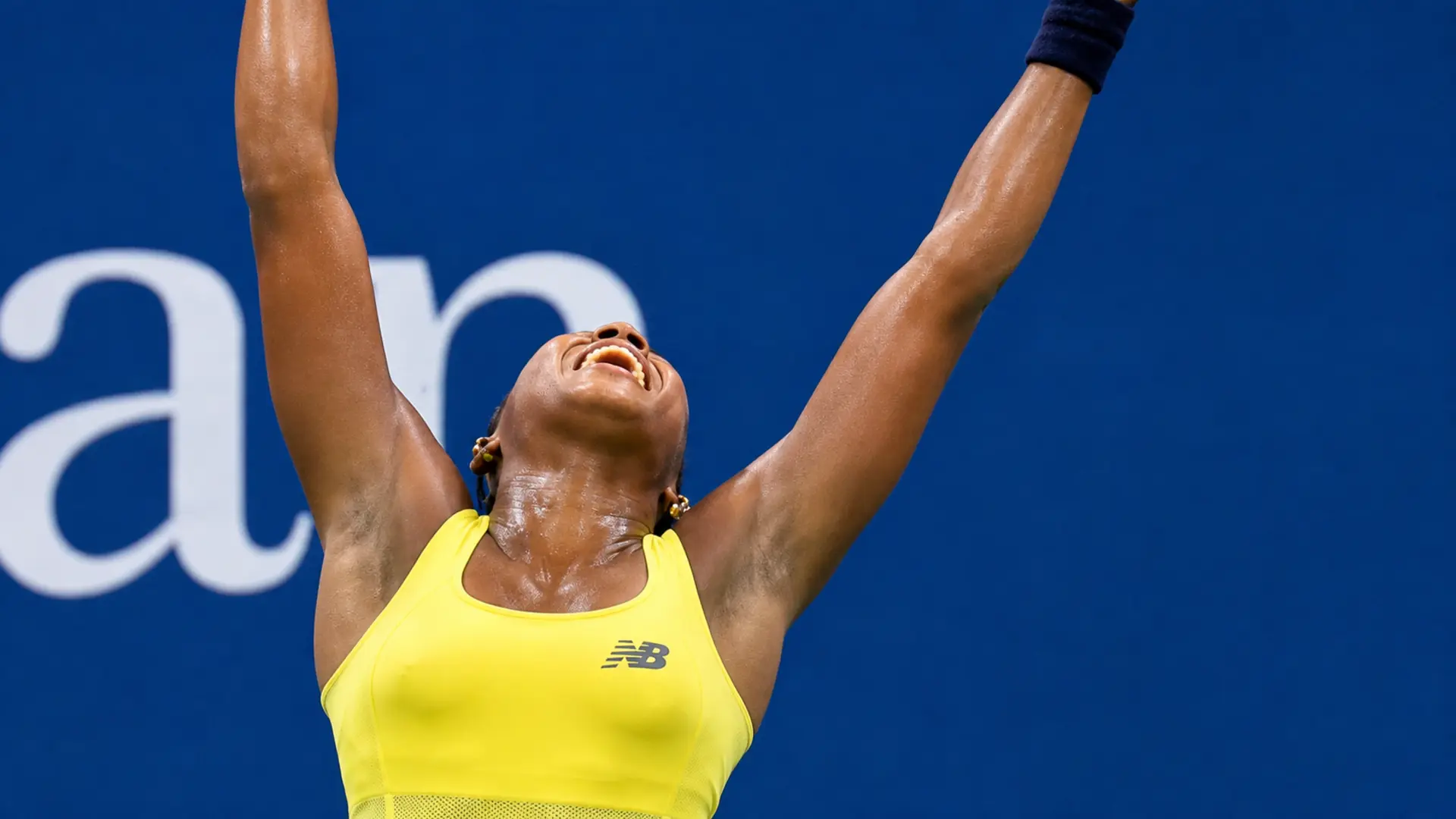
And when Badosa’s final forehand sailed beyond the baseline, the No. 4 seed celebrated like a player who knew exactly how uncomfortable the alternative might have become.
One Late Break Gives Gauff the First Set
Badosa made the steadier start.
She held for 1-0, Gauff answered, and the pair moved through 2-2 and 3-3 without either player finding a break.
Then Gauff made her move.
At 3-3, she worked her way into a long Badosa service game and eventually broke for 4-3.
That was the opening.
Gauff consolidated for 5-3. Badosa held to stay within reach at 5-4, but Gauff served out the set in the next game.
6-4.
There had been little between them for most of the set.
One break separated them at the end.
Set 1 at a Glance
- Gauff won her service games at a perfect 5 of 5, while Badosa managed 4 of 5.
- Gauff won her return games 1 of 5, while Badosa failed to win any (0 of 5).
- Gauff won 37 of 68 total points, converting her only break point (1 of 1) while Badosa went 0 of 2.
Full Set 1 Stats
| Badosa | Statistic | Gauff |
|---|---|---|
| Set 1 Duration: 0h52m | ||
| 0.67 | Dominance Ratio | 1.49 |
| 8 | Winners | 11 |
| 13 | Unforced Errors | 11 |
| 270 | Serve Rating | 318 |
| 1 | Aces | 2 |
| 3 | Double Faults | 2 |
| 79% (31/39) | 1st Serve % | 90% (26/29) |
| 58% (18/31) | 1st Serve Points Won | 73% (19/26) |
| 55% (11/20) | 2nd Serve Points Won | 55% (6/11) |
| 0% (0/1) | Break Points Saved | 100% (2/2) |
| 72 | Return Rating | 207 |
| 27% (7/26) | 1st Return Points Won | 42% (13/31) |
| 45% (5/11) | 2nd Return Points Won | 45% (9/20) |
| 0/2 | Break Points Won | 1/1 |
| 31 | Total Points Won | 37 |
The Second Set Refuses to Stay With Either Player
Badosa again opened with a hold.
This time Gauff struck earlier.
After levelling at 1-1, she broke for 2-1 and held for 3-1.
Badosa stayed close, holding for 3-2, but Gauff remained in front at 4-2.
Then the match became considerably less orderly.
Badosa held for 4-3 and broke Gauff to level at 4-4.
Gauff immediately broke back.
5-4.
Badosa answered with another break.
5-5.
Gauff broke again.
6-5.
And once more, Badosa refused to let the match end there, breaking back to force a tiebreak.
Four breaks of serve had arrived across the final five games.
By then, the match was being played as much between the ears as from the baseline.
A Tiebreak of Nerves, Hesitation and One Massive Gauff Point
The deciding tiebreak began with Badosa serving.
0-1: Badosa opened with a hesitant forehand. Gauff immediately punished it.
1-1: Badosa answered with a fierce forehand winner.
1-2: Gauff produced an excellent second serve.
1-3: Badosa tried to overpower Gauff with another heavy forehand. Gauff defended the first blow well enough to make the Spaniard hit again, and Badosa missed on her second attempt.
2-3: Badosa responded with an excellent drop shot.
3-3: Gauff’s second serve lacked speed, and Badosa attacked it with a brilliant return. At this stage, the nerves on the American side were becoming increasingly visible.
Then came one of the points of the match.
3-4: During the rally, Badosa was forced to send the ball high into the air. Gauff waited for the bounce with her heels almost on her own baseline and controlled the overhead beautifully.
It was a massive point.
Badosa could have emerged from the rally ahead.
Instead, Gauff led again.
4-4: Badosa responded in an unusual way, surprising Gauff with an extremely slow first serve that carried almost no pace at all.
The Tension Tightened
4-5: After a single whistle between her first and second serves, Badosa stopped and reacted to the interruption. The delay did not help her. She double-faulted.
4-6: The confidence appeared to drain further. Badosa missed a poor backhand and handed Gauff two match points.
The first disappeared in unusual fashion.
5-6: Badosa received a fortunate net-cord bounce that carried all the way toward Gauff’s baseline. Gauff managed to return it, but Badosa finished the point with a winner.
One match point saved.
The second ended differently.
5-7: This time Gauff sent a surprisingly inviting ball short over the net.
Badosa accepted the invitation too eagerly.
She attacked.
And overhit it.
The forehand sailed beyond the baseline.
Match over.
Set 2 at a Glance
- Gauff won 58% of her second serve points (14 of 24), well ahead of Badosa’s 42% (10 of 24).
- Badosa won 57% of pressure points, 8 of 14, compared with Gauff’s 6 of 14.
- Gauff narrowly edged the total points race, 46 to 42, despite Badosa hitting more winners, 17 to 10.
Full Set 2 Stats
| Badosa | Statistic | Gauff |
|---|---|---|
| Set 2 Duration: 1h08m | ||
| 0.89 | Dominance Ratio | 1.13 |
| 17 | Winners | 10 |
| 19 | Unforced Errors | 10 |
| 236 | Serve Rating | 271 |
| 2 | Aces | 1 |
| 3 | Double Faults | 3 |
| 74% (35/47) | 1st Serve % | 83% (34/41) |
| 54% (19/35) | 1st Serve Points Won | 65% (22/34) |
| 42% (10/24) | 2nd Serve Points Won | 58% (14/24) |
| 67% (4/6) | Break Points Saved | 33% (1/3) |
| 177 | Return Rating | 170 |
| 35% (12/34) | 1st Return Points Won | 46% (16/35) |
| 42% (10/24) | 2nd Return Points Won | 58% (14/24) |
| 2/3 | Break Points Won | 2/6 |
| 42 | Total Points Won | 46 |
Badosa Had the Winners, Gauff Had the Cleaner Match
The statistics explain why Badosa could make the contest uncomfortable without ever quite taking control of it.
She struck 25 winners to Gauff’s 21.
But she also committed 32 unforced errors, compared with only 21 from the American.
That 11-error difference carried considerable weight in a match decided by only 10 total points.
Gauff won 83 of the 156 points, Badosa 73.
The American also held the better dominance ratio, 1.24 to 0.81.
Their first-serve percentages were identical at 50 percent, but Gauff did much more damage when hers landed. She won 71 percent of first-serve points compared with Badosa’s 63 percent.
Gauff also won 57 percent behind her second serve, while Badosa managed 48 percent.
Neither woman was especially clean from the line.
Badosa hit six double faults.
Gauff hit five.
The return numbers were close enough to explain why the second set became so unstable, but Gauff maintained the slight edge that ultimately carried her through.
Badosa Walks Off Smiling, but This One May Hurt Tomorrow
Badosa left Arthur Ashe to applause.
And she left smiling.
That was fitting after a match in which she had given Gauff almost everything she could handle in the second set and had come within touching distance of forcing a third.
Tomorrow morning may feel different.
There was a golden opportunity here.
Badosa had already broken Gauff two times in the second set. She had reached 6-6. She had the crowd engaged and the American visibly nervous.
The tiebreak was there to be played for.
Instead came the double fault at 4-4, the backhand error at 4-5 and finally the forehand that flew long on match point.
Badosa had done enough to make Gauff uncomfortable.
She had not done enough to make her play another set.
Gauff Looks Happier With Every Win
There has been something increasingly noticeable about Gauff during Cincinatti and this US Open.
She appears happier each time she gets through.
This one brought something extra.
Relief.
Gauff admitted during her on-court interview that nerves had played a major role in the match, and her voice also sounded as though she was dealing with a cold.
That gives the final stages a slightly different context.
A third set against Badosa would not merely have meant another hour of tennis. It would have demanded more physically from a player who did not sound entirely well.
Perhaps that explains some of the emotion when Badosa’s final forehand flew long.
Gauff had survived the opponent.
She had survived the nerves.
And she had avoided finding out what another set might have done to her system.
The Seeds Keep Marching Into Round Three
Gauff’s victory also continued a striking pattern in the women’s draw.
Every seeded player who had completed her second-round assignment was through to the third round, with Elena Rybakina the final seeded player still trying to secure the same passage.
For Gauff, the route continues after a match that asked considerably more than the scoreline alone suggests.
Badosa brought the weight of shot.
She brought the drop shots.
She brought the nerves.
And for stretches of the second set, she brought Arthur Ashe fully into the contest.
But when the match narrowed to a handful of points, Gauff found enough.
That is sometimes all a Grand Slam requires.