
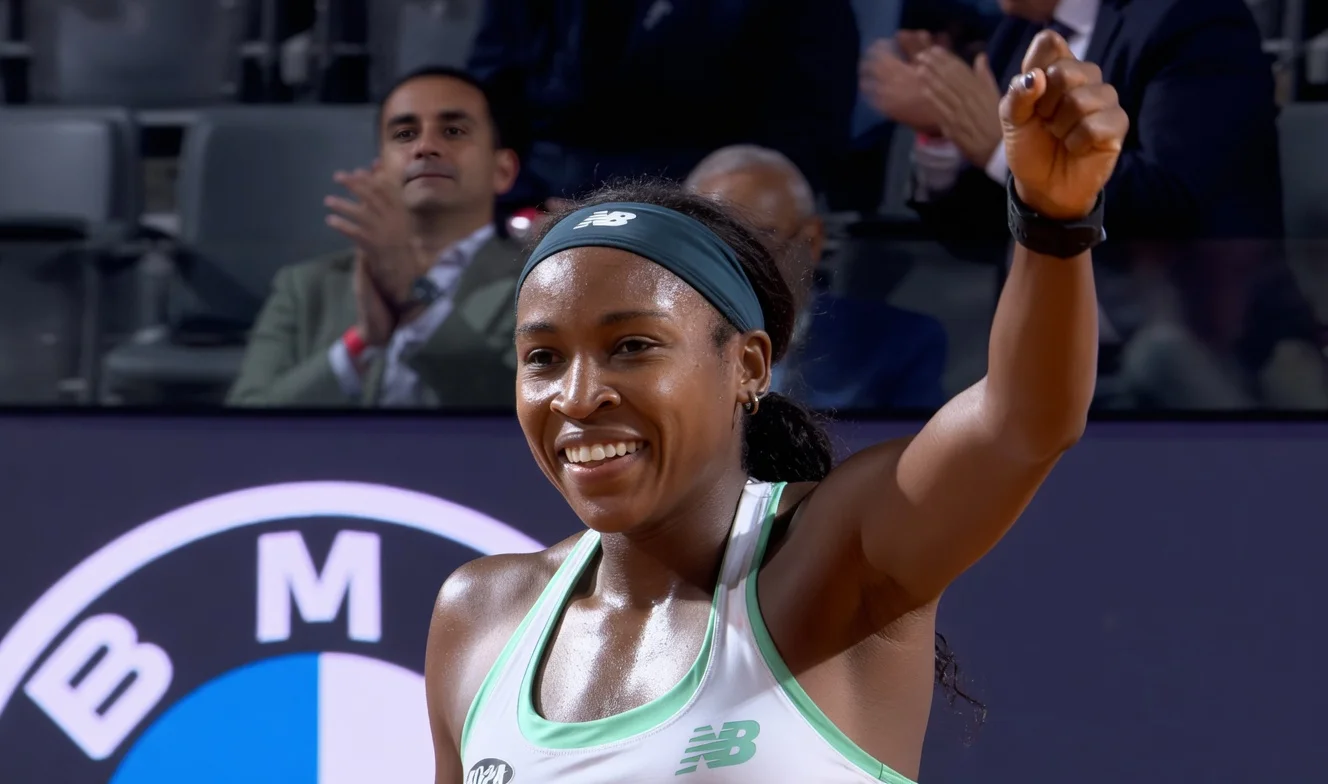
Coco Gauff — US Open 2026 Third-Round Press Conference After Defeating Cristina Bucsa
Coco Gauff found the feeling she had been waiting for at 4-all.
Not confidence exactly. Not momentum in the ordinary sense either.
Something harder to manufacture.
A flow state.
After beating Cristina Bucsa in the third round of the US Open, Gauff described one return game late in the match as the moment when everything suddenly began to feel right.
That was notable enough.
Her explanation afterwards was even more revealing.
Gauff does not walk onto court assuming the higher-ranked player should win. Quite the opposite.
“I go into every match thinking I’m going to get upset.”
She laughed at the admission, then defended it.
For a player carrying the expectations that follow Gauff everywhere, perhaps that mentality explains why she remains so wary of opponents such as Bucsa.
Bucsa Made Gauff Work for the Finish
Gauff did not pretend this had been a comfortable afternoon.
Bucsa’s ability to disrupt rhythm was central to the difficulty.
“She does a good job of changing the pace,” Gauff said. “She can get a lot of balls in.”
That forced Gauff to keep producing rather than waiting for the match to come to her.
Bucsa, as Gauff noted, does not offer many cheap errors either.
That was the source of some visible frustration.
There was also another adjustment.
This was Gauff’s first day match of the tournament, bringing different conditions from those she had experienced earlier in the week.
She was therefore solving two things at once: Bucsa’s awkward changes of pace and a different feel on court.
What pleased Gauff most was how she eventually closed the second set after being broken.
At 4-All, Gauff Felt Something Change
Gauff’s description of a flow state was one of the most interesting parts of her press conference because she did not present it as something a player can simply summon.
“For me, it’s not something that you just try to get to,” she said.
Preparation can help.
Routine can help.
But the feeling itself remains elusive.
“Some days you just step on the court and you feel like you’re not going to lose.”
Sometimes, she said, it appears in the warm-up.
Sometimes much later.
Against Bucsa, Gauff knew almost exactly when it arrived.
“For me, it was 4-all. That return game was probably the best game I had that match.”
That was the moment she believed she had entered it.
The significance was that the uncertainty disappeared.
Eala Reminds Gauff of Manny Pacquiao’s Impact
The press conference moved beyond Gauff’s own match when she was asked about Alexandra Eala.
Gauff’s comparison was striking.
She spoke about Eala breaking barriers for Filipino tennis and said her impact reminded her of what Manny Pacquiao had represented for the Philippines.
That was not merely an observation from afar.
Gauff and Eala are friends.
She said Eala’s family reminded her of her own and described the Filipino as someone she would like to know even better.
There was obvious respect for the position Eala now occupies.
That friendship also reflects something broader about Gauff’s own place on tour.
Gauff No Longer Feels Like the Kid in the Room
Gauff admitted that her early years on tour could be lonely.
She was simply too young.
A teenager competing against adults may share a locker room with them, but that does not necessarily create a social life.
“No 20-year-old wants to go out with a 15-year-old,” Gauff said.
Now 22, she understands it from the other side.
The difference is that more players around her own age are now succeeding at the same time.
That has changed life away from the court.
There are people she can text.
Players she can meet for dinner.
Peers with whom she can share the routine frustrations and successes of professional tennis without the age gap making everything awkward.
“I feel much happier now,” Gauff said.
The Tennis Ball Incident Comes With a New Resolution
Gauff also addressed one less flattering moment: hitting herself with a tennis ball in frustration.
Her team hates it.
So does she.
The explanation was delivered with typical self-awareness.
Players sometimes convince themselves that hitting themselves is somehow preferable to breaking a racket.
Gauff has reconsidered.
“I think I should just break the racket, honestly, and just take the fine.”
She then offered the more sensible advice to younger players.
Don’t copy it. Gauff said she intends to stop doing it herself.
It was a small moment in the press conference, but an unusually candid one.
Bucsa Tested Gauff Before the Flow Arrived
The most useful part of Gauff’s press conference was not a declaration about winning the tournament.
There wasn’t one.
Instead, she described the uncertainty that exists even for one of the leading players in the draw.
She can become frustrated.
She expects opponents to be dangerous.
She does not believe rankings remove the possibility of an upset.
And sometimes the feeling she wants does not arrive until 4-all in the middle of a match.
Against Bucsa, it arrived in time.
That may be the more interesting version of Gauff at this US Open: not a player pretending everything is under control, but one increasingly comfortable admitting when it isn’t.
Then finding the moment when it is.