
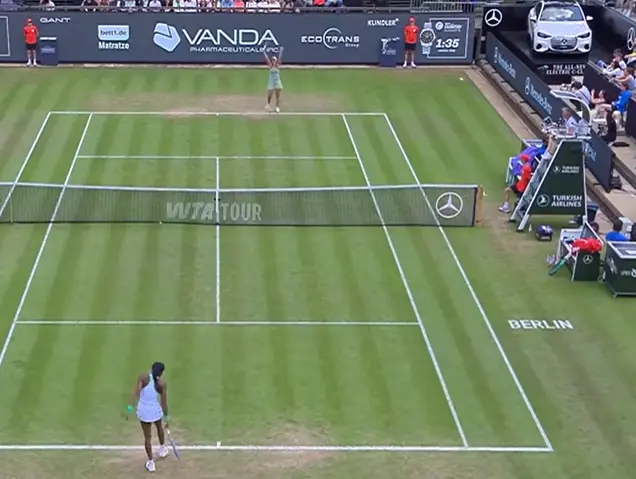
Paula Badosa’s season has been running on fragments.
A good spell here. A worrying defeat there. Wildcards, fitness questions, ranking damage, flashes of the player who used to sit near the top of the sport, then another reminder that the body has not always allowed the tennis to follow.
Then came Berlin.
Badosa beat Coco Gauff 1-6, 6-3, 6-2 at the Berlin Ladies Open, overturning a first set that looked almost terminal and turning the match into her biggest win for well over a year. The Spaniard, ranked No. 142 and playing on a wildcard, had not beaten a top-seven opponent since the 2025 Australian Open quarter-finals.
That opponent was also Gauff.
This one was different in texture but similar in value. In Melbourne, Badosa beat the American 7-5, 6-4 on hard court. In Berlin, she had to absorb a first-set beating, rebuild the match on grass, and make Gauff’s own discomfort on the surface visible again.
It was a huge win for Badosa.
It was another early grass problem for Gauff.
Gauff Starts Like She Is Going to Run Away With It
The first set lasted only 27 minutes and gave no real hint of what was coming.
Gauff broke immediately, held for 2-0, then protected her serve through a long second game in which Badosa created three break points but could not take them.
That felt like the early hinge. If Badosa had broken back there, perhaps the opening set would have found a different rhythm. Instead, Gauff escaped, then ran.
She broke again for 4-1 and closed the set 6-1.
At that point, the match looked straightforward. Gauff was serving with more authority, moving better, and using the early scoreboard pressure to keep Badosa stuck behind the match. The American hit through the court more cleanly, and Badosa’s own game had not yet settled into anything that looked stable.
Badosa vs Gauff – Set One Stats
| Statistic | Badosa | Gauff |
|---|---|---|
| Dominance Ratio | 0.37 | 2.73 |
| Winners | 5 | 12 |
| Unforced Errors | 13 | 7 |
| Serve Rating | 215 | 339 |
| Aces | 1 | 4 |
| Double Faults | 2 | 2 |
| 1st Serve % | 95% (21/22) | 95% (19/20) |
| 1st Serve Points Won | 48% (10/21) | 79% (15/19) |
| 2nd Serve Points Won | 40% (4/10) | 63% (5/8) |
| Break Points Saved | 50% (2/4) | – (0/0) |
| Service Games | 33% (1/3) | 100% (4/4) |
| Ace % | 4.5% | 20% |
| Double Fault % | 9.1% | 10% |
| Return Rating | 59 | 229 |
| 1st Return Points Won | 21% (4/19) | 52% (11/21) |
| 2nd Return Points Won | 38% (3/8) | 60% (6/10) |
| Break Points Won | – (0/0) | 50% (2/4) |
| Return Games | 0% (0/4) | 67% (2/3) |
| Pressure Points | 50% (3/6) | 50% (3/6) |
| Service Points | 45% (10/22) | 80% (16/20) |
| Return Points | 20% (4/20) | 55% (12/22) |
| Total Points | 33% (14/42) | 67% (28/42) |
| Set 1 Duration | 0h27m | |
For Gauff, who had not won a grass-court match since beating Sonay Kartal at Wimbledon in 2024, it looked like the right kind of start.
For Badosa, it looked like another hard day coming.
Badosa Finds Her Response Before the Match Gets Away
The second set changed everything.
Badosa opened with a hold after saving a break point, then broke Gauff for 2-0. That alone shifted the feeling. The Spaniard had spent the first set chasing. Suddenly, she had made Gauff answer a question.
She held for 3-0, and the match began to look nothing like the first set.
Gauff got on the board with a hold to love for 3-1, but she made no real inroads on Badosa’s serve in the next game. Badosa held for 4-1, then broke again for 5-1. She had built the same kind of lead Gauff had used to dominate the opener.
There was still a wobble. Gauff broke back for 5-2, then held for 5-3, briefly suggesting that the set might tighten late.
Badosa did not let it.
She served it out for 6-3 and forced a deciding set.
Badosa vs Gauff – Set Two Stats
| Statistic | Badosa | Gauff |
|---|---|---|
| Dominance Ratio | 1.09 | 0.92 |
| Winners | 6 | 12 |
| Unforced Errors | 7 | 12 |
| Serve Rating | 285 | 237 |
| Aces | 3 | 7 |
| Double Faults | 3 | 2 |
| 1st Serve % | 97% (28/29) | 100% (20/20) |
| 1st Serve Points Won | 61% (17/28) | 55% (11/20) |
| 2nd Serve Points Won | 47% (8/17) | 27% (3/11) |
| Break Points Saved | 50% (1/2) | 0% (0/2) |
| Service Games | 80% (4/5) | 50% (2/4) |
| Ace % | 10.3% | 35% |
| Double Fault % | 10.3% | 10% |
| Return Rating | 268 | 162 |
| 1st Return Points Won | 45% (9/20) | 39% (11/28) |
| 2nd Return Points Won | 73% (8/11) | 53% (9/17) |
| Break Points Won | 100% (2/2) | 50% (1/2) |
| Return Games | 50% (2/4) | 20% (1/5) |
| Pressure Points | 80% (4/5) | 20% (1/5) |
| Service Points | 59% (17/29) | 55% (11/20) |
| Return Points | 45% (9/20) | 41% (12/29) |
| Total Points | 53% (26/49) | 47% (23/49) |
| Set 2 Duration | 0h35m | |
The match had been turned on its head, not with one spectacular spell, but with steadier serving, more controlled aggression and better punishment of Gauff’s second serve.
The Decider Belongs to Badosa
Gauff held to start the third set, but the momentum was already moving in the other direction.
Badosa held for 1-1, then broke for 2-1 after forcing Gauff through another uncomfortable service game. That break changed the match. It did not just put Badosa ahead. It made Gauff look as if the first set belonged to another match entirely.
The Spaniard held to love for 3-1, broke again for 4-1, then held to love once more for 5-1.
That was the real statement.
Badosa was was dictating the final set against a top-10 player who had opened the match like she was ready to make quick work of the afternoon. Gauff managed one more hold for 5-2, but the damage was too deep.
Serving for the match, Badosa reached match point at 40-30 and took it.
Badosa vs Gauff – Set Three Stats
| Statistic | Badosa | Gauff |
|---|---|---|
| Dominance Ratio | 2.07 | 0.48 |
| Winners | 3 | 8 |
| Unforced Errors | 3 | 13 |
| Serve Rating | 335 | 233 |
| Aces | 0 | 3 |
| Double Faults | 2 | 4 |
| 1st Serve % | 100% (24/24) | 100% (27/27) |
| 1st Serve Points Won | 75% (18/24) | 48% (13/27) |
| 2nd Serve Points Won | 62% (8/13) | 36% (5/14) |
| Break Points Saved | – (0/0) | 33% (1/3) |
| Service Games | 100% (4/4) | 50% (2/4) |
| Ace % | 0% | 11.1% |
| Double Fault % | 8.3% | 14.8% |
| Return Rating | 233 | 63 |
| 1st Return Points Won | 52% (14/27) | 25% (6/24) |
| 2nd Return Points Won | 64% (9/14) | 38% (5/13) |
| Break Points Won | 67% (2/3) | – (0/0) |
| Return Games | 50% (2/4) | 0% (0/4) |
| Pressure Points | 71% (5/7) | 29% (2/7) |
| Service Points | 75% (18/24) | 48% (13/27) |
| Return Points | 52% (14/27) | 25% (6/24) |
| Total Points | 63% (32/51) | 37% (19/51) |
| Set 3 Duration | 0h36m | |
From 1-6 down, Paula Badosa had won 12 of the next 17 games.
The Numbers Show How Narrow but Ruthless It Was
This was not a match Badosa won by dominating every category.
The full-match numbers were almost level. Badosa’s dominance ratio was 1.01, Gauff’s 0.99. Badosa won 72 total points, Gauff 70. Both players won 60 percent of their service points and 40 percent of their return points.
But Badosa was better in the moments that decided the match.
She won 64 percent of the pressure points, taking seven of 11. She converted four of five break points, while Gauff converted three of six. That efficiency was decisive, especially after the first set had gone so quickly in the American’s direction.
Gauff produced more winners, 32 to Badosa’s 14, but she also made 32 unforced errors. Badosa kept her error count to 23. The American had 12 aces, but also seven double faults. Badosa also double-faulted seven times, but she found more stability from the baseline once the match moved beyond the first set.
The key return number was on Gauff’s second serve. Badosa won 61 percent of those points.
That is where she slowly pulled the match away.
Badosa’s Latest 15 Results
| Date | Tournament | Round | Opponent | Result | Score |
|---|---|---|---|---|---|
| June 2026 | Berlin | R16 | Coco Gauff | Win | 1-6, 6-3, 6-2 |
| Berlin | R32 | Suzan Lamens | Win | 6-3, 6-2 | |
| June 2026 | ’s-Hertogenbosch | R32 | Daria Snigur | Loss | 1-6, 6-7(2) |
| April 2026 | Madrid | R128 | Julia Grabher | Loss | 6-7(3), 6-4, 0-6 |
| April 2026 | Stuttgart | R32 | Eva Lys | Loss | 6-2, 5-7, 4-6 |
| April 2026 | Linz | R32 | Lilli Tagger | Loss | 4-6, 6-7(5) |
| March 2026 | Charleston | R16 | Anna Kalinskaya | Loss | 4-6, 2-6 |
| Charleston | R32 | Maria Sakkari | Win | 6-3, 6-4 | |
| Charleston | R64 | Kayla Day | Win | 6-4, 6-3 | |
| March 2026 | Miami | R64 | Iva Jovic | Loss | 2-6, 1-6 |
| Miami | R128 | Aliaksandra Sasnovich | Win | 7-5, 6-3 | |
| March 2026 | Austin 125 | SF | Bianca Andreescu | Loss | 2-6, 6-3, 3-6 |
| Austin 125 | QF | Sinja Kraus | Win | 7-5, 6-1 | |
| Austin 125 | R16 | Lulu Sun | Win | 6-1, 7-6(6) | |
| Austin 125 | R32 | Elena-Gabriela Ruse | Win | 2-6, 6-2, 7-5 |
A Win That Changes the Tone of Badosa’s Grass Season
This was the sort of result Badosa badly needed.
Her last big win over a player ranked inside the top seven had come at the 2025 Australian Open, when she beat Gauff in the quarter-finals. Since then, injuries, interruptions and uneven results had dragged her well outside the top 100.
Berlin does not solve all of that in one afternoon.
But it gives her something tangible: a top-10 win, on grass, from a set down, against a player who had briefly looked in complete control.
That matters for confidence, but also for perception. When Badosa is fit and striking cleanly, she still has enough weight, enough timing and enough competitive edge to bother elite players. The problem has been staying physically available long enough to prove it.
In Berlin, she proved it again.
Gauff’s Grass Questions Continue
For Gauff, the concern is not only the defeat.
It is the surface.
The American had not won on grass since Wimbledon 2024 before this tournament, and after that first set, this looked like the match that could stop the pattern. Instead, the same doubts returned. Once Badosa began to pressure her second serve and extend the rallies on better terms, Gauff’s control faded.
The winners were there. So were the aces.
But so were the errors, the double faults and the service games that slipped away too quickly in the second and third sets.
Gauff remains dangerous on any surface because of her movement, athleticism and ability to create pace under pressure. But grass continues to ask different questions of her timing and shot selection. Against Badosa, she had a lead, then lost the shape of the match.
That will sting.
Badosa Is Still Here
Badosa has been easy to overlook during this difficult spell because the ranking no longer reflects the player she has been at her best. But Berlin showed that the top-end version has not vanished. It is still there, even if it has appeared in bursts rather than long runs.
A wildcard ranked No. 142 beating the world No. 7 from a set down is always a story.
Doing it against Gauff, the same player she beat in her last major top-seven win, gives it an extra layer.
The grass season is short. Badosa has no time to slowly rediscover herself. But if Berlin is any guide, she may not need as long as the ranking suggests.