
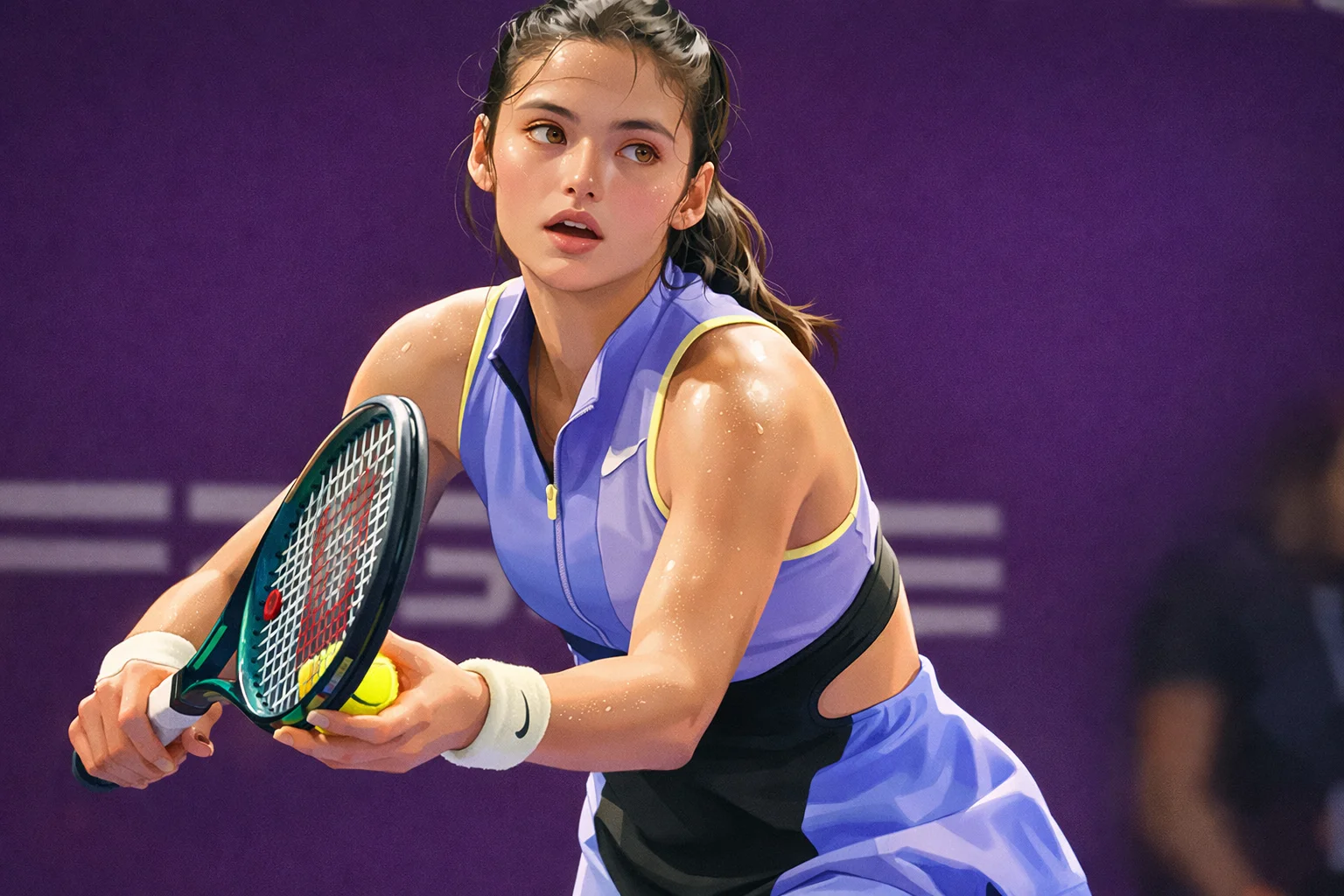
Emma Raducanu had earned the right to rest.
That may sound strange after a final defeat, but Queen’s Club asked plenty of her. Too much, probably.
The rain turned the schedule into a squeeze, the matches piled up late in the week, and by the time Donna Vekic stood across the net in the final, Raducanu was still fighting but no longer moving through the tournament with the same freedom.
Now Nottingham has paid the price.
Raducanu has withdrawn from the Nottingham Open after her run to the Queen’s Club final, removing the British No. 1 from a first-round meeting with former world No. 1 Karolina Pliskova. Sara Bejlek steps into her place in the draw.
It is not a shock. It may even be the sensible call. But it is still another blow for Nottingham, and another reminder that Raducanu’s grass-court revival has to be managed carefully before Wimbledon.
Queen’s Gave Raducanu Matches, Momentum and a Heavy Bill
Raducanu’s Queen’s week was her best stretch since reaching the Transylvania Open final earlier this season.
She arrived on grass after a difficult period. The final defeat in Cluj-Napoca had been her first final since the 2021 US Open, but the months that followed were uneven. A lingering virus disrupted her level, the clay swing brought little reward, and she arrived in London needing evidence that her game was still moving in the right direction.
Queen’s gave her that evidence.
Raducanu beat Anna Blinkova, Sorana Cirstea, Kamilla Rakhimova and Iva Jovic without dropping a set. The win over Jovic was especially useful, given the American teenager’s own grass-court rise and impressive week in London.
But the run came with a cost.
The rain delays forced Raducanu into a compressed schedule. She had barely warmed up against Cirstea before weather interrupted play. She returned to finish that job, then had to play Rakhimova and Jovic on the same day. Even winning those matches in straight sets could not make the workload light.
By Sunday, the legs were not quite there.
Raducanu Admits She Had Been Managing Niggles
After losing the Queen’s final to Vekic, Raducanu did not hide the physical reality.
“I’ve been dealing with a few niggles,” she said after the defeat, while still taking clear positives from a week that had lifted her level, her ranking and her confidence.
She also made the bigger picture clear. Queen’s had been valuable because it gave her five grass matches before Wimbledon, but there was no need to force another tournament immediately afterwards.
That is the key to the Nottingham withdrawal.
She pulled out because Queen’s worked almost too well. It gave her the matches she needed, pushed her back into the top 32, and positioned her for a Wimbledon seeding. At that point, chasing another week of tennis at Nottingham risked turning useful momentum into unnecessary strain.
For a player whose career has repeatedly been shaped by physical interruptions, that calculation matters.
The Final Showed Both Progress and Fatigue
The final itself told the same story.
Vekic started brilliantly, taking the first set 6-0 while Raducanu struggled to settle. The Croatian played at a high level from the opening game, using her experience and clean grass-court timing to take control before the home crowd could properly pull Raducanu into the match.
Then the British player did what she had done all week.
She fought.
Raducanu led 5-2 in the second set with a double break and had chances to drag the match into a decider. Twice she served for the set. Twice she could not close it. Vekic missed several championship points before the match moved into a tense tie-break, where the former Wimbledon semi-finalist finally took the title.
For Raducanu, the defeat hurt because the opportunity was there.
But the week still shifted the tone around her grass season.
“I think I played really well this week,” she said. “I think I’m playing pretty freely, pretty aggressively but finding the right balance, returning and serving pretty well. It’s important on grass.”
That is the part she will want to carry into Wimbledon.
Not the missed chances. Not the tired legs. The balance.
Nottingham Loses Another Name
Raducanu is not the only player to skip Nottingham.
Iva Jovic also withdrew because of an ankle issue, while Barbora Krejcikova’s miserable luck continued after illness kept her from playing the Libéma Open final and then ruled her out of Nottingham too.
That leaves the tournament with plenty of quality, but without some of the names it had hoped to feature. Zheng Qinwen and Maria Sakkari still offer a strong first-round matchup. Katie Boulter and Harriet Dart provide an all-British meeting. Leylah Fernandez, Emma Navarro, Marie Bouzkova, McCartney Kessler, Ann Li and Pliskova remain among the notable names in the draw.
Still, Raducanu’s absence changes the feel of the week.
A British No. 1 coming off a Queen’s final would have been one of Nottingham’s biggest attractions. Instead, she will step away, recover and look toward the bigger prize.
Wimbledon Is the Real Target Now
Raducanu’s Queen’s run has lifted her back inside the top 32, and she is set to be seeded at Wimbledon. That gives her a better path through the early rounds and removes the risk of drawing one of the highest-ranked players immediately.
Wimbledon is the tournament that can reshape Raducanu’s summer. The home crowd will be louder. The attention will be heavier. The opportunity will be bigger. After Queen’s, she has matches in her legs, confidence in her game and renewed proof that grass can still bring out some of her best tennis.