
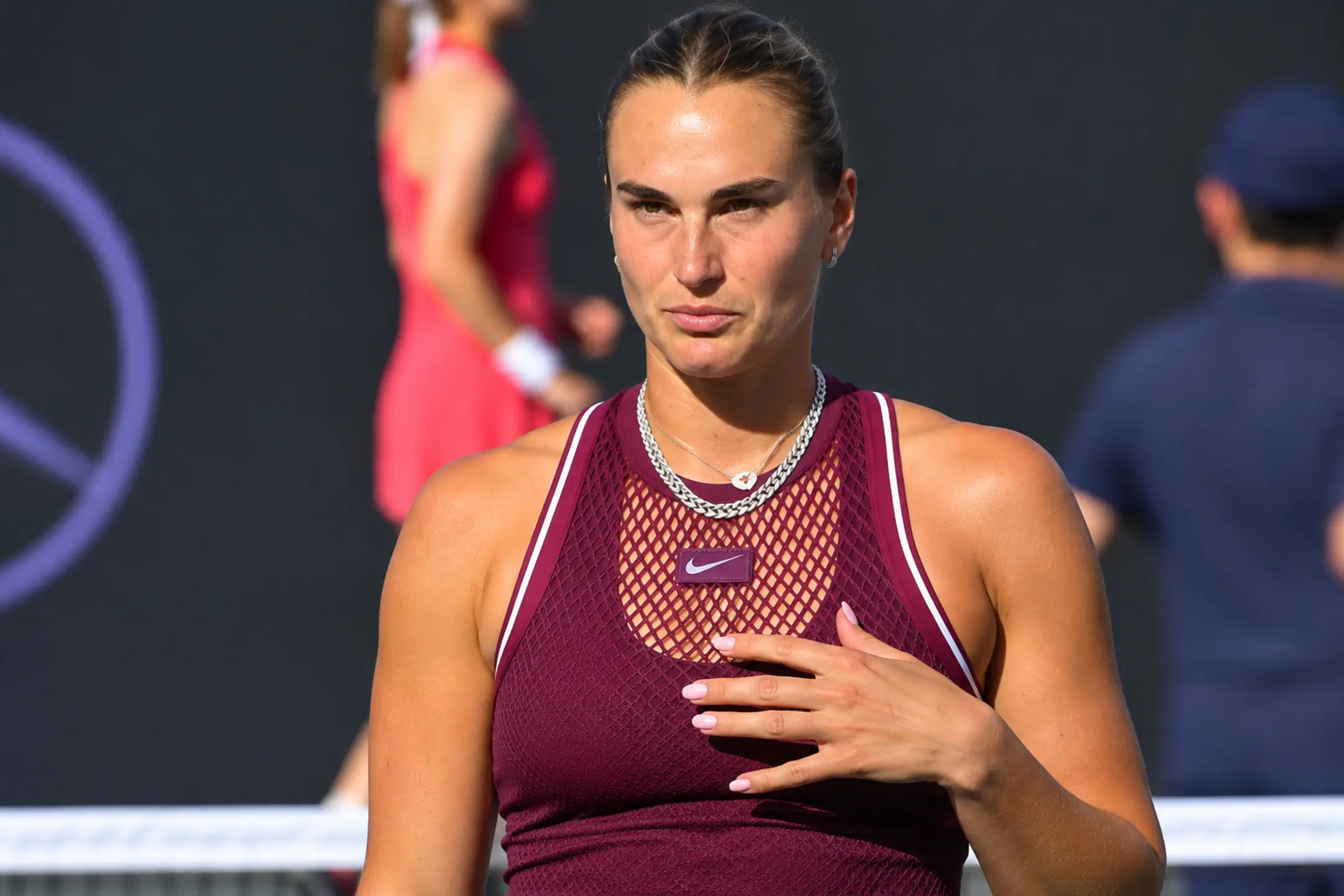
Aryna Sabalenka vs. Karolina Muchova — Indian Wells WTA Finals 2026 Group 2 Round-Robin Match Report.
How often does Karolina Muchova walk onto a tennis court against Aryna Sabalenka and find herself the crowd favorite?
In Indian Wells on Monday, November 9, the Czech enjoyed that unusual privilege. The Californian WTA fans were firmly behind her, particularly as she twice broke Sabalenka’s serve in the opening set.
Unfortunately for Muchova, the support did not translate into a victory.
Sabalenka defeated Muchova 7-6(2), 7-5 in their opening round-robin match at the 2026 WTA Finals, producing a performance that was more businesslike than brilliant.
The world No. 2 was far from her devastating best. Her first serve was inconsistent, her second delivery came under considerable pressure, and she committed seven double faults.
But whenever Muchova threatened to take control, Sabalenka found a response.
The Czech produced several wonderful passages of tennis. The problem was that they never lasted quite long enough.
Muchova Breaks Twice but Cannot Hold Her Advantage
The opening four games passed without a break, although both players were already showing signs of vulnerability on serve.
Muchova made the first significant move.
With Sabalenka serving at 2-2, the Czech created a break point and converted it to move ahead 3-2.
The crowd had every reason to believe an upset might be developing.
But Muchova immediately surrendered her advantage.
Sabalenka broke straight back for 3-3, held for 4-3 and forced Muchova to serve under pressure once again.
The Czech responded well, holding for 4-4 before attacking Sabalenka’s serve.
Another break put Muchova ahead 5-4, leaving her serving for the opening set.
It was her second opportunity to establish a meaningful advantage.
And for the second time, Sabalenka refused to let her keep it.
The Belarusian broke immediately for 5-5, held for 6-5 and eventually forced a tiebreak.
Muchova had twice led by a break without managing to consolidate either advantage.
The tiebreak was considerably less competitive.
Sabalenka raced ahead 2-0, extended her lead to 5-2 and closed it out 7-2.
The first set had lasted 12 closely contested games, but its conclusion was emphatic.
Muchova had played some excellent tennis. Sabalenka had simply been more effective when the score demanded it.
Sabalenka Finds Enough Consistency to Finish the Job
The second set continued in much the same fashion.
Muchova held the opening game, but Sabalenka broke for 2-1.
The Czech immediately broke back, only for Sabalenka to secure another break and move ahead 3-2.
This time, the world No. 2 consolidated her advantage.
She held for 4-2 and then 5-3, leaving Muchova serving to stay in the match.
The Czech responded with a hold for 5-4.
Then came another encouraging moment for the player receiving so much support from the stands.
With Sabalenka serving for the match, Muchova attacked and eventually broke for 5-5.
The contest appeared to be heading toward another tiebreak, perhaps even a deciding set.
But Muchova could not maintain her momentum.
Sabalenka broke again for 6-5 and then served out the match 7-5.
It was a familiar pattern.
Muchova played her way into promising positions but struggled to turn those moments into sustained control.
Sabalenka, meanwhile, did not need to produce an extraordinary performance.
She had found her business mode: absorb the difficult periods, attack when an opportunity appeared and make sure the scoreboard kept moving in the right direction.
Neither Player Could Rely on Her Second Serve
Muchova actually finished with one more winner than Sabalenka, striking 23 compared with the Belarusian’s 22.
| Sabalenka | Statistic | Muchova |
|---|---|---|
| Full Match Duration: 1h54m | ||
| 1.16 | Dominance Ratio | 0.86 |
| 22 | Winners | 23 |
| 18 | Unforced Errors | 24 |
| 236 | Serve Rating | 218 |
| 4 | Aces | 5 |
| 7 | Double Faults | 5 |
| 59% (44/74) | 1st Serve % | 59% (41/70) |
| 75% (33/44) | 1st Serve Points Won | 63% (26/41) |
| 37% (11/30) | 2nd Serve Points Won | 38% (11/29) |
| 50% (4/8) | Break Points Saved | 44% (4/9) |
| 196 | Return Rating | 172 |
| 37% (15/41) | 1st Return Points Won | 25% (11/44) |
| 62% (18/29) | 2nd Return Points Won | 63% (19/30) |
| 5/9 | Break Points Won | 4/8 |
| 77 | Total Points Won | 67 |
 Created by rallyher.com
But she also committed 24 unforced errors, six more than her opponent.
That difference mattered in a match where neither player consistently controlled the rallies.
Both women landed exactly 59% of their first serves.
Yet Sabalenka was considerably more effective when those deliveries found their target.
She won 75% of first-serve points, compared with Muchova’s 63%.
Neither player could say the same about her second serve.
Sabalenka won only 37% of points behind her second delivery, while Muchova managed 38%.
That vulnerability explains why the match contained nine breaks of serve across just two sets.
Muchova converted four of eight break points, but Sabalenka was marginally more clinical, taking five of nine.
The difference was especially important in the opening set, where the Czech twice failed to consolidate a break.
Sabalenka also returned Muchova’s first serve more effectively, winning 37% of those points compared with the Czech’s 25%.
The overall numbers were close: 77 points for Sabalenka and 67 for Muchova.
But the Belarusian was the more reliable player in the moments that ultimately decided the match.
Sabalenka Takes an Early Advantage in Group 2
The victory gives Sabalenka a winning start in a difficult round-robin group that also includes Mirra Andreeva and Elina Svitolina.
Muchova, meanwhile, must recover quickly.
Under the WTA Finals format, every player contests three group matches, with the top two advancing to the semifinals.
A defeat in the opening round does not end a player’s chances, but it places greater importance on the remaining contests.
Sabalenka can now approach her next match knowing that she has already secured a victory without producing her finest tennis.
Muchova has a different task.
Her ability to trouble the world No. 2 was clear, particularly when she took the initiative in the opening set. Against Andreeva and Svitolina, she will need to sustain that level for longer.
The group remains open, but the early advantage belongs to Sabalenka.
The Standard Will Have to Rise
Neither player left Indian Wells having delivered the sort of performance that would immediately establish her as the tournament favorite.
Muchova had the crowd, the creativity and enough opportunities to make the match far more uncomfortable for Sabalenka.
What she lacked was the consistency to make those opportunities count.
Sabalenka’s victory was perhaps deserved, but it was hardly intimidating. Seven double faults and a second-serve success rate of 37% are not numbers she will want to repeat.
Sabalenka pressed the business-mode button and got the job done. That was enough to beat Muchova on Monday. Whether it will be enough against the strongest players later in the week is another matter entirely.