
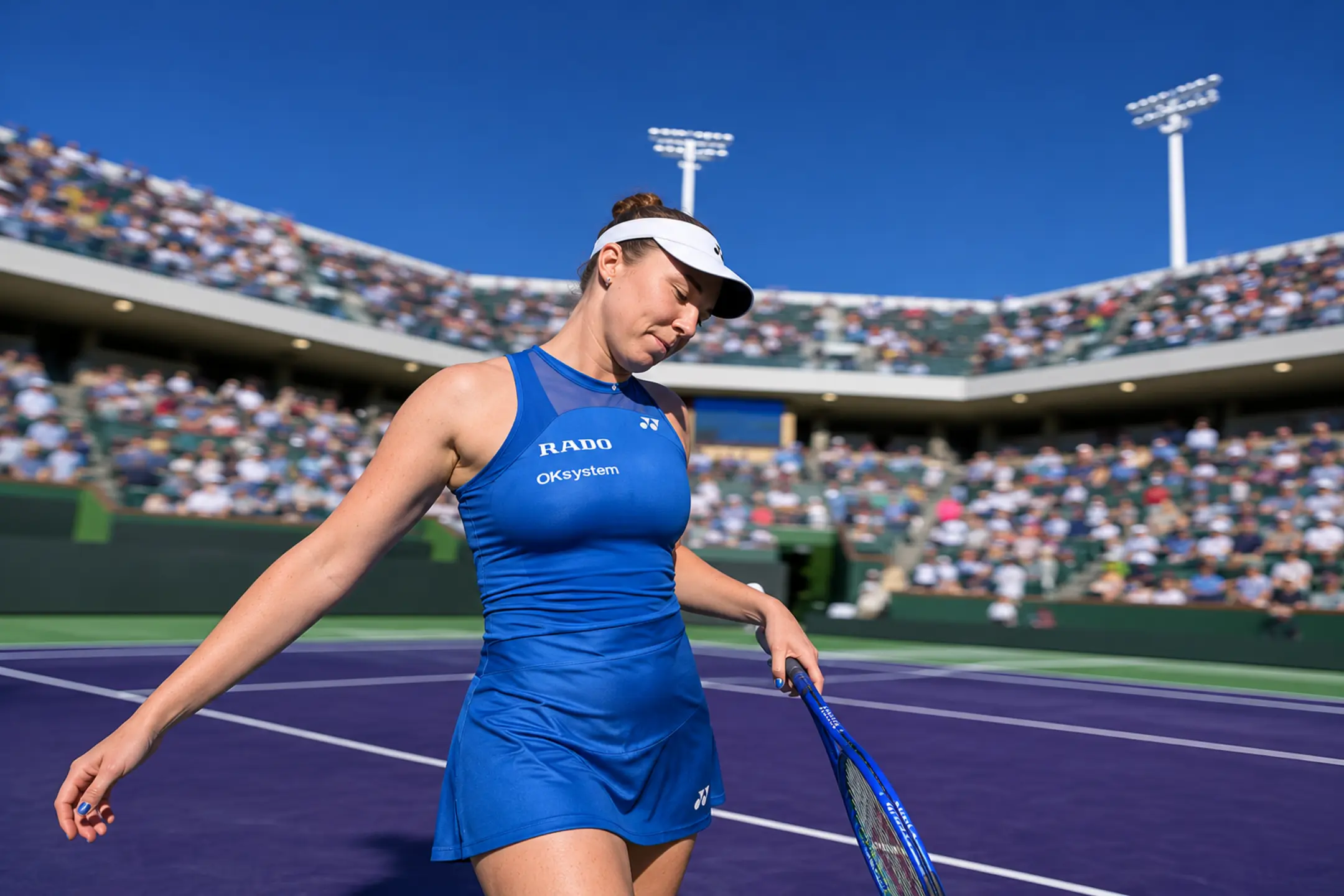
Linda Noskova vs. Marta Kostyuk — Indian Wells WTA Finals 2026 Group 1 Round-Robin Match Report.
The WTA Finals had barely begun when Linda Noskova established the standard everyone else would have to match.
In front of a packed crowd at Indian Wells, the 21-year-old Czech defeated Marta Kostyuk 6-2, 6-4 on Sunday, November 8, winning the tournament’s opening round-robin match with a performance built around composure, efficient serving and an almost flawless response to the opportunities that came her way.
Four break points against Kostyuk. Four breaks converted.
Kostyuk, a late replacement for the withdrawn Elena Rybakina, produced flashes of the aggressive tennis that makes her such a dangerous opponent. She even finished with more winners than Noskova.
But the Ukrainian struggled to sustain that level, particularly behind her second serve.
Noskova rarely needed a second invitation. Whenever Kostyuk left a door open, the Czech walked through it.
And with all eight singles players having arrived in California hoping to reach the semifinals, Noskova became the first to put a 2026 WTA Finals victory on the board.
Three Breaks Give Noskova Control of the Opening Set
The match began with an exchange of breaks.
Noskova immediately attacked Kostyuk’s opening service game, converting her first break point to move ahead 1-0.
But the Ukrainian responded in the next game.
Kostyuk put the Czech’s serve under pressure and eventually broke back for 1-1, suggesting that neither player would enjoy a straightforward afternoon.
It was an encouraging response from the Ukrainian, whose ability to strike powerful groundstrokes can quickly change the direction of a match.
The problem was that she could not consolidate.
Noskova broke again for 2-1 and then held serve to establish a 3-1 advantage.
Kostyuk needed to stop the momentum, but another difficult service game followed.
The Czech secured her third break of the set for 4-1 and consolidated for 5-1.
Only then did Kostyuk manage to hold serve for the first time, reducing the deficit to 5-2.
Noskova served out the opening set 6-2 without further difficulty.
Kostyuk Has Her Chance but Noskova Refuses to Yield
The second set was a much tighter contest.
Kostyuk held serve to begin, and Noskova answered.
The Ukrainian moved ahead 2-1, producing the sort of tennis she needed if she wanted to turn the match around.
Then came one of its most important games.
Serving at 1-2, Noskova found herself facing a break point.
Kostyuk had an opportunity to establish a lead and apply pressure to an opponent who had controlled much of the opening set.
But Noskova saved the break point.
The game continued through several deuces, with the Czech repeatedly having to work for the final point.
Eventually, she held for 2-2.
The consequences became clear almost immediately.
Noskova broke Kostyuk in the following game to move ahead 3-2.
She consolidated for 4-2, placing the Ukrainian under pressure once again.
To Kostyuk’s credit, she did not disappear.
She held for 3-4 and again for 4-5, keeping herself within a single break of the Czech.
But Noskova was offering almost nothing on her own serve.
She held for 5-3 and then served out the match 6-4, converting her first match point.
The opening set had required three breaks. The second needed only one.
Noskova had found two different ways to win, neither of which required her to play spectacular tennis on every point.
The Numbers Show Why Kostyuk Could Not Turn the Match Around
One of the more surprising aspects of Sunday’s result is that Kostyuk finished with the better winners-to-unforced-errors balance.
| Kostyuk | Statistic | Noskova |
|---|---|---|
| Full Match Duration: 1h26m | ||
| 0.82 | Dominance Ratio | 1.23 |
| 20 | Winners | 16 |
| 20 | Unforced Errors | 22 |
| 209 | Serve Rating | 270 |
| 6 | Aces | 2 |
| 6 | Double Faults | 4 |
| 38% (20/53) | 1st Serve % | 58% (38/65) |
| 70% (14/20) | 1st Serve Points Won | 68% (26/38) |
| 45% (15/33) | 2nd Serve Points Won | 56% (15/27) |
| 0% (0/4) | Break Points Saved | 75% (3/4) |
| 112 | Return Rating | 229 |
| 32% (12/38) | 1st Return Points Won | 30% (6/20) |
| 44% (12/27) | 2nd Return Points Won | 55% (18/33) |
| 1/4 | Break Points Won | 4/4 |
| 53 | Total Points Won | 65 |
 Created by rallyher.com
The Ukrainian struck 20 winners and committed 20 unforced errors.
Noskova produced 16 winners and 22 unforced errors.
Ordinarily, that might suggest Kostyuk had played the more effective attacking tennis.
But the service and pressure statistics tell a different story.
Kostyuk landed only 38% of her first serves.
That forced her to rely heavily on her second delivery, which Noskova attacked successfully throughout the match.
The Czech won 18 of the 33 points played against Kostyuk’s second serve, a return success rate of 55%.
Kostyuk also committed six double faults.
Noskova was considerably more reliable behind her own serve, winning 63% of service points and holding in eight of nine service games.
The most revealing difference, however, came when break points were available.
Noskova converted all four of her opportunities.
Kostyuk converted only one of four, with the Czech saving the other three.
The pressure-point statistics underline the contrast: Noskova won 14 of 17, compared with just three for Kostyuk.
Across the match’s 118 points, Noskova won 65 and Kostyuk 53.
The Ukrainian had moments when her attacking game looked dangerous. Noskova simply made far better use of the moments that mattered most.
A Late Call-Up Leaves Kostyuk With Little Margin for Error
Kostyuk’s presence at the WTA Finals was itself unexpected.
The Ukrainian had originally been named as a singles alternate, but Elena Rybakina’s withdrawal before the tournament began opened a place in the eight-player field.
Instead of watching from the sidelines, Kostyuk found herself competing in Group 1 alongside Noskova, Coco Gauff and Jessica Pegula.
That gave her an opportunity she had not initially expected to receive.
It also meant facing three formidable opponents in quick succession, with little room for a slow start.
The defeat to Noskova does not eliminate Kostyuk from semifinal contention. Under the round-robin format, each player faces all three group opponents, with the top two advancing.
But she will now need results against Gauff and Pegula to keep her qualification hopes alive.
Noskova, meanwhile, can approach those two matches knowing that she already has one victory behind her.
Neither player has the luxury of an easy group. Sunday’s result has simply given the Czech a much more comfortable starting position.
Indian Wells Has Already Made a Case for Keeping the WTA Finals
There was another striking aspect to Sunday’s opening match: the crowd.
Indian Wells was packed.
Not merely well attended for the first day of a season-ending tournament, but genuinely full of spectators eager to watch the best players in women’s tennis.
The atmosphere was particularly encouraging given that this is the first time the WTA Finals have been staged at the Indian Wells Tennis Garden.
If the WTA is looking for evidence that this tournament can attract a committed audience in California, the opening day provided plenty.
Whether Indian Wells should become a longer-term home for the season-ending championships deserves serious consideration.
Noskova Has Given the Rest of Group 1 Something to Think About
The attention now turns to Coco Gauff and Jessica Pegula, whose opening match follows the Czech’s victory.
Both Americans will have learned, how effectively Noskova handled the first examination of the tournament.
Her performance was not built on overwhelming power or an extraordinary number of winners.
Instead, she protected her serve, recovered when placed under pressure and punished nearly every serious mistake Kostyuk made.
That’s how she won Wimbledon.
Noskova still has two round-robin matches ahead of her, and nothing has been decided about semifinal qualification.
But Sunday’s opener offered a clear indication of what her American opponents can expect.
Linda Noskova needed to be the player who made the fewest costly mistakes when it mattered. And in the first match of the 2026 WTA Finals, nobody could have set a better example.