
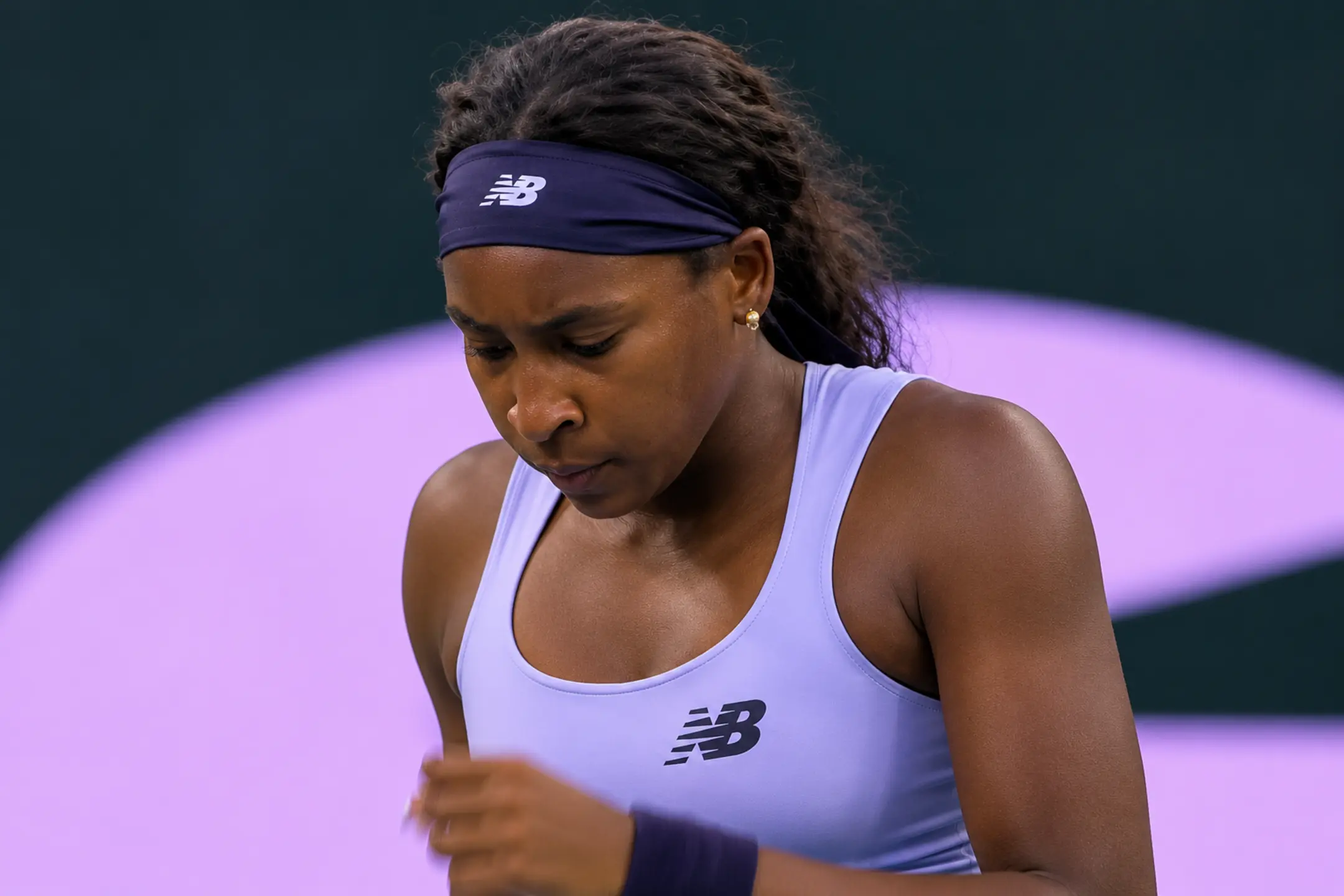
Coco Gauff vs. Jessica Pegula — Indian Wells WTA Finals 2026 Group 1 Round-Robin Match Report.
Jessica Pegula had already escaped defeat once. After squandering a 5-1 lead in the second set, she survived a match point and somehow managed to force a decider against Coco Gauff.
For a while, it seemed that the most extraordinary comeback of the WTA Finals opening day might belong to the 32-year-old American.
Gauff had other ideas.
The world No. 4 defeated Pegula 6-4, 6-7(5), 6-2 on Sunday, November 8, surviving a wildly fluctuating contest between two players who know each other’s games almost as well as their own.
Neither American produced her cleanest tennis. They committed 96 unforced errors between them, and the match contained enough changes of momentum to leave both players wondering what might happen next.
But Gauff was slightly more reliable when she needed to be. She recovered after letting a match point slip in the second set and finished with a commanding final-set performance.
For a player arriving in Indian Wells with serious ambitions of another WTA Finals title, it was exactly the start she needed, even if the route to victory was anything but straightforward.
Pegula’s Early Net Attacks Give Gauff Something to Think About
Pegula made her intentions clear almost immediately.
Rather than allowing Gauff to settle into extended baseline exchanges, she repeatedly moved forward, attacking the net even when returning serve.
It was an unusual opening approach, and Gauff initially looked uncomfortable with the American’s willingness to shorten points.
Pegula created a break point in the opening game, but Gauff saved it and held serve.
The two players then exchanged service holds, with Pegula continuing to look for opportunities to move forward and disrupt Gauff’s rhythm.
At 3-3, neither player had managed a break.
Gradually, however, Gauff began to find better answers.
She adjusted to Pegula’s attacking intentions, became more confident in the rallies and started placing greater pressure on the world No. 5’s serve.
The ninth game was particularly important.
Serving at 4-4, Gauff fell behind 0-40 and faced three consecutive break points. Losing that game would have left Pegula serving for the opening set.
Instead, Gauff won five straight points to hold for 5-4.
It was an enormous escape.
Pegula now had to serve to stay in the set, and her delivery was becoming increasingly vulnerable.
Gauff created several set points as the game moved through repeated deuces. Pegula resisted, but the pressure eventually proved too much.
Gauff broke to take the opening set 6-4.
After spending much of the set dealing with Pegula’s attacking tactics, she had taken her opportunity at precisely the right moment.
Pegula Races Ahead as Gauff’s Game Falls Apart
The second set began disastrously for Gauff.
She lost the opening eight points, dropping her first service game and allowing Pegula to consolidate for 2-0.
Gauff’s tennis had become increasingly erratic, particularly from the forehand side.
Pegula recognized the opportunity and pushed harder.
She broke again for 3-0, taking advantage of a succession of errors from her opponent.
Gauff briefly responded by breaking for 1-3, but another loose service game immediately handed the advantage back to Pegula.
Moments later, the score was 5-1.
At that stage, a deciding set seemed inevitable.
Gauff was struggling to find any consistent rhythm, while Pegula had rediscovered the aggression and confidence that had made the opening set so competitive.
But the contest was about to take another extraordinary turn.
Gauff’s Comeback Nearly Wins the Match in Straight Sets
Gauff held serve to reduce the deficit to 2-5.
Pegula then served for the set.
The American had opportunities to close it out, but Gauff refused to surrender.
She produced some exceptional tennis around the net, including a crucial intervention to save a set point, and eventually broke for 3-5.
Suddenly, the pressure shifted.
Gauff held for 4-5 and then attacked Pegula’s serve again.
Another break brought her level at 5-5, completing a recovery that had looked highly improbable only minutes earlier.
She held for 6-5.
Pegula had gone from apparently cruising toward a deciding set to serving to stay in the match.
And Gauff was not finished.
She earned a match point on Pegula’s serve.
But Pegula survived.
In a tense service game, several balls landed agonizingly close to Gauff’s baseline, allowing Pegula to escape situations that had previously gone against her.
The world No. 5 eventually held for 6-6.
After surrendering a commanding lead, she had somehow forced a tiebreak.
A Tiebreak Turns Into Another Unwelcome Surprise for Gauff
The tiebreak brought another sharp change in momentum.
Gauff’s forehand, which had helped her fight back into the set, suddenly became unreliable again.
A succession of unforced errors handed Pegula an early advantage.
The world No. 5 moved ahead 5-2.
Gauff recovered to 5-5, threatening yet another turnaround.
But Pegula sealed the set when Gauff double-faulted, taking the tiebreak 7-5.
After all that had happened, the match was level at one set apiece.
Pegula had lost a 5-1 lead, failed to serve out the set and survived a match point.
Yet she was still standing.
A Missed Smash Helps Gauff Take Control of the Decider
Pegula served first in the final set.
An unexpectedly missed smash gave Gauff an opening, and she took full advantage by breaking immediately.
The American consolidated for 2-0 and then secured another break for 3-0.
Pegula responded by breaking Gauff for 3-1, offering some hope that the second-set recovery might be repeated.
But Gauff was determined not to allow another escape.
Pegula held for 3-2 after a demanding service game, but Gauff answered with a comfortable hold for 4-2.
The decisive blow came in the following game.
Pegula struggled to protect her serve and Gauff eventually broke again for 5-2.
The world No. 4 served out the match 6-2, converting her second match point.
Pegula had fought remarkably hard, but her backhand had lacked consistency at important moments, while Gauff’s second serve proved particularly difficult for her to attack.
The difference between the two players was often small.
By the end of the third set, however, Gauff had made that difference count.
More Winners for Pegula but Too Many Errors
Pegula actually struck more winners than Gauff, finishing with 30 compared with her opponent’s 24.
| Gauff | Statistic | Pegula |
|---|---|---|
| Full Match Duration: 2h39m | ||
| 1.17 | Dominance Ratio | 0.85 |
| 24 | Winners | 30 |
| 41 | Unforced Errors | 55 |
| 242 | Serve Rating | 211 |
| 4 | Aces | 5 |
| 5 | Double Faults | 6 |
| 52% (52/100) | 1st Serve % | 56% (70/125) |
| 67% (35/52) | 1st Serve Points Won | 60% (42/70) |
| 50% (24/48) | 2nd Serve Points Won | 42% (23/55) |
| 64% (7/11) | Break Points Saved | 56% (9/16) |
| 189 | Return Rating | 146 |
| 40% (28/70) | 1st Return Points Won | 33% (17/52) |
| 58% (32/55) | 2nd Return Points Won | 50% (24/48) |
| 7/16 | Break Points Won | 4/11 |
| 119 | Total Points Won | 106 |
 Created by rallyher.com
But she also committed 55 unforced errors, 14 more than Gauff.
Neither player was particularly economical with her shots, and both struggled for extended periods to control their groundstrokes.
The difference was that Gauff generally produced fewer mistakes when the match became most demanding.
Her second serve was especially valuable.
That advantage was reinforced on return, where Gauff captured 58% of points against Pegula’s second serve.
Pegula’s struggles were also apparent in the break-point statistics.
Gauff converted seven of 16 opportunities, while Pegula managed four breaks from 11 chances.
The world No. 4 held serve in 11 of her 15 service games, compared with only eight of 15 for Pegula.
Across 225 points, Gauff won 119 and Pegula 106.
The numbers do not suggest a particularly polished performance from either player. They do, however, explain why Gauff eventually came through.
She was more effective on return, protected her service games more consistently and made fewer mistakes.
Gauff Joins Noskova at the Top of Group 1
Gauff’s victory completes the first round of Group 1 matches at the 2026 WTA Finals.
Earlier on Sunday, Linda Noskova defeated Marta Kostyuk 6-2, 6-4 in the tournament’s opening contest.
That leaves Gauff and Noskova with one victory each, while Pegula and Kostyuk have both started with defeats.
The standings are still in their earliest stages.
Each player has two round-robin matches remaining, with the top two advancing to the semifinals.
For Pegula, Sunday’s defeat does not end her campaign. But she will need to improve her consistency if she hopes to qualify from a group containing three opponents capable of punishing prolonged periods of erratic tennis.
Gauff can approach her remaining matches from a stronger position.
A victory over a direct American rival has given her an important advantage in the race for semifinal qualification.
Pegula produced the escape of the evening. Gauff produced the response that made it irrelevant to the final result.