
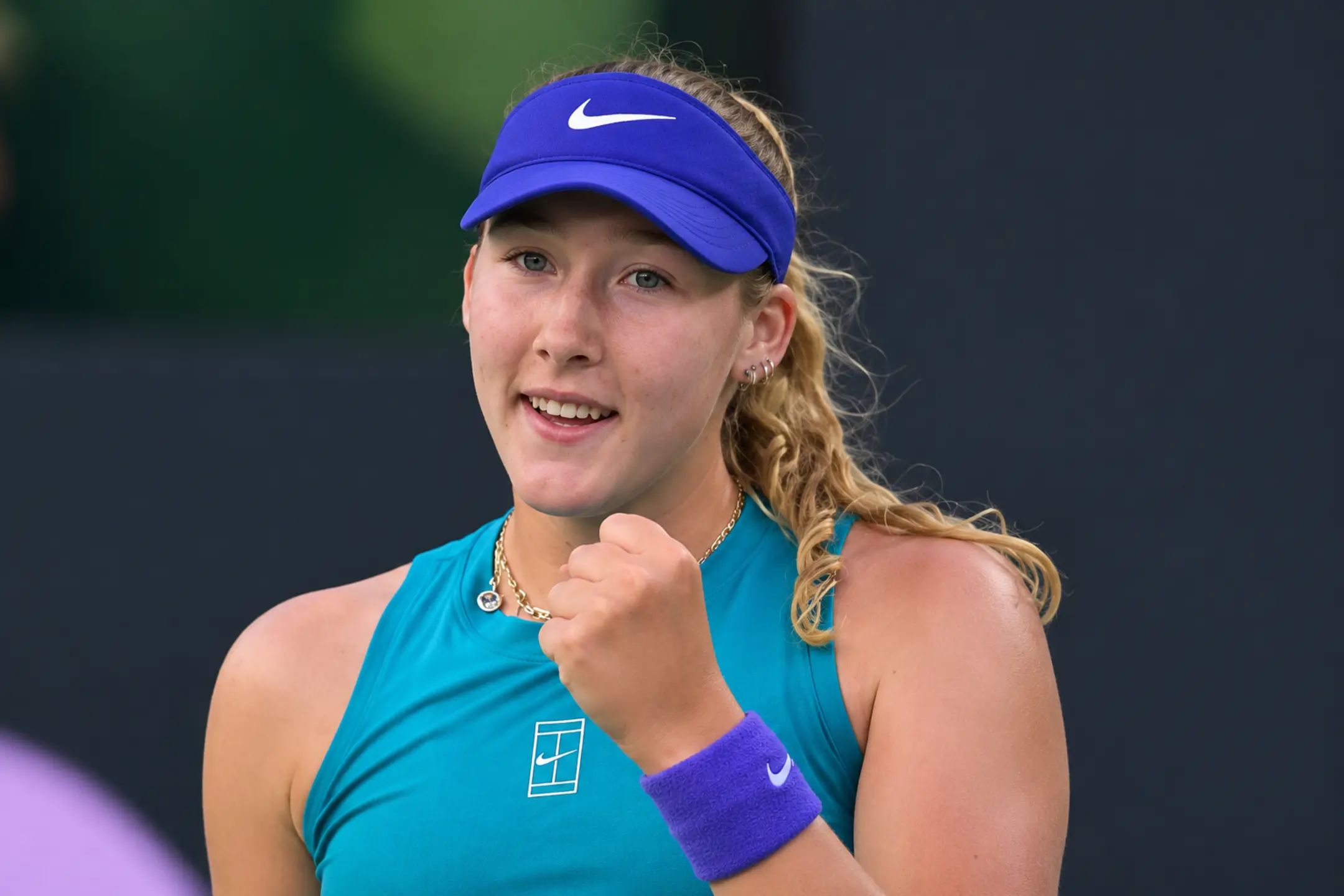
Mirra Andreeva vs. Elina Svitolina — Indian Wells WTA Finals 2026 Group 2 Round-Robin Match Report.
At one point during her WTA Finals debut, Mirra Andreeva gave a little shake of her head. She appeared to be enjoying herself. Across the net, Elina Svitolina was having a considerably less pleasant afternoon.
The Russian teenager looked remarkably comfortable on one of the biggest stages in women’s tennis, defeating the Ukrainian 6-4, 6-0 on Monday, November 9, to make a winning start to her campaign in Indian Wells.
The score suggests a straightforward victory. It wasn’t quite that simple.
Svitolina had six opportunities to break Andreeva’s serve. She converted none. Some of the rallies were fiercely contested, and the final games of both sets demanded considerably more from the teenager than the scoreboard reveals.
But Andreeva never looked particularly troubled by the occasion. Even when facing break points, she continued swinging freely, trusting her groundstrokes and taking chances with her second serve.
The only teenager competing in the eight-player singles field had arrived at her first WTA Finals. She certainly didn’t look intimidated.
One Break Separates the Players in the Opening Set
Svitolina made a solid start, holding her opening service game before Andreeva responded.
The Ukrainian moved ahead 2-1, and for the opening four games there was little to separate the players.
Andreeva was finding her range from the baseline, but Svitolina was equally capable of extending rallies and forcing the Russian into difficult positions.
The first decisive moment arrived in the fifth game.
With Svitolina serving at 2-2, Andreeva created a break opportunity and converted it to move ahead 3-2.
She consolidated for 4-2, establishing the advantage that would ultimately decide the set.
Svitolina remained competitive, holding for 4-3 and again for 5-4.
But she could not recover the break.
Serving for the opening set, Andreeva faced another demanding game. Svitolina resisted, and the teenager had to work through repeated pressure before finally converting a set point.
Andreeva took the opener 6-4, having protected her serve throughout.
It was a much closer set than the overall result would eventually suggest, but Andreeva had already demonstrated one important quality: she could handle pressure without retreating into defensive tennis.
A Second-Set Bagel That Was Harder Than It Looked
The second set began with an immediate break for Andreeva.
Svitolina had barely settled into the set before she was trailing again.
The teenager then survived a difficult service game to consolidate for 2-0.
That was a significant moment. Svitolina had opportunities to prevent the score from running away from her, but Andreeva continued attacking rather than allowing the Ukrainian to dictate the rallies.
Another break followed for 3-0.
By now, Andreeva was playing with increasing freedom. She held for 4-0 and broke again for 5-0.
The score was becoming uncomfortable for Svitolina, although the tennis itself was not entirely one-sided.
The Ukrainian continued producing competitive rallies and occasionally forced Andreeva into awkward positions.
What she could not do was finish enough of those exchanges when a game was there to be won.
Even at 5-0, the contest was not quite finished.
Serving for the match, Andreeva encountered another prolonged battle. Svitolina continued fighting, and the game moved through several deuces as the teenager tried to close out her victory.
Andreeva refused to become tentative.
Eventually, she converted match point to complete the 6-0 second set.
Two sets, two difficult closing service games, and not a single break conceded.
For a WTA Finals debutante, it was an impressive demonstration of composure.
Six Break Points Saved and a Huge First-Serve Advantage
The match statistics reveal where Andreeva established her superiority.
| Andreeva | Statistic | Svitolina |
|---|---|---|
| Full Match Duration: 1h11m | ||
| 1.61 | Dominance Ratio | 0.62 |
| 15 | Winners | 10 |
| 23 | Unforced Errors | 25 |
| 284 | Serve Rating | 195 |
| 1 | Aces | 0 |
| 6 | Double Faults | 5 |
| 54% (32/59) | 1st Serve % | 52% (28/54) |
| 88% (28/32) | 1st Serve Points Won | 54% (15/28) |
| 44% (12/27) | 2nd Serve Points Won | 42% (11/26) |
| 100% (6/6) | Break Points Saved | 33% (2/6) |
| 221 | Return Rating | 68 |
| 46% (13/28) | 1st Return Points Won | 13% (4/32) |
| 58% (15/26) | 2nd Return Points Won | 56% (15/27) |
| 4/6 | Break Points Won | 0/6 |
| 68 | Total Points Won | 45 |
 Created by rallyher.com
Although she landed only 54% of her first serves, she won an extraordinary 88% of the points played behind them.
Svitolina managed just 54% on her first delivery.
That difference was enormous.
Whenever Andreeva found her first serve, the Ukrainian struggled to gain a foothold in the rallies.
The teenager was also particularly effective returning Svitolina’s first serve, winning 46% of those points.
Neither player produced especially clean attacking statistics.
Andreeva finished with 15 winners and 23 unforced errors, while Svitolina struck 10 winners against 25 errors.
The Russian therefore did not win simply by producing an endless stream of spectacular shots.
She won because she served more effectively when it mattered, attacked Svitolina’s delivery and handled the important points considerably better.
Andreeva converted four of six break points while saving all six she faced.
Across 113 points, Andreeva won 68 to Svitolina’s 45.
Her overall dominance ratio of 1.61 underlined the superiority that gradually emerged as the afternoon progressed.
The Youngest Player Makes an Immediate Impression in Group 2
Andreeva’s victory gives her a successful start in Group 2, where Aryna Sabalenka had already defeated Karolina Muchova 7-6(2), 7-5 earlier on Monday.
Both Andreeva and Sabalenka therefore begin with one victory, while Svitolina and Muchova are still looking for their first wins.
For Svitolina, the result is undoubtedly disappointing.
Losing the second set without winning a game will hurt, particularly when she knows she had opportunities to break Andreeva’s serve.
But the Ukrainian is not eliminated.
She still has matches against Sabalenka and Muchova ahead of her, and the round-robin format allows players to recover from an opening defeat.
Andreeva, meanwhile, has given herself an excellent starting position in the battle for semifinal qualification.
At 19, she is the youngest player in the competition, yet she displayed a level of confidence that many experienced players would welcome on their opening appearance.
The next challenge will be maintaining that freedom against opponents capable of applying even greater pressure.
Andreeva’s Next Opponents Will Test Her Freedom
There was something refreshing about Andreeva’s demeanor on Monday.
She smiled, occasionally shook her head and appeared to enjoy the tennis she was producing, even while Svitolina continued to challenge her.
But the numbers also leave room for improvement.
Six double faults and a first-serve percentage of 54% could become costly against Sabalenka or Muchova, particularly if those opponents make better use of their break opportunities.
Andreeva cannot expect every opponent to miss six chances to break her serve.
That is what makes her opening performance so interesting.
She won convincingly without serving perfectly, and she looked comfortable enough to play her natural game throughout.
The Russian teenager has passed her first WTA Finals examination. The next two will reveal whether that same carefree confidence can carry her into the semifinals.