
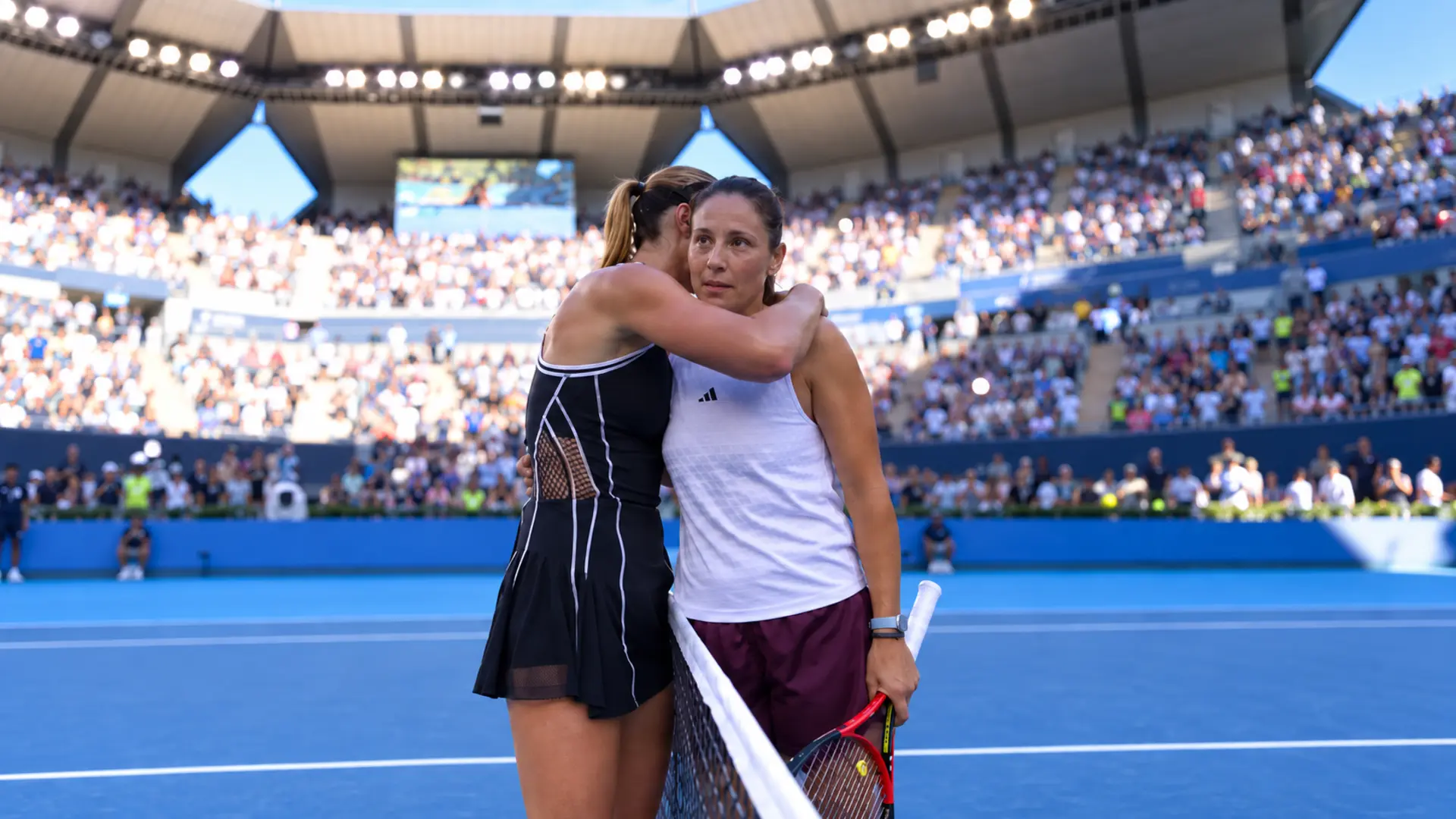
Paula Badosa vs. Daria Kasatkina — China Open 2026 First-Round Match Report
On ranking alone, this looked like a meeting between world No. 59 and world No. 80.
On résumé, it was arguably the biggest match of the China Open first round.
Former world No. 2 Paula Badosa faced former No. 8 Daria Kasatkina, two players now traveling in very different directions. Badosa has been inching upward again, while Kasatkina’s ranking has been sliding quickly.
The recent form pointed toward the Spaniard.
The match nearly went the other way. Twice.
Kasatkina led the second-set tiebreak 5-2 and was still two points from a straight-sets victory at 5-4. Then, in the deciding set, she moved ahead 3-1 and 4-2 before Badosa recovered once more.
After 227 points and almost nothing separating them statistically, Badosa survived 4-6, 7-6(7), 6-4.
Kasatkina Takes the First Set After a Messy Exchange of Breaks
Badosa opened with a hold before the match quickly became unstable.
Kasatkina held for 1-1 and then broke to move ahead 2-1.
Badosa broke straight back.
Kasatkina did the same immediately, moving ahead 3-2, then held for 4-2.
Badosa stayed close and eventually recovered the break for 4-4, but Kasatkina responded with another hold and then broke again to close the set 6-4.
Neither woman had established much security behind serve.
Kasatkina had handled the final two games better.
Set 1 at a Glance
- Badosa hit more than twice as many winners as Kasatkina (12 to 5), but her 30 unforced errors, twice Kasatkina’s 15, undid that work.
- Badosa’s second serve was a big weakness. She won only 4 of 20 points behind it, and Kasatkina took 80% of those return points.
- The set was played out on break points. Badosa faced nine and saved six, but Kasatkina broke three times to Badosa’s two and took the set with 43 of the 77 points.
Full Set 1 Stats
| Badosa | Statistic | Kasatkina |
|---|---|---|
| Set 1 Duration: 0h54m | ||
| 0.78 | Dominance Ratio | 1.29 |
| 12 | Winners | 5 |
| 30 | Unforced Errors | 15 |
| 178 | Serve Rating | 236 |
| 1 | Aces | 0 |
| 5 | Double Faults | 2 |
| 55% (24/44) | 1st Serve % | 76% (25/33) |
| 67% (16/24) | 1st Serve Points Won | 64% (16/25) |
| 20% (4/20) | 2nd Serve Points Won | 38% (3/8) |
| 67% (6/9) | Break Points Saved | 50% (2/4) |
| 189 | Return Rating | 206 |
| 36% (9/25) | 1st Return Points Won | 33% (8/24) |
| 63% (5/8) | 2nd Return Points Won | 80% (16/20) |
| 2/4 | Break Points Won | 3/9 |
| 34 | Total Points Won | 43 |
Kasatkina Gets Within Two Points of the Match
Badosa made the better start to the second set.
She held and broke for 2-0, only for Kasatkina to respond immediately.
Another exchange of breaks followed, and by 3-3 the set had already begun to resemble the first.
Badosa moved ahead 4-3.
Kasatkina leveled.
Badosa held for 5-4, but the Australian answered and eventually forced a tiebreak.
That was where the match almost ended.
Kasatkina surged to a 5-2 lead.
Badosa recovered two points, but at 5-4 Kasatkina remained only two points away from a straight-sets victory on serve.
She never reached match point.
Badosa drew level at 5-5, then edged ahead 6-5. Kasatkina saved the first set point and later another, but the Spaniard finally converted at 9-7.
One set all.
For the first time all afternoon, the momentum belonged to Badosa.
Set 2 at a Glance
- The set could hardly have been closer. Both players held four of their six service games, the dominance ratio sat at exactly 1.00 each, and Badosa edged the points by just 47 to 46.
- Badosa again hit twice as many winners (16 to 8), and again made almost twice as many unforced errors (29 to 15).
- Badosa’s second serve recovered from Set 1. She won 9 of 15 points behind it, while Kasatkina won just 2 of 7 behind hers.
Full Set 2 Stats
| Badosa | Statistic | Kasatkina |
|---|---|---|
| Set 2 Duration: 1h07m | ||
| 1.00 | Dominance Ratio | 1.00 |
| 16 | Winners | 8 |
| 29 | Unforced Errors | 15 |
| 249 | Serve Rating | 239 |
| 0 | Aces | 1 |
| 2 | Double Faults | 3 |
| 70% (35/50) | 1st Serve % | 84% (36/43) |
| 54% (19/35) | 1st Serve Points Won | 61% (22/36) |
| 60% (9/15) | 2nd Serve Points Won | 29% (2/7) |
| 60% (3/5) | Break Points Saved | 33% (1/3) |
| 210 | Return Rating | 159 |
| 39% (14/36) | 1st Return Points Won | 46% (16/35) |
| 71% (5/7) | 2nd Return Points Won | 40% (6/15) |
| 2/3 | Break Points Won | 2/5 |
| 47 | Total Points Won | 46 |
Kasatkina Keeps Finding a Lead but Badosa Keeps Taking It Back
The deciding set began with a break rather than a hold.
Badosa immediately broke Kasatkina to lead 1-0, but the advantage disappeared just as quickly when Kasatkina broke back for 1-1.
The Australian then held for 2-1 before striking again on return, breaking Badosa to move ahead 3-1.
Badosa responded, breaking back for 2-3.
Kasatkina nevertheless restored her advantage in the next game, breaking once more for 4-2.
That was the last game she would win.
Badosa broke straight back for 3-4, then held for 4-4.
At 4-4, Kasatkina lost serve again, giving Badosa her first lead since the opening game of the set at 5-4.
The Spaniard then served out the match.
From 2-4 down, Badosa won the final four games to complete the comeback 6-4.
| Badosa | Statistic | Kasatkina |
|---|---|---|
| Set 3 Duration: 0h40m | ||
| 1.20 | Dominance Ratio | 0.83 |
| 5 | Winners | 8 |
| 11 | Unforced Errors | 18 |
| 187 | Serve Rating | 180 |
| 1 | Aces | 2 |
| 2 | Double Faults | 1 |
| 70% (19/27) | 1st Serve % | 80% (24/30) |
| 53% (10/19) | 1st Serve Points Won | 29% (7/24) |
| 25% (2/8) | 2nd Serve Points Won | 50% (3/6) |
| 40% (2/5) | Break Points Saved | 0% (0/4) |
| 301 | Return Rating | 242 |
| 71% (17/24) | 1st Return Points Won | 47% (9/19) |
| 50% (3/6) | 2nd Return Points Won | 75% (6/8) |
| 4/4 | Break Points Won | 3/5 |
| 32 | Total Points Won | 25 |
One Point Separated Them After 227
The statistics almost refuse to choose a winner.
Kasatkina actually won 114 points.
Badosa won 113.
The dominance ratios were nearly identical:
Kasatkina 1.01
Badosa 0.99
Both won exactly half of their service games.
Both broke serve eight times.
Both won 50 percent of their service points and 50 percent of their return points.
Yet Badosa won the match.
The difference was not sustained statistical dominance. It was surviving the moments when Kasatkina had the result within reach.
Badosa’s Aggression Came With a Heavy Price
Badosa produced considerably more attacking tennis.
She hit 33 winners, compared with 21 from Kasatkina.
She also committed a remarkable 70 unforced errors.
Kasatkina finished with 48.
That left Badosa operating with an enormous margin of risk throughout the match.
Her serve followed the same pattern. She hit only two aces and committed nine double faults, while Kasatkina produced three aces and six doubles.
Kasatkina also landed 81 percent of first serves, against Badosa’s 67 percent.
But neither player could consistently protect the second delivery.
Badosa won 38 percent of second-serve points.
Kasatkina managed 35 percent.
The match remained permanently vulnerable to another break.
Break-Point Efficiency Keeps Badosa Alive
Where Badosa did hold a clear advantage was in converting opportunities.
She won eight of 10 break points, an 80 percent conversion rate.
Kasatkina also broke eight times, but needed 19 opportunities to do it.
Badosa saved 11 of those 19 break points.
Kasatkina saved only two of 10.
That efficiency became crucial in a match where neither woman could create real separation.
The pressure-point total also leaned narrowly toward Badosa, 25-23.
Not enough to dominate the match.
Enough to survive it.
Badosa Moves On While Kasatkina Lets Another One Slip
The broader direction of their seasons suggested Badosa should win this match.
The route she took was anything but logical.
Kasatkina won the first set, came within one point of reaching set point on four occasions in the second-set tiebreak, and then built another two-game lead in the decider.
She put in a massive effort, repeatedly dragging herself back into the contest and coming agonizingly close to taking control.
Badosa, though, kept finding a way to stop her.
For a player trying to climb toward the ranking territory she once occupied, this was not a polished victory. It was something potentially more useful: a China Open match she could easily have lost and somehow refused to.