
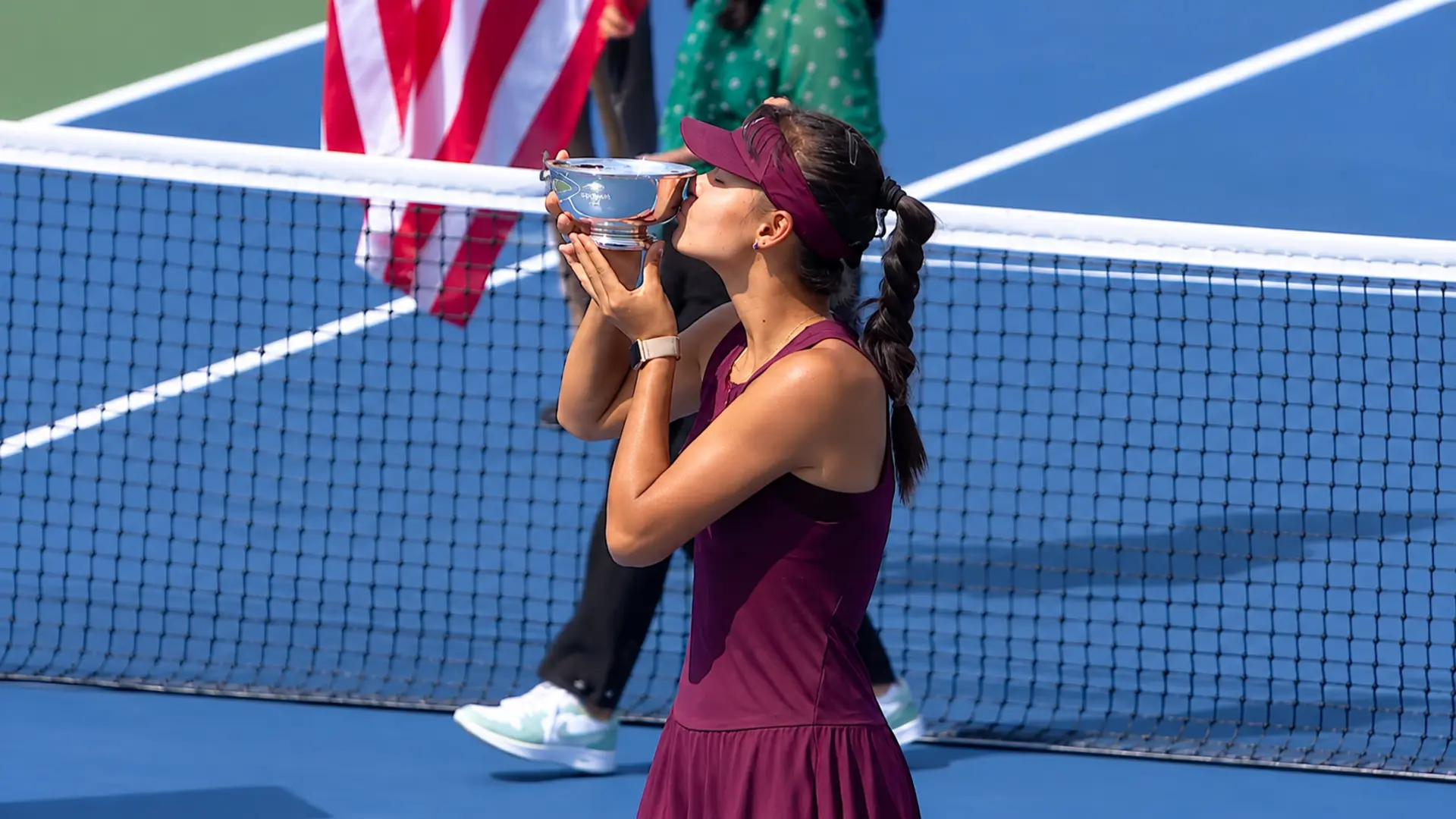
Chinese tennis already knows where the Asian Games women’s singles gold medal is going.
Xiyu Wang and Shuai Zhang will meet in an all-Chinese final on Saturday, guaranteeing gold and silver for China after both came through their semifinals in Japan.
At almost the same time, the China Open in Beijing has been producing another encouraging picture for the country’s women: Qinwen Zheng survived a three-set opener, Zhu Lin and Gao Xinyu advanced in straight sets, and 16-year-old junior No. 1 Sun Xinran announced herself on the WTA stage.
For Chinese tennis, the first days of October have started to look unusually rich.
Wang and Zhang Make Asian Games Gold an All-Chinese Affair
Xiyu Wang had to work considerably harder for her place in the Asian Games final.
She defeated top seed Alexandra Eala after 2h34m, winning 98 points to 88 and converting six of 11 break points.
The match turned on Wang’s ability to do more damage behind the second serve. Eala won 63 percent of her first-serve points but only 29 percent behind the second delivery, while Wang took 62 percent of her own second-serve points.
That difference gave Wang enough room to survive a match full of pressure.
Shuai Zhang’s semifinal was much cleaner.
She beat Yulia Putintseva 6-4, 6-2 in 1h32m, converting five of seven break chances while Putintseva managed only one from 10.
Zhang won 71 points to 52 and controlled the bigger moments almost from start to finish.
Eala and Putintseva therefore take bronze medals, with no third-place playoff in the Asian Games tennis format.
On Friday, Wang and Zhang will decide who takes gold.
The winner will also be in position to claim the Asian continental qualification place for the Los Angeles 2028 Olympics, provided the relevant qualification conditions are satisfied.
Qinwen Zheng Survives a Difficult Beijing Opener
While Wang and Zhang were securing medals in Japan, Qinwen Zheng was beginning her China Open campaign at home.
Her first-round match against qualifier Han Shi became much more complicated than the ranking gap might have suggested.
Zheng edged the first set in a tiebreak 7-6(8-6), dropped the second 4-6, then recovered to take the deciding set 6-2.
That mattered for more than the scoreline.
Zheng entered Beijing as a wildcard and carries much of the local attention whenever she plays in China. Surviving a match like this gives her a route into the tournament without the immediate pressure of an early upset hanging over the draw.
She remains one of the most important Chinese names in the event.
Zhu Lin and Gao Xinyu Start Strongly
Two other Chinese players produced much more straightforward first-round wins.
Zhu Lin defeated Alycia Parks 6-4, 6-2, taking control without allowing the match to become complicated.
Gao Xinyu was even more convincing, beating Panna Udvardy 6-2, 6-3.
Those results show depth because the Chinese presence in the main draw is not concentrated around Zheng alone.
Wang Xinyu is seeded No. 31 and begins in the second round after a bye, while Yue Yuan also advanced with a 6-2, 6-3 victory over Oleksandra Oliynykova.
That gives China several players already moving into the next stage.
Sun Xinran May Be the Most Intriguing Story of All
Then there is Sun Xinran.
At just 16, the Shenzhen-born junior No. 1 is widely regarded as China’s biggest young talent.
Her first-round match against Eva Lys ended early when the German retired, but Sun had already taken control at 6-1, 3-0.
For a player of her age, the significance is not only the win.
It is the setting.
Beijing is a WTA 1000, and Sun Xinran is already competing in a field containing some of the strongest players in the world.
She is still at the beginning of her career, but performances like this make her a name worth remembering.
China has established players, a major home star in Zheng, and now a 16-year-old beginning to appear on the same stage.
Qualifying Already Showed the Depth
The Chinese presence had started before the main draw.
Several home players came through the opening qualifying round, including Jing-Jing Wang, Zhuoxuan Bai, Han Shi, Yexin Ma and Xinyu You.
Bai then dominated Wang 6-1, 6-0 in the qualifying final to reach the main draw.
Han Shi also came through a difficult three-set match against Elvina Kalieva, winning 6-7(5), 7-5, 6-3.
Not every Chinese player made it through qualifying, but the volume of entries itself underlined the breadth of the home contingent.
And several of those names immediately reappeared in the main draw.
A Mixed First Round but More Winners Than One Headline Can Hold
There were defeats too.
Yushan Shao lost to Anastasia Zakharova, Yu Jun Lin fell to Storm Hunter and Yihan Qu was edged by Harriet Dart in three sets.
Zhuoxuan Bai, after qualifying, lost to lucky loser Linda Fruhvirtova.
Yexin Ma also went out in three sets to Polina Kudermetova.
But the overall picture remains positive.
Zheng, Zhu, Gao and Yuan all advanced.
Sun Xinran produced perhaps the most eye-catching young-player performance.
Wang Xinyu is still waiting to enter after her bye.
And away from Beijing, Wang and Zhang have already guaranteed China both gold and silver at the Asian Games.
For a few days, Chinese women’s tennis is not relying on one player or one tournament.
It is everywhere at once.