

WTA Special Report — November 3, 2026 | Paula Badosa’s injury history, Hong Kong retirement and struggle to regain her former ranking.
Paula Badosa was leading 4-1 against Elena Pridankina in Hong Kong. Another victory seemed within reach, and the former world No. 2 was playing an opponent ranked more than 140 places below her.
Just over an hour after the match began, Badosa was in tears as medical staff checked her blood pressure and vital signs on court.
Having surrendered the opening set 7-5, the 28-year-old Spaniard decided she could not continue.
It was another painful ending to a season repeatedly interrupted by physical problems.
But the numbers behind Badosa’s career tell an even more troubling story.
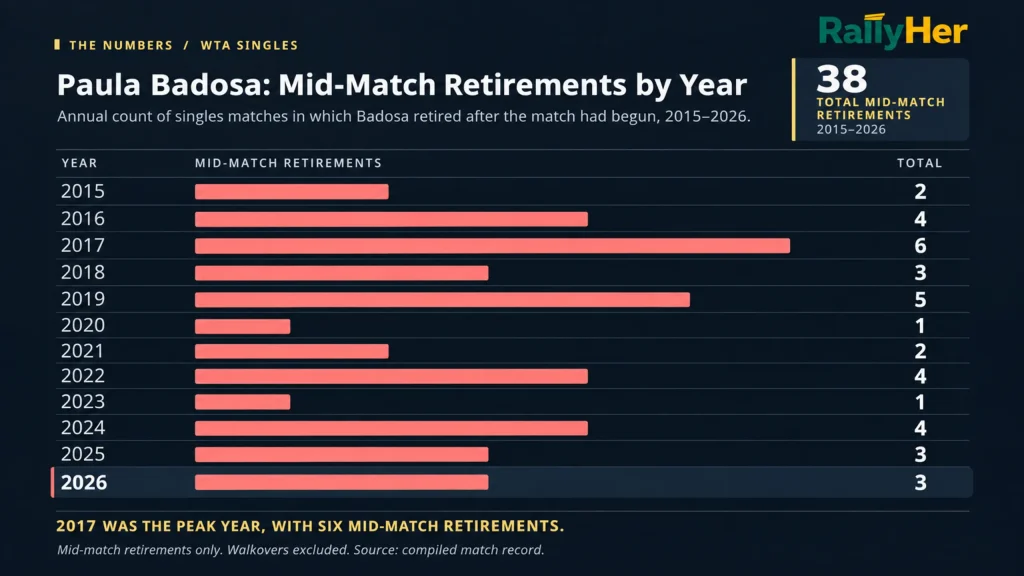
According to our examination of her singles match history, Badosa has retired during 38 matches since 2015 and conceded another two through pre-match walkovers (see chart below).
Forty occasions when a match could not be completed or even started.
For a player who reached world No. 2 in April 2022 and was firmly established among the elite, it is a remarkable statistic. And it raises a question that has followed her for years: how much more can her body withstand?
From 4-1 Up to Another Painful Retirement
Badosa initially looked comfortable against Elena Pridankina, the 21-year-old Russian ranked No. 206.
The Spaniard held her opening two service games and broke Pridankina to establish a 3-1 advantage. Another hold put her ahead 4-1.
She then had an opportunity to break again for 5-1, but Pridankina survived a lengthy service game to remain in contention.
That proved an important turning point.
Pridankina broke back for 3-4 and held to level the set at 4-4. Badosa briefly steadied herself, holding for 5-4, but the Russian refused to surrender.
After Pridankina held for 5-5, Badosa became involved in an exhausting service game featuring repeated deuces and break opportunities.
The Spaniard eventually lost her serve.
Pridankina then held to take the opening set 7-5, winning six of the final seven games.
Badosa did not begin the second set.
Medical staff attended to her on court, checking her blood pressure and vital signs. Visibly distressed, she eventually retired from the match and left the court in tears.
The precise medical reason for her withdrawal has not been publicly established. Although Badosa has a long history of back problems, there is no confirmed evidence that her back caused this particular retirement.
Her 2026 season ended there.
Thirty-Eight Retirements and Two Walkovers Since 2015
The Hong Kong withdrawal prompted RallyHer to examine Badosa’s record across WTA, ITF and other recorded singles competitions.
The findings cover her career from 2015 through November 3, 2026.
Two additional matches ended before Badosa could take the court:
- Adelaide 2023: Walkover conceded to Daria Kasatkina.
- Miami 2025: Walkover conceded to Alexandra Eala.
That brings the combined total to 40 retirements and walkovers.
The 38 retirements also span different levels of professional competition. They should not be described as 38 WTA Tour retirements.
Nine other matches in our examined record ended because Badosa’s opponents retired. Those are excluded from the count.
What stands out is how far back the problem extends.
Badosa recorded six mid-match retirements in 2017 and another five in 2019, years before the serious back injury that later threatened her career.
Consequently, the entire retirement history cannot be attributed to one medical condition.
The Back Injury That Nearly Ended Her Career
The most significant documented medical problem affecting Badosa in recent years has been a stress fracture in her lower back.
The injury became a major concern in 2023, forcing her to miss the latter part of that season. She returned in 2024, but the pain persisted.
In an April 2024 interview with the WTA, Badosa revealed that doctors had warned her it would be complicated to continue her professional career after examining her scans.
The Spaniard was only 26.
She subsequently underwent treatment involving cortisone injections in an attempt to manage the pain and continue competing.
The severity of the situation became particularly apparent during the 2024 season, when Badosa considered retiring from tennis altogether.
Yet she fought her way back.
She won the Washington title later that year, reached the US Open quarterfinals and finished 2024 ranked No. 12. Her performances earned her the WTA Comeback Player of the Year award.
In January 2025, Badosa advanced to her first Australian Open semifinal, returning to the world’s top ten.
For a while, it appeared that the worst of her physical difficulties might finally be behind her.
Unfortunately, the problems returned.
The back injury forced her to miss Indian Wells in 2025 and contributed to her withdrawal from Miami, where she conceded a walkover to Alexandra Eala.
And the back was not her only concern.
A September 2026 report published by the US Open also documented a torn labrum in Badosa’s right hip, another significant injury that had complicated her attempts to return to consistent competition.
From World No. 2 to No. 57
The contrast with Badosa’s position four years ago is striking.
In April 2022, she reached a career-high ranking of world No. 2, having established herself among the leading players on the WTA Tour.
She spent much of that season inside the top five, although her ranking slipped during the autumn and she finished the year at No. 13.
Now, at 28, she is ranked No. 57.
That decline is not entirely explained by injuries. Rankings reflect tournament results, consistency and the standard of opposition. Nevertheless, prolonged absences and repeated interruptions have made it considerably harder for Badosa to maintain the competitive rhythm she once enjoyed.
There have still been encouraging moments.
In 2026, she defeated Coco Gauff in Berlin, won the WTA 125 tournament in Bastad and reached the final in Iasi.
But sustaining that level throughout a full season remains the larger challenge.
Paula Badosa can compete against strong opponents. What she has struggled to establish is a prolonged period without another physical setback.
Elena Pridankina’s Lucky-Loser Opportunity Takes an Unexpected Turn
Lost in the understandable concern surrounding Badosa was an important afternoon for Elena Pridankina.
The 21-year-old Russian, ranked world No. 206, had initially failed to qualify for the Hong Kong main draw.
She lost to Japan’s Himeno Sakatsume in the final qualifying round before receiving a place as a lucky loser following Kaitlin Quevedo’s withdrawal.
Pridankina subsequently found herself facing a former world No. 2.
She deserves credit for the way she recovered from 1-4 in the opening set. Badosa’s physical difficulties became increasingly apparent, but the Russian still had to capitalize on her opportunities, recover the early break and serve out the set.
Pridankina advances to the second round of the Hong Kong Open, although her victory came in circumstances neither player would have wanted.
For the young Russian, it is nevertheless another opportunity to gain experience on the WTA Tour.
At 28, Badosa Should Have Years Ahead of Her
There is something particularly frustrating about Badosa’s situation.
She is not approaching the end of her career because of age. At 28, she should still have several competitive seasons ahead of her.
And the quality of her tennis, when she is healthy enough to produce it, has not vanished.
But professional tennis is brutal. It requires a body capable of withstanding repeated competition, recovery and training across an exhausting calendar.
That has become Badosa’s greatest obstacle.
Forty retirements and walkovers across a career is a sobering figure.
The question is whether Badosa can find a sufficiently stable physical condition to compete regularly without another interruption.
Hong Kong offered no answer. Instead, it provided another painful reminder of the uncertainty surrounding her career.
Badosa knows what it takes to reach world No. 2.
She did it four years ago.
Whether she can ever get close to that level again is another matter. For now, even the chance to find out keeps slipping away.