
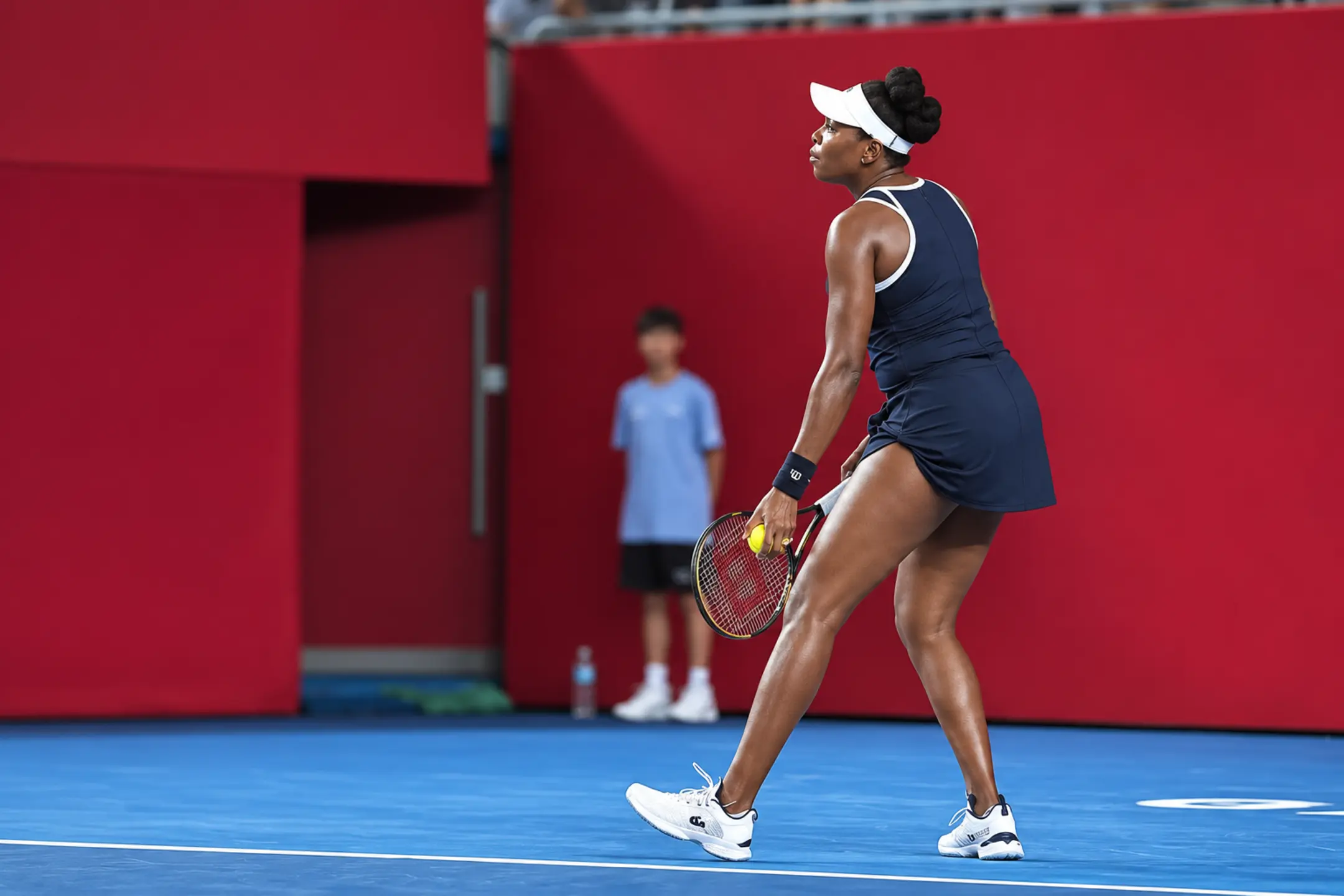
WTA Special Report, Hong Kong — November 3, 2026 | Five conclusions from Venus Williams’s last 50 singles matches.
Seventeen matches have come and gone since Venus Williams last won a singles encounter. At 46, the seven-time Grand Slam singles champion is still stepping onto WTA courts, still drawing attention and still searching for another victory.
Her latest attempt ended in Hong Kong, where Mary Stoiana defeated her 6-2, 6-3 in just one hour and 17 minutes. Williams failed to create a single break point against the 24-year-old American, ranked world No. 114.
Another defeat. Another opening-round exit. But how much can we really learn from one match?
We examined Venus Williams’s last 50 singles matches, stretching back to August 2020. The record is 7 wins and 43 defeats, including 17 consecutive losses since July 2025.

| Date | Event/Round | Opponent | W/L | Result | Duration |
|---|---|---|---|---|---|
| Hong Kong · R32 | Mary Stoiana | L | 6-2, 6-3 | 1h 17m | |
| Guangzhou · R32 | Lilli Tagger | L | 6-2, 6-2 | 1h 12m | |
| US Open · R128 | Sofia Kenin | L | 6-2, 7-6(6) | 1h 47m | |
| Cincinnati · R128 | Emiliana Arango | L | 6-2, 6-2 | 1h 06m | |
| Toronto · R128 | Kamilla Rakhimova | L | 6-4, 6-1 | 1h 27m | |
| Washington · R32 | Anastasia Potapova | L | 6-3, 6-3 | 1h 15m | |
| Bad Homburg · R32 | Irina Camelia Begu | L | 6-2, 4-6, 7-6(6) | 2h 57m | |
| Madrid · R128 | Kaitlin Quevedo | L | 6-2, 6-4 | 1h 43m | |
| Miami · R128 | Francesca Jones | L | 7-5, 7-5 | 1h 51m | |
| Indian Wells · R128 | Diane Parry | L | 6-3, 6-7(4), 6-1 | 2h 21m | |
| Austin · R32 | Ajla Tomljanovic | L | 6-4, 6-1 | 1h 35m | |
| Australian Open · R128 | Olga Danilovic | L | 6-7(5), 6-3, 6-4 | 2h 17m | |
| Hobart · R32 | Tatjana Maria | L | 6-4, 6-3 | 1h 27m | |
| Auckland · R32 | Magda Linette | L | 6-4, 4-6, 6-2 | 2h 12m | |
| Us Open · R128 | Karolina Muchova | L | 6-3, 2-6, 6-1 | 2h 00m | |
| Cincinnati · R128 | Jessica Bouzas Maneiro | L | 6-4, 6-4 | 1h 27m | |
| Washington · R16 | Magdalena Frech | L | 6-2, 6-2 | 1h 13m | |
| Washington · R32 | Peyton Stearns | W | 6-3, 6-4 | 1h 37m | |
| Miami · R128 | Diana Shnaider | L | 6-3, 6-3 | 1h 19m | |
| Indian Wells · R128 | Nao Hibino | L | 2-6, 6-3, 6-0 | 2h 01m | |
| Us Open · R128 | Greet Minnen | L | 6-1, 6-1 | 1h 14m | |
| Cincinnati · R32 | Qinwen Zheng | L | 1-6, 6-2, 6-1 | 1h 56m | |
| Cincinnati · R64 | Veronika Kudermetova | W | 6-4, 7-5 | 1h 57m | |
| Montreal · R64 | Madison Keys | L | 6-2, 7-5 | 1h 52m | |
| Wimbledon · R128 | Elina Svitolina | L | 6-4, 6-3 | 1h 32m | |
| Birmingham · R16 | Jelena Ostapenko | L | 6-3, 5-7, 6-3 | 2h 26m | |
| Birmingham · R32 | Camila Giorgi | W | 7-6(5), 4-6, 7-6(6) | 3h 17m | |
| s Hertogenbosch · R32 | Celine Naef | L | 3-6, 7-6(3), 6-2 | 2h 18m | |
| Auckland · R16 | Lin Zhu | L | 3-6, 6-2, 7-5 | 2h 23m | |
| Auckland · R32 | Katie Volynets | W | 7-6(4), 6-2 | 1h 44m | |
| Us Open · R128 | Alison Van Uytvanck | L | 6-1, 7-6(5) | 1h 47m | |
| Cincinnati · R64 | Karolina Pliskova | L | 7-5, 6-1 | 1h 40m | |
| Toronto · R64 | Jil Teichmann | L | 6-2, 6-3 | 1h 15m | |
| Washington · R32 | Rebecca Marino | L | 4-6, 6-1, 6-4 | 1h 52m | |
| Chicago 1 · R32 | Su Wei Hsieh | L | 6-2, 6-3 | 1h 07m | |
| Wimbledon · R64 | Ons Jabeur | L | 7-5, 6-0 | 1h 20m | |
| Wimbledon · R128 | Mihaela Buzarnescu | W | 7-5, 4-6, 6-3 | 2h 37m | |
| Roland Garros · R128 | Ekaterina Alexandrova | L | 6-3, 6-1 | 56m | |
| Strasbourg · R32 | Sorana Cirstea | L | 6-1, 2-6, 6-1 | 1h 45m | |
| Parma · R32 | Anna Karolina Schmiedlova | L | 5-7, 6-2, 6-2 | 2h 39m | |
| Madrid · R64 | Jennifer Brady | L | 6-2, 6-4 | 1h 36m | |
| Miami · R128 | Zarina Diyas | L | 6-2, 7-6(10) | 1h 28m | |
| Australian Open · R64 | Sara Errani | L | 6-1, 6-0 | 1h 15m | |
| Australian Open · R128 | Kirsten Flipkens | W | 7-5, 6-2 | 1h 32m | |
| Yarra Valley Classic · R32 | Petra Kvitova | L | 7-6(6), 7-5 | 2h 00m | |
| Yarra Valley Classic · R64 | Arantxa Rus | W | 6-1, 6-3 | 1h 05m | |
| Roland Garros · R128 | Anna Karolina Schmiedlova | L | 6-4, 6-4 | 2h 06m | |
| Rome · R64 | Victoria Azarenka | L | 7-6(7), 6-2 | 2h 01m | |
| Us Open · R128 | Karolina Muchova | L | 6-3, 7-5 | 1h 49m | |
| Cincinnati · R64 | Dayana Yastremska | L | 5-7, 6-2, 7-5 | 2h 36m |
There are compelling arguments both for and against her continued participation in professional tennis.
Some question the wildcards she receives, while others point to the spectators she attracts and the remarkable experience for opponents of facing a living tennis legend.
But before discussing whether Williams should still be playing, it is worth examining how well she is actually playing.
The numbers provide five revealing conclusions.
1. The Results Have Deteriorated Despite a Busier 2026
Williams has won only 14% of her last 50 singles matches, but the overall percentage is not the most concerning figure.
It is the direction in which her results have been moving.
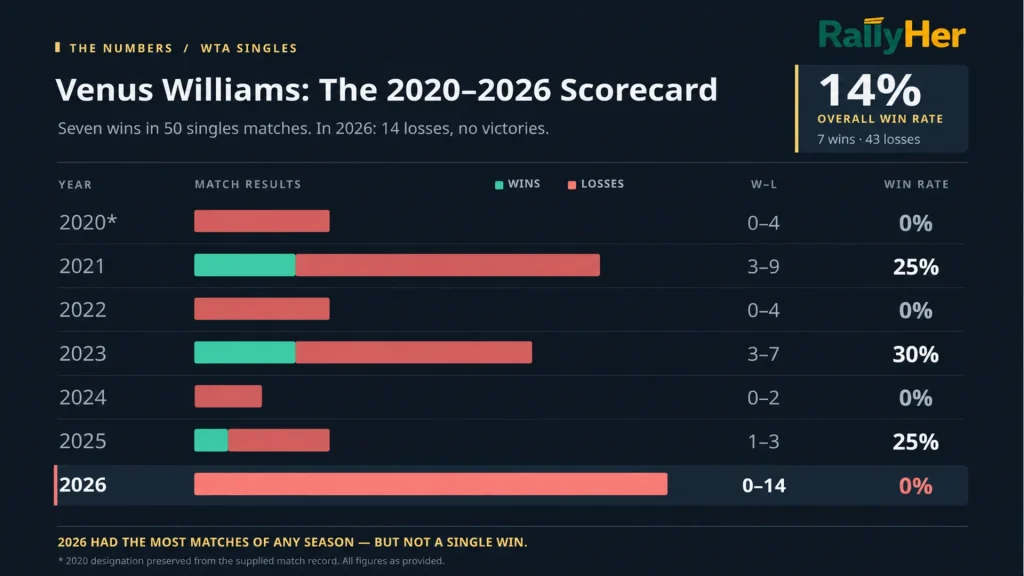
Williams competed in just four singles matches in 2025, winning once. This year, she has increased her activity substantially, entering 14 tournaments across hard courts, grass and clay.
Yet the additional appearances have produced no victories.
All 14 matches in 2026 ended in opening-round defeats.
Her most recent success remains the 6-3, 6-4 victory over Peyton Stearns in Washington in July 2025.
Since that afternoon, Williams has suffered 17 consecutive singles losses: three during the remainder of 2025 and another 14 this year.
That is a difficult pattern to ignore. Playing more frequently has not produced the improvement in results that might reasonably have been hoped for.
And the losing streak is no longer confined to encounters against the world’s highest-ranked players.
2. Her Victories Have Become Isolated Events
Williams has still produced some excellent individual performances during the past six years.
In 2023, she defeated Camila Giorgi in Birmingham after an extraordinary three-hour, 17-minute contest, winning 7-6(5), 4-6, 7-6(6).
Later that summer, she overcame Veronika Kudermetova 6-4, 7-5 in Cincinnati. It was another reminder that her tennis could still trouble accomplished WTA professionals.
Other victories came against Arantxa Rus, Kirsten Flipkens, Mihaela Buzarnescu and Katie Volynets, before her last success against Stearns in July 2025.
But there is a troubling common feature across all seven victories.
Not one was followed by another win at the same tournament.
Williams has not won consecutive singles matches at an event anywhere in this 50-match sample.
A player can produce one outstanding performance through experience, determination or an exceptionally good day. Advancing through a tournament requires reproducing that level against different opponents, often with little recovery time.
That ability to string victories together has disappeared from Venus Williams’s recent results.
There is no evidence in the 50-match record that she has been able to rediscover it, even briefly.
3. Sixteen Deciding Sets, but Only Two Victories
Not every defeat has been one-sided.
Indeed, 16 of Williams’s last 50 matches went to a deciding third set, suggesting she has frequently remained competitive for substantial periods.
The problem is what happened when those matches reached their conclusion.
Williams won just two of those 16 three-set contests, against Buzarnescu at Wimbledon in 2021 and Giorgi in Birmingham in 2023.
The other 14 ended in defeat.
Four of those deciding-set losses came in 2026.
At the Australian Open, Williams took the opening set against Olga Danilovic before losing 6-7(5), 6-3, 6-4.
In Auckland, she pushed Magda Linette into a third set. Against Diane Parry at Indian Wells, she recovered to win the second-set tiebreak before losing the decider 6-1.
Her closest opportunity came in June at Bad Homburg against Irina-Camelia Begu.
Williams fought for two hours and 57 minutes, took the second set and forced a deciding-set tiebreak before losing 6-2, 4-6, 7-6(6).
That was hardly the performance of someone incapable of competing.
But it was another defeat.
Across her 14 matches in 2026, Williams has won only four sets. Ten opponents defeated her in straight sets.
The results do not establish why she struggles to finish matches.
What they do establish is that taking a set from an opponent has become considerably more achievable than winning the match.
4. The Latest Defeat Shows How Large the Gap Can Be
The Hong Kong loss to Mary Stoiana offered a particularly stark illustration of Williams’s current difficulties.
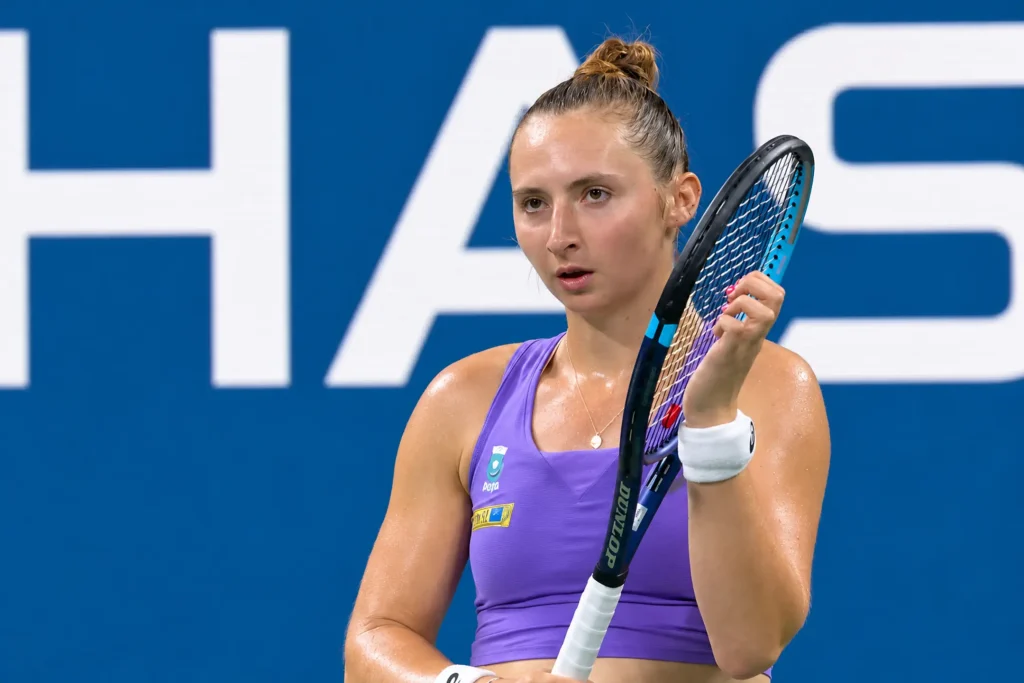
The opening set was reasonably competitive until Stoiana broke for a 2-1 lead. Williams broke neither her opponent’s serve nor her rhythm, and the American added another break before taking the set 6-2.
The second set remained level through six games, with Williams holding serve to move ahead 3-2 before Stoiana responded.
Then came the decisive sequence.
Stoiana broke for 4-3, consolidated to 5-3 and broke again to close out the match 6-3.
Williams had failed to create a single break opportunity throughout the entire contest.
Key Stats: Venus Williams vs. Mary Stoiana
| Williams | Statistic | Stoiana |
|---|---|---|
| Full Match Duration: 1h17m | ||
| 0.52 | Dominance Ratio | 1.94 |
| 11 | Winners | 24 |
| 15 | Unforced Errors | 6 |
| 217 | Serve Rating | 307 |
| 0 | Aces | 0 |
| 2 | Double Faults | 3 |
| 69% (40/58) | 1st Serve % | 69% (31/45) |
| 50% (20/40) | 1st Serve Points Won | 77% (24/31) |
| 44% (8/18) | 2nd Serve Points Won | 64% (9/14) |
| 50% (4/8) | Break Points Saved | – (0/0) |
| 59 | Return Rating | 200 |
| 23% (7/31) | 1st Return Points Won | 50% (20/40) |
| 36% (5/14) | 2nd Return Points Won | 56% (10/18) |
| 0/0 | Break Points Won | 4/8 |
| 40 | Total Points Won | 63 |
Created by rallyher.comBoth players landed 69% of their first serves, but Stoiana was vastly more effective behind hers.
Williams won only half the points played on her first delivery, compared with 77% for Stoiana. On the return, the difference was equally pronounced.
The younger American struck 24 winners against Williams’s 11 while committing just six unforced errors, nine fewer than her opponent.
Williams won 40 of the 103 points contested, or just 39%.
No single match should determine how a player’s entire career is judged. But the statistics underline the challenge an ageing Venus Williams currently faces.
At this level, possessing experience and an exceptional tennis history does not compensate for an inability to win enough points against today’s opponents.
5. The Wildcard Debate Is About More Than One Player
Williams’s continued appearances have inevitably created a debate about the invitations she receives.
Critics argue that tournament wildcards should be directed towards younger players attempting to establish themselves on the professional tour.
There is merit in that position.
A place in a WTA main draw offers ranking points, prize money and valuable experience. For an emerging player, receiving that opportunity can make a meaningful difference.
And when a player has lost 17 consecutive singles matches, questions about the sporting justification for further invitations are understandable.
Yet tournament organizers have other considerations.
Williams remains one of the most recognizable figures in women’s tennis. Her name can attract spectators, publicity and interest that an ordinary opening-round contest might not generate.
That matters to tournaments, particularly smaller events competing for attention.
There is also something unique about the opportunity she presents to her opponents.
Consider Lilli Tagger, Kaitlin Quevedo, Emiliana Arango and Mary Stoiana.
All four defeated Williams during 2026.
For young professionals, sharing a court with a seven-time Grand Slam singles champion is already unusual. Defeating her provides a memorable chapter in their developing careers.
In that sense, Williams’s continued participation creates opportunities as well as controversy.
But the argument has limits.
The 50-match record does not establish how many spectators bought tickets specifically to watch Williams, nor does it identify which players might otherwise have received her wildcard places.
Those questions cannot be answered simply by examining match results.
What we can establish is that the commercial and historical arguments for inviting Williams have become much stronger than the arguments based on her recent singles results.
That does not mean the invitations are necessarily wrong. It means the reasons for awarding them should be understood separately from her present competitive level.
The Legacy Remains. The Results Tell Another Story.
There is something extraordinary about a 46-year-old player still choosing to face professional opponents who, in some cases, were not even born when she was winning her earliest major titles.
Venus Williams has earned enormous respect throughout her career.
And there is nothing inherently wrong with wanting to continue playing a sport one loves.
But tennis is also a competition. That means the results deserve to be examined without sentimentality.
Seven victories in 50 matches. Seventeen consecutive defeats. Four sets won in 14 matches during 2026.
The occasional encouraging performance has not developed into sustained improvement.
The three-set battles show that Williams can still compete, sometimes for nearly three hours. They also reveal how rarely those efforts now produce victories.
Whether she continues is ultimately her decision. Tournament organizers must make their own judgments about offering invitations.
As for the younger players across the net, they have every reason to respect her achievements while trying their hardest to defeat her.
Perhaps that is the essential distinction in this discussion.
Venus Williams no longer needs to prove what a great tennis player she was. But every time she enters another tournament, she faces the much harder task of proving how competitive she still is.