
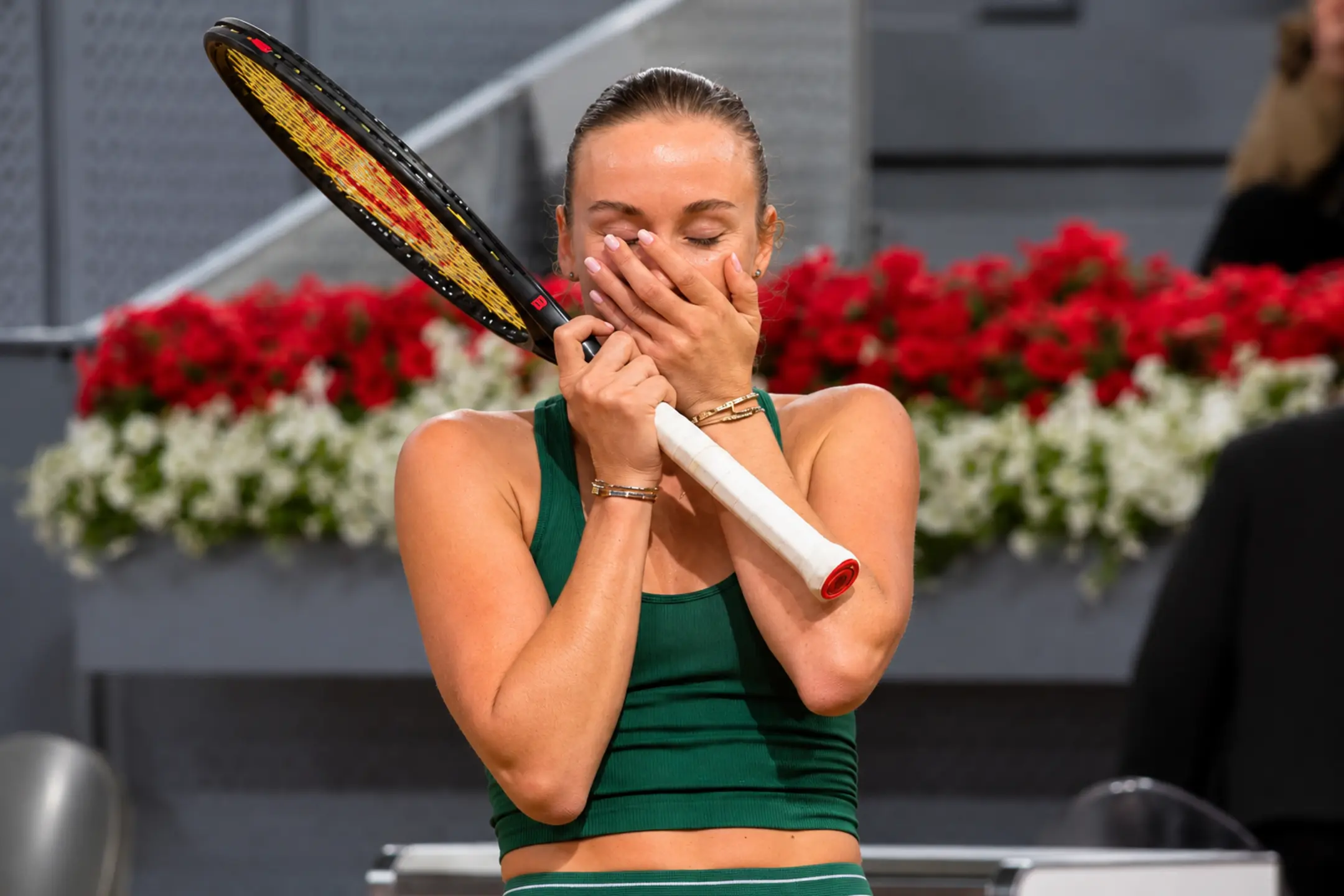
Anastasia Potapova’s 2026 season, assessed in one line: from No. 97 in April to No. 28 in November, carried by a Madrid semifinal as a lucky loser and a win over Coco Gauff, then cut short by injuries.
When she arrived in Linz in April, she was ranked No. 97 and still falling. Five months later, she beat Amanda Anisimova at the US Open while hitting eight winners to the American’s 22.
Between those two points sits one of the stranger seasons on the tour. Potapova is a flat hitter whose two-handed backhand can take the racket out of anyone’s hand. In 2026 she also learned when to leave that shot in the bag.
She finished at No. 28 in the live WTA rankings, up from No. 51 a year earlier, with three Top 10 wins and two Grand Slam fourth rounds. That puts her deep enough into the RallyHer season assessments countdown to be talking about seedings rather than survival.
Melbourne: Two Tiebreaks and a Broken Finger
Potapova began the year playing for Austria, having switched from Russia late in 2025.
Brisbane and Adelaide brought one win between them, a three-set escape against Daria Kasatkina.
The Australian Open was better.
She recovered from losing the first set to Suzan Lamens, beat Emma Raducanu 7-6(3), 6-2 and then took world No. 1 Aryna Sabalenka to two tiebreaks before losing 7-6(4), 7-6(7). She played with a fractured finger on her left hand, which is not the preparation most coaches recommend for Sabalenka.
It was a decent fortnight, one round better than 2025, but it was not a turning point. The turning point was still three months and a lot of lost points away.
The Slide to No. 97
Cluj-Napoca was where she had won her third WTA title in 2025. She came back as champion, won two matches from a set down, and lost 7-5, 6-4 to Sorana Cirstea in the quarterfinals. The title points went, and Merida added a first-round loss to Emiliana Arango.
At Indian Wells she won the first set against Jasmine Paolini in a tiebreak and then faded, 6-7(5), 6-2, 6-3. The weak spot was already visible. She won 37.3% of her second-serve points against Cirstea and 42.9% against Paolini, so any opponent willing to step in on that serve got a free start to the rally.
For a former world No. 21, No. 97 was an uncomfortable place to stand. She was no longer chasing the Top 20. She was protecting her place in main draws.
Linz: A Final in Her New Colours
Linz had given Potapova her 2023 title, and the event had now moved to clay.
She beat Shuai Zhang and Tamara Korpatsch, held off Austrian teenager Lilli Tagger 7-6(7), 6-0, and dropped only six games against Donna Vekic in the semifinal.
Linz has been on the WTA calendar since 1991, and no player from Austria had reached its final until then. A sold-out home crowd got exactly what it wanted for one set, as Potapova took the ball early, rushed Mirra Andreeva and won it 6-1.
Andreeva then started making Potapova hit one more ball, and the accuracy went. The final finished 1-6, 6-4, 6-3. Of Potapova’s 37 unforced errors, 22 came off the backhand, the very shot that had won her the first set.
It was a defeat, but a useful one. She had arrived in Linz at No. 97 and left with a WTA 500 final.
Madrid: The Lucky Loser Who Kept Winning
Potapova lost in qualifying in Madrid and got into the main draw anyway as a lucky loser. She then beat Zhang again and came back from a set down to beat Jelena Ostapenko 4-6, 6-4, 6-4.
The fourth round against world No. 2 Elena Rybakina showed the best of her tennis. She led 3-1, trailed 5-3 and broke back to force a tiebreak. She won it 10-8 with a backhand winner hit as she fell to the clay. In the second set she was down 4-2, broke back, and held for 5-4 with two more backhand winners. She won 7-6(8), 6-4, her first Top 5 win since 2024.
A 6-1, 6-7(4), 6-3 win over Karolina Pliskova made her the first lucky loser to reach a WTA 1000 semifinal. She was also the first player for Austria in a semifinal at that level since Sybille Bammer at Indian Wells in 2007.
Marta Kostyuk ended it 6-2, 1-6, 6-1. Potapova won a quarter of her second-serve points that day, and the rest followed. Even so, in March a WTA 1000 semifinal would have looked like a misprint.
Rome and Paris: Beating the Defending Champion
Rome began in qualifying, where one of her wins came against Nikola Bartunkova, whose own season ended two places below hers.
In the main draw she beat Dalma Galfi and then took Karolina Muchova apart 6-3, 6-2. She won 57.1% of her second-serve points that day, and Muchova never got the slow, tricky rallies she likes.
Liudmila Samsonova went out 6-3, 6-2 before Jessica Pegula won a close first set and then ran away with the match, 7-6(6), 6-2.
Roland Garros brought the win of her year.
After beating Maya Joint and Katie Boulter, she faced defending champion and world No. 4 Coco Gauff. She lost the first set 6-4 and was trying to hit through one of the best defenders in the game, which is usually a losing plan.
So she changed it. She mixed in higher, slower balls to break Gauff’s rhythm and attacked the short reply that followed. The backhand did the rest, with 16 of her 29 winners. She won the second-set tiebreak 7-1 and closed out a 4-6, 7-6(1), 6-4 win.
Anna Kalinskaya beat her 6-4, 2-6, 7-6(7) in the fourth round. A year earlier she had lost in the second round in Paris. This time she reached the second week. In two months on clay she had climbed from No. 97 to No. 30.
Grass and the Summer: When the Serve Went
The grass season lasted about three weeks and felt longer.
In ‘s-Hertogenbosch she was ill and quit against Zeynep Sonmez.
In Berlin, a sore neck stopped her after one set against Ekaterina Alexandrova.
At Wimbledon, Jessica Bouzas Maneiro beat her 6-2, 6-3 in the first round. Potapova put only 38.5% of her first serves in, which left her opponent a second serve to attack all afternoon.
The North American hard courts were worse.
She beat Venus Williams in Washington and Elena Gabriela Ruse in Toronto. She then won two games against Elina Svitolina and lost to Sloane Stephens, ranked No. 240, in Cincinnati.
The Washington loss to Diana Shnaider was the low point. Potapova won 9.5% of her second-serve points, and roughly one service point in five ended in a double fault.
On clay she had beaten Rybakina and Gauff with the backhand. In August she could barely start a point on her own terms.
New York: Winning by Hitting Less
Before the US Open she split with coach Henner Nehles and returned to her former coach, Irina Doronina. Potapova said Doronina knew her very well, and New York suggested she was right.
After wins over Darja Semenistaja and Léolia Jeanjean, she met world No. 10 Amanda Anisimova, who hits even harder than she does. Potapova did not try to win that contest. She defended, extended the rallies and made Anisimova hit one more ball, then another. She said afterwards that it was not how she normally plays.
The numbers explain the 6-2, 7-5 result. Anisimova hit 22 winners to Potapova’s eight, and made 46 unforced errors to Potapova’s 17.
It was her first US Open fourth round, and the most grown-up match she played all year.
Andreeva was waiting again. Potapova won the first set 7-5 before losing 5-7, 6-4, 6-3. Late in the third set she fell and hurt her left knee. She finished the match after treatment but left the court in tears.
Beijing: Twenty-Four Minutes, Then Rest
Her last match of the 2026 season lasted 24 minutes.
Trailing Sinja Kraus 4-1 in Beijing, she retired with a right shoulder injury, and a few days later she ended her season. Her body, she said, had been sending clear signals that it needed a break.
It is hard to argue. The year included a broken finger, an illness, a neck problem, a knee injury and finally the shoulder. She stopped in early October, and by mid-November nothing had moved her from No. 28.
Anastasia Potapova Assessment
The weapon is obvious. Potapova hits flat, early and hard, and her two-handed backhand is the shot that hurts people. It beat Rybakina in Madrid and supplied more than half her winners against Gauff.
The more interesting change was tactical. Against Gauff she varied the height of the ball before attacking it. Against Anisimova she gave up attacking almost entirely. Hitting hard and hurrying are different things, and she played her best tennis when she kept them apart.
The serve is the problem, and it is not new.
Cluj-Napoca, Linz, Madrid and Washington all show the same pattern: when opponents attacked the second serve, her groundstrokes became a way out of trouble instead of a way to take control. The injuries made the summer worse, but they do not explain all of it.
The tight sets tell the same story. She went 4-8 in tiebreaks, and against the Top 10 she was 3-6. Those are the moments when a player needs a serve she can trust, and Potapova did not have one.
Andreeva is the clearest example. Twice Potapova took the first set from her, in Linz and in New York, and twice Andreeva adjusted while Potapova kept hitting the same shots a little less accurately. Beating a Top 10 player for one set is the easy part. Making the plan last for three is the job for 2027.
On clay, where she had a moment longer to build the point, she went 14-4 in the main draws from Linz to Roland Garros. Across the season she finished 26-18 at tour level.
That gap between the spring and the rest of the year is the whole assessment in two numbers.
Final Verdict
A reasonable target for 2026 was a return to the Top 40 and a deeper run at a major. She got to No. 28 and reached the second week twice, after not getting past the second round of a Grand Slam in 2025. Her best result went from a WTA 250 title to a WTA 1000 semifinal.
Against that, she won no title, lost most of the summer and never fixed the second serve. Bartunkova earned an A without a title too, with a weaker Grand Slam record. What separates them is the summer. Potapova lost most of hers to injury and form, then gave up the autumn as well, and that costs her half a grade.
Letter Grade: A-
GPA: 3.6
At No. 28 she should be seeded at the Australian Open in January, if she is fit and stays inside the top 32. A seeding keeps her clear of the other 31 seeds until the third round. At the 2026 Australian Open, unseeded, she met Sabalenka in the third round and still took her to two tiebreaks. Beating Top 10 players is no longer the question; she did it three times. The question is whether her body and her second serve can last a full season.
Clay gave Potapova her season back. Her body took the last three months of it.
Leave a Reply