
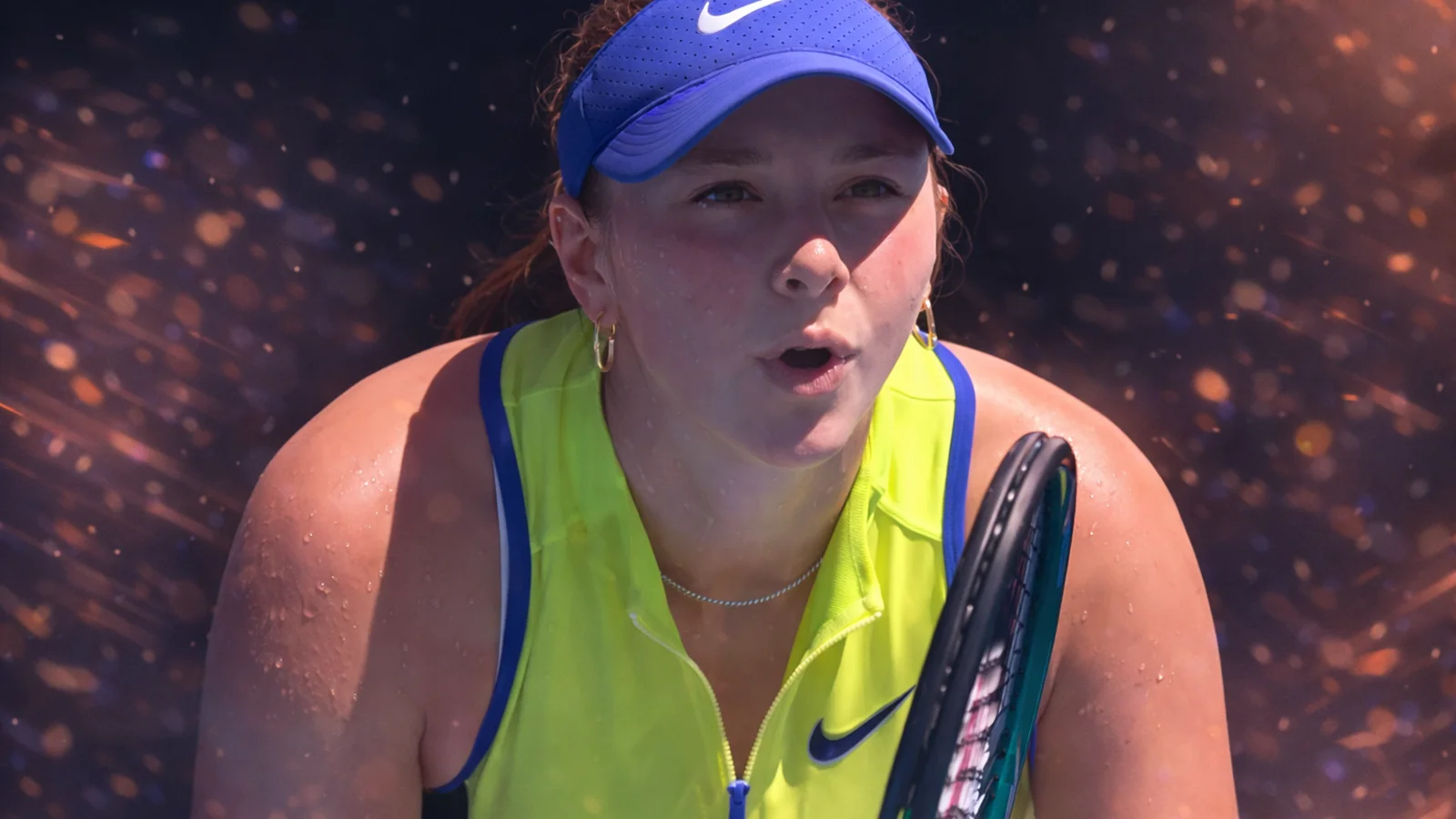
Amanda Anisimova already knows what a grass-court run can do to a season.
Last year, Queen’s Club helped start one. She reached the final in London, carried that rhythm into Wimbledon, and went all the way to the final there too. It changed how her grass-court game was seen. Not as a useful fit. Not as an occasional threat. As something real enough to carry her through the biggest fortnight of the summer.
Now comes the hard part.
At least doing it again.
Anisimova opened her 2026 Queen’s Club campaign with a sharp 6-1, 6-3 win over Laura Siegemund, beating one of the tour’s most awkward rhythm-breakers in just over an hour and moving into a quarter-final against fellow American Iva Jovic.
It was the right kind of first step. Clean enough to settle the nerves. Demanding enough to mean something.
Siegemund Could Not Drag Anisimova Into the Mess
Siegemund is rarely a comfortable first grass match.
She slices, changes height, drags opponents forward, breaks rhythm and turns matches into something less predictable than most baseline hitters want. For Anisimova, who is at her best when she can set her feet and strike through the ball, this was not an ideal first-round opponent.
She knew that.
“I know she likes to play a game style that sometimes doesn’t match up great with my game,” Anisimova told Tennis Channel. “I knew she was going to give me really tough balls and she plays very tricky tennis. I was definitely ready for that.”
The readiness showed.
Anisimova saved a break point in the opening game, then held. That was the only break point she faced all afternoon. Once she survived that first small test, the match began to tilt heavily her way.
Siegemund held for 1-1, but Anisimova broke for 2-1, held for 3-1, broke again for 4-1 and then shut the set down. The German had enough variety to ask questions, but not enough weight behind the answers. Anisimova took the first set 6-1 without letting the match become one of those strange Siegemund puzzles.
Siegemund vs Anisimova – Set One Stats
| Statistic | Siegemund | Anisimova |
|---|---|---|
| Dominance Ratio | 0.53 | 1.89 |
| Winners | 3 | 4 |
| Unforced Errors | 4 | 7 |
| Serve Rating | – | 312 |
| Aces | 0 | 1 |
| Double Faults | 0 | 0 |
| 1st Serve % | 100% (20/20) | 100% (24/24) |
| 1st Serve Points Won | 45% (9/20) | 71% (17/24) |
| 2nd Serve Points Won | – (0/0) | 40% (2/5) |
| Break Points Saved | 50% (2/4) | 100% (1/1) |
| Service Games | 33% (1/3) | 100% (4/4) |
| Ace % | 0% | 4.2% |
| Double Fault % | 0% | 0% |
| Return Rating | 89 | 172 |
| 1st Return Points Won | 29% (7/24) | 55% (11/20) |
| 2nd Return Points Won | 60% (3/5) | – (0/0) |
| Break Points Won | 0% (0/1) | 50% (2/4) |
| Return Games | 0% (0/4) | 67% (2/3) |
| Pressure Points | 29% (2/7) | 71% (5/7) |
| Service Points | 45% (9/20) | 71% (17/24) |
| Return Points | 29% (7/24) | 55% (11/20) |
| Total Points | 36% (16/44) | 64% (28/44) |
| Set 1 Duration | 0h32m | |
Anisimova Keeps Siegemund at Arm’s Length in the Second Set
The second set was more competitive on the scoreboard, but not much more dangerous for Anisimova.
She broke immediately for 1-0, then held to love for 2-0. Siegemund finally stopped the slide with a hold for 1-2, but Anisimova answered with another clean hold for 3-1.
The German had one last chance to make the set awkward at 2-3, saving a break point in a long service game before holding. But Anisimova did not blink on serve. She held for 4-2, then again for 5-3, keeping the gap intact.
At 3-5, Siegemund served to stay in the match. Anisimova pressed one final time, moved to match point, and broke to seal the 6-1, 6-3 win.
That was the quiet strength of the performance. The second set had more resistance, but no real loss of control.
Siegemund vs Anisimova – Set Two Stats
| Statistic | Siegemund | Anisimova |
|---|---|---|
| Dominance Ratio | 0.24 | 4.20 |
| Winners | 5 | 10 |
| Unforced Errors | 7 | 6 |
| Serve Rating | 232 | 356 |
| Aces | 0 | 1 |
| Double Faults | 1 | 0 |
| 1st Serve % | 100% (30/30) | 94% (17/18) |
| 1st Serve Points Won | 53% (16/30) | 94% (16/17) |
| 2nd Serve Points Won | 20% (1/5) | 67% (4/6) |
| Break Points Saved | 33% (1/3) | – (0/0) |
| Service Games | 60% (3/5) | 100% (4/4) |
| Ace % | 0% | 5.6% |
| Double Fault % | 3.3% | 0% |
| Return Rating | 39 | 234 |
| 1st Return Points Won | 6% (1/17) | 47% (14/30) |
| 2nd Return Points Won | 33% (2/6) | 80% (4/5) |
| Break Points Won | – (0/0) | 67% (2/3) |
| Return Games | 0% (0/4) | 40% (2/5) |
| Pressure Points | 40% (2/5) | 60% (3/5) |
| Service Points | 53% (16/30) | 89% (16/18) |
| Return Points | 11% (2/18) | 47% (14/30) |
| Total Points | 38% (18/48) | 63% (30/48) |
| Set 2 Duration | 0h34m | |
Anisimova’s Serve Turns the Match Into a One-Way Street
The numbers show why Siegemund never really got close.
Anisimova won 87 percent of her first-serve points and held all eight of her service games. She hit two aces, did not double fault, and saved the only break point she faced. On grass, that is almost everything.
Siegemund landed 90 percent of her first serves, which sounds impressive until the next number arrives. She won only 53 percent of those points. Behind her second serve, it was worse: one point won out of five.
That left Anisimova free to keep pressing.
She broke four times from seven chances, won 50 percent of Siegemund’s service points and finished with a dominance ratio of 2.33. Siegemund’s was 0.43.
It was not a wild winner count that decided this. Anisimova hit 14 winners to 13 unforced errors. Siegemund hit eight winners and 11 unforced errors.
The American won 58 of the 92 points played.
The First Days on Grass Still Hurt
The strange part is that Anisimova does not pretend grass feels easy immediately.
After last year’s Queen’s final and Wimbledon final, it would be tempting to imagine her stepping onto the surface and instantly looking at home. Her own description was very different.
“It’s kind of funny because the first few days on the grass when I practice are always awful and my legs are always hurting so much,” she said. “Every time it’s like that transition, it’s like, ‘Oh my God, this is so tough.’”
That makes her grass success more interesting.
For Anisimova, the surface seems to click not in practice, but in competition. The faster court rewards her first strike. It gives her flat power more bite. It encourages her to step in, shorten points and look for the net more often.
“Then once I start to get to the matches and start to compete, it just kind of clicks for me and I find my rhythm,” she said. “I feel like it suits my game style and I’m trying to add coming into the net. So I feel like my game could really come together on the grass.”
Against Siegemund, it already looked assembled.
Not perfect. Not fully tested. But stable, assertive and far too clean for an opening match against an opponent who usually makes clean tennis difficult.
Queen’s Still Feels Special After Last Year
Queen’s carries good memories for Anisimova.
Last year, it gave her a first grass-court final and helped build the run that later took her to the Wimbledon final. It was also the first time the WTA returned to the historic London venue, giving the event a novelty and prestige that players have clearly felt.
“It was my first-ever final on grass, so that’s already special,” Anisimova said. “It was the first time that we, as a WTA, played here at this club. It’s a privilege to get to play here. The courts are so beautiful and the club is amazing as well.”
That affection now comes with expectation.
Anisimova is not arriving as a player trying to discover whether grass can help her. She already knows it can. The question is whether she can repeat the standard she set last year, when Queen’s and Wimbledon became the best evidence yet that her aggressive game could travel deep into the summer.
The first answer was encouraging.
Jovic Brings the Next American Test
Next comes Iva Jovic, and that quarter-final has a different edge.
Jovic has never played Anisimova before, but she has already made a strong impression at Queen’s.
“I’ve never played her before,” she said. “I know she’s a great player playing some great tennis. I really like to watch her as well. I feel like she doesn’t really miss much, so I’m sure it’ll be a great matchup for me.”
That last phrase is the key.
Jovic is not Siegemund. She will not try to turn the match into a maze of slices and strange heights. She will ask a cleaner American question: who controls the first strike better, who protects serve better, who handles the grass under pressure better?
For Anisimova, Queen’s is not only a return to a place she likes.
It is the start of an attempt to rebuild the grass-court authority she showed last year.
The Wimbledon final run is no longer a distant reference point. It is the standard now.
Against Siegemund, she began like someone who understands that.